

Artificial Intelligence is increasingly applied in education, but its effectiveness in evaluating research methodologies remains underexplored. This study examines the intra- and inter-rater reliability of ChatGPT-4o, employing zero-shot learning, in assessing 37 research proposals from English majors at Saigon University, Vietnam, focusing on Research Title, Questions, Hypotheses, Paradigm, Design, and Techniques. A quantitative quasi-experimental design was used, with two evaluation groups: Control (module lecturers) and Experimental (ChatGPT-4o). ChatGPT-4o followed a structured zero-shot prompt set, with a researcher-designed five-point rubric and the How to Research book uploaded for reference to evaluate each proposal twice. The lecturers evaluated proposals independently, discussed and finalized scores. Data collected were analyzed using Quadratic Cohen’s weighted Kappa. Results showed moderate to high intra-rater reliability and moderate inter-rater reliability in straightforward areas, but the machine struggled with abstract criteria requiring deeper reasoning, such as evaluating title relevance and the justification of paradigm and design. These findings highlight the limitations of AI in fully capturing the complexities of research methodologies. However, ChatGPT-4o may be a reliable tool in contexts with clear rubrics and minimal training, reducing the need for human intervention. Future studies should expand the sample size and explore different approaches to improve its ability in research evaluation.
AI for Me, Not (Yet) for Thee? Desirable Difficulties and Deliberate Friction with LLMs
In December 2025, I was grading final projects for my course on data visualization with R. On one of my screens, I had a browser open to my university’s learning management system and came across a now-familiar phenomenon: a student had used verbatim ChatGPT output for their assignment. The code they included was flawless, but used function arguments and code syntax that we never covered in class and that weren’t actually necessary. More concerning, the original chat prompt was inadvertently still included, along with fill-in-the-blank sections that the large language model (LLM) had included to help tailor the response to the course (e.g. “[insert an example from your professor’s class here]”). Following my course’s AI policy, I gave a sizable point reduction, sighed heavily, and moved on to the next assignment.
Large Language Models and the Analyses of Adherence to Reporting Guidelines in Systematic Reviews and Overviews of Reviews (PRISMA 2020 and PRIOR)
In the context of Evidence-Based Practice (EBP), Systematic Reviews (SRs), Meta-Analyses (MAs) and overview of reviews have become cornerstones for the synthesis of research findings. The Preferred Reporting Items for Systematic Reviews and Meta-Analyses (PRISMA) 2020 and Preferred Reporting Items for Overviews of Reviews (PRIOR) statements have become major reporting guidelines for SRs/MAs and for overviews of reviews, respectively. In recent years, advances in Generative Artificial Intelligence (genAI) have been proposed as a potential major paradigm shift in scientific research. The main aim of this research was to examine the performance of four LLMs for the analysis of adherence to PRISMA 2020 and PRIOR, in a sample of 20 SRs and 20 overviews of reviews. We tested the free versions of four commonly used LLMs: ChatGPT (GPT-4o), DeepSeek (V3), Gemini (2.0 Flash) and Qwen (2.5 Max). Adherence to PRISMA 2020 and PRIOR was compared with scores defined previously by human experts, using several statistical tests. In our results, all the four LLMs showed a low performance for the analysis of adherence to PRISMA 2020, overestimating the percentage of adherence (from 23 to 30%). For PRIOR, the LLMs presented lower differences in the estimation of adherence (from 6 to 14%) and ChatGPT showed a performance similar to human experts. This is the first report of the performance of four commonly used LLMs for the analysis of adherence to PRISMA 2020 and PRIOR. Future studies of adherence to other reporting guidelines will be helpful in health sciences research.

ChatGPT as a cognitive crutch: Evidence from a randomized controlled trial on knowledge retention
The rapid integration of generative artificial intelligence into higher education has outpaced empirical understanding of its effects on fundamental learning processes. To address this gap, this randomized controlled trial (n = 120) tested ChatGPT's impact on long-term knowledge retention in undergraduates learning AI. Participants were randomly assigned either to use ChatGPT as a study aid (AI-Assisted Group) or to use only traditional, non-AI study methods (traditional learning group). Knowledge retention was assessed with a surprise test 45 days after learning. Students who used ChatGPT scored significantly lower on the retention test (57.5 % correct) compared to those who studied traditionally (68.5 % correct), t (83) = −3.19, p = .002, Cohen's d = 0.68. This suggests that unrestricted ChatGPT use impaired long-term retention, likely by reducing the cognitive effort that supports durable memory. The findings align with cognitive offloading theory and the ‘desirable difficulties’ principle: while AI assistance may ease initial learning, it appears to undermine the effortful processes needed for robust learning. These results have important implications for how generative AI tools should be integrated into higher education.
Evaluating large language models as grant reviewers: a comparative study of prompt engineering strategies
Grant application review is resource-intensive and subject to inter-rater variability. Large language models (LLMs) may augment this process, but their reliability in grant evaluation remains unexplored. This exploratory pilot study compared LLM-generated grant reviews to human expert reviews across three prompt engineering strategies: zero-shot (no examples), few-shot (multiple training examples), and few-shot with strict scoring instructions. Three commercial LLMs (OpenAI GPT-5 Nano, Google Gemini 2.5 Flash, xAI Grok 4 Fast Reasoning) each reviewed three de-identified faculty seed grant applications ($5,000 awards) under each condition, generating 63 LLM reviews compared against 12 human expert reviews. Among the three conditions tested, few-shot prompting produced scores closest to human reviewers (mean difference: −2.57 points on a 100-point scale, p = 0.671, Glass's Δ = −0.19). Zero-shot prompting showed moderate optimism bias (+4.55 points, p = 0.347) and strict instructions produced substantial under-scoring (−10.68 points, p = 0.097). LLMs demonstrated 49%–59% lower score dispersion than humans (49% in Experiment 1 and 59% in Experiments 2–3), which likely reflects range restriction. Chance-corrected agreement between LLM and human funding recommendations was at or below chance in every condition (Cohen's κ: −0.11–0.05), indicating LLM funding recommendations provided no meaningful signal beyond chance. These preliminary findings suggest prompt engineering affects LLM scoring behavior in this sample, and that LLMs cannot yet reliably replicate human grant review scores or funding recommendations but may provide adjunctive data for consideration.

Assessing the methodologic quality of systematic reviews using generative large language models
INTRODUCTION: We aimed to evaluate whether generative large language models (LLMs) can accurately assess the methodologic quality of systematic reviews (SRs). METHODS: A total of 114 SRs from five leading urology journals were included in the study. Human reviewers graded each of the SRs in duplicate, with differences adjudicated by a third expert. We created a customized generative artificial intelligence (generative pretrained transformer [GPT]), “Urology AMSTAR 2 Quality Assessor,” and graded the 114 SRs in three iterations using a zero-shot method. We performed an enhanced trial focusing on critical criteria by giving GPT detailed, step-by-step instructions for each of the SRs using chain-of-thought method. Accuracy, sensitivity, specificity, and F1 score for each GPT trial were calculated against human results. Internal validity among three trials were computed. RESULTS: GPT had an overall congruence of 75%, with 77% in critical criteria and 73% in non-critical criteria when compared to human results. The average F1 score was 0.66. There was a high internal validity at 85% among three iterations. GPT accurately assigned 89% of studies into the correct overall category. When given specific, step-by-step instructions, congruence of critical criteria improved to 91%, and overall quality assessment accuracy to 93%. CONCLUSIONS: GPT showed promising ability to efficiently and accurately assess the quality of SRs in urology.
AI Research Assistant Claude Scholar: Open Source, Free, and Citation-Verified | João Cláudio Nunes Carvalho posted on the topic | LinkedIn
🚨 Professors are going to hate this. Someone just open sourced an AI that writes research papers from idea to publication. Conference-ready. Citation-verified. Free. It's called Claude Scholar. An AI-powered research system that handles every step of the academic workflow. Idea to publication. Fully automated. No advisor at 2am. No staring at blank LaTeX files. No crying during rebuttal season. Here's what's inside this thing: → AI brainstorms research topics, reviews literature, and finds gaps nobody has explored → Runs statistical analysis on your experiments. t-tests, ANOVA, ablation studies. Publication-ready figures. → Writes your paper section by section. Abstract to conclusion. Conference-formatted. → Verifies every citation through multi-layer validation so AI never hallucinates a reference → Strips robotic AI language and adds human voice so reviewers can't tell → Self-reviews your draft with a 6-point quality checklist before you submit → Parses reviewer comments, classifies each one, and drafts your entire rebuttal Here's the wildest part: It supports NeurIPS, ICML, ICLR, ACL, AAAI, Nature, Science, Cell, and PNAS. Downloads the conference template, strips sample content, and gives you a clean LaTeX structure ready to write into. The creator says it covers 90% of the academic research lifecycle. Research assistants charge $30 to $60/hour. Conference paper consultants charge $5,000+. Graduate programs cost $50K/year. This is free. All of it. 100% Open Source.

Evaluating the predictive capacity of ChatGPT for academic peer review outcomes across multiple platforms
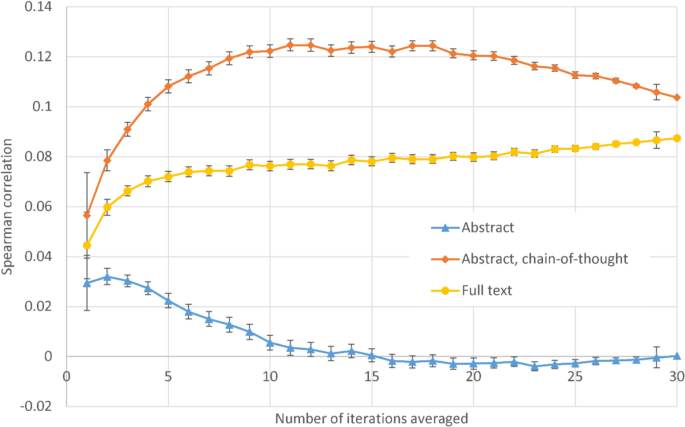
Academic peer review is at the heart of scientific quality control, yet the process is slow and time-consuming. Technology that can predict peer review outcomes may help with this, for example by fast-tracking desk rejection decisions. While previous studies have demonstrated that Large Language Models (LLMs) can predict peer review outcomes to some extent, this paper introduces two new contexts and employs a more robust method—averaging multiple ChatGPT scores. Averaging 30 ChatGPT predictions, based on reviewer guidelines and using only the submitted titles and abstracts failed to predict peer review outcomes for F1000Research (Spearman’s rho = 0.00). However, it produced mostly weak positive correlations with the quality dimensions of SciPost Physics (rho = 0.25 for validity, rho = 0.25 for originality, rho = 0.20 for significance, and rho = 0.08 for clarity) and a moderate positive correlation for papers from the International Conference on Learning Representations (ICLR) (rho = 0.38). Including article full texts increased the correlation for ICLR (rho = 0.46) and slightly improved it for F1000Research (rho = 0.09), with variable effects on the four quality dimension correlations for SciPost LaTeX files. The use of simple chain-of-thought system prompts slightly increased the correlation for F1000Research (rho = 0.10), marginally reduced it for ICLR (rho = 0.37), and further decreased it for SciPost Physics (rho = 0.16 for validity, rho = 0.18 for originality, rho = 0.18 for significance, and rho = 0.05 for clarity). Overall, the results suggest that in some contexts, ChatGPT can produce weak pre-publication quality predictions. However, their effectiveness and the optimal strategies for employing them vary considerably between platforms, journals, and conferences. Finally, the most suitable inputs for ChatGPT appear to differ depending on the platform.
No. 030: Google Deep Review, AI research taste, AI in dissertations - The Hallway Track
The Hallway Track No. 030 - How AI is affecting the practice of science
no slop grenade
Stop throwing AI-generated walls of text into conversations. If they wanted an AI essay, they would have asked ChatGPT themselves.
I saw this meta-analysis shared a couple of times recently, so we took a look and re-analyzed the data. | František Bartoš
I saw this meta-analysis shared a couple of times recently, so we took a look and re-analyzed the data. We found that the conclusion is almost entirely driven by publication bias. Both state-of-the-art and standard methods reduce the degree of the effect 2-3 fold. Moreover, the data no longer show statistical evidence for the main conclusions. Importantly, our findings do not imply that there is no positive effect of ChatGPT, or other large language models on learning; in fact, our analysis reveals that there is “absence of evidence” rather than “evidence of absence”. The present literature appears to be contaminated by publication bias; high-quality registered reports are needed to properly evaluate the effect of large language models in educational settings. See the full response just submitted for publication at https://lnkd.in/eGKHHKtg

Deep Dive into LLMs like ChatGPT
ChatGPT acts as a "cognitive crutch" that weakens memory, new research suggests
A recent experiment provides evidence that relying on artificial intelligence to study tends to reduce how much information students remember weeks later.

People who frequently use ChatGPT for writing tasks are accurate and robust detectors of AI-generated text
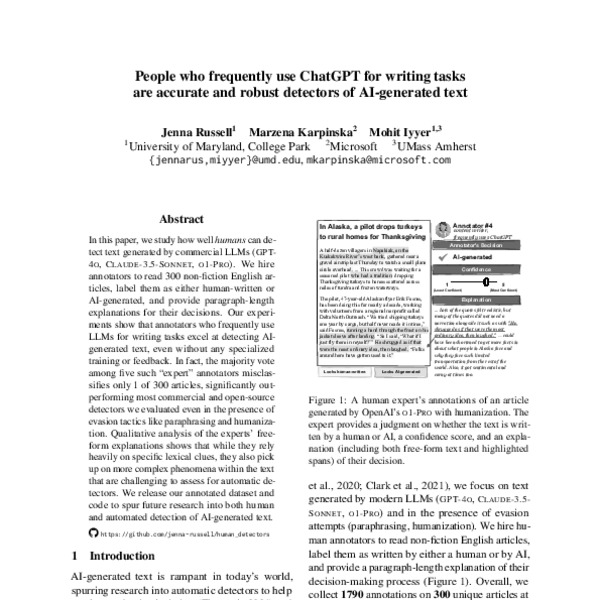
In this paper, we study how well humans can detect text generated by commercial LLMs (GPT-4o, Claude, o1). We hire annotators to read 300 non-fiction English articles, label them as either human-written or AI-generated, and provide paragraph-length explanations for their decisions. Our experiments show that annotators who frequently use LLMs for writing tasks excel at detecting AI-generated text, even without any specialized training or feedback. In fact, the majority vote among five such “expert” annotators misclassifies only 1 of 300 articles, significantly outperforming most commercial and open-source detectors we evaluated even in the presence of evasion tactics like paraphrasing and humanization. Qualitative analysis of the experts' free-form explanations shows that while they rely heavily on specific lexical clues (`AI vocabulary'), they also pick up on more complex phenomena within the text (e.g., formality, originality, clarity) that are challenging to assess for automatic detectors. We release our annotated dataset and code to spur future research into both human and automated detection of AI-generated text.
People who frequently use ChatGPT for writing tasks are accurate and robust detectors of AI-generated text
In this paper, we study how well humans can detect text generated by commercial LLMs (GPT-4o, Claude, o1). We hire annotators to read 300 non-fiction English articles, label them as either human-written or AI-generated, and provide paragraph-length explanations for their decisions. Our experiments show that annotators who frequently use LLMs for writing tasks excel at detecting AI-generated text, even without any specialized training or feedback. In fact, the majority vote among five such “expert” annotators misclassifies only 1 of 300 articles, significantly outperforming most commercial and open-source detectors we evaluated even in the presence of evasion tactics like paraphrasing and humanization. Qualitative analysis of the experts' free-form explanations shows that while they rely heavily on specific lexical clues (`AI vocabulary'), they also pick up on more complex phenomena within the text (e.g., formality, originality, clarity) that are challenging to assess for automatic detectors. We release our annotated dataset and code to spur future research into both human and automated detection of AI-generated text.
Idea Gatekeeper
AI-powered research idea evaluation platform. Evaluate your research pitch quality using models trained on institutional publication traces.
Retraction Note: The effect of ChatGPT on students’ learning performance, learning perception, and higher-order thinking: insights from a meta-analysis
Humanities and Social Sciences Communications - Retraction Note: The effect of ChatGPT on students’ learning performance, learning perception, and higher-order thinking: insights from a...