


Records released as part of a lawsuit challenging racial profiling show that immigration agents used slurs to refer to Latino targets.
Latinxs in <i>La Migra</i> : Why They Join and Why It Matters
Once an exclusively white enterprise, the last forty-five years have witnessed the emergence of a disproportionately Latinx immigration law enforcement workforce. This article addresses the question of why Latinxs elect to work for agencies that have systematically targeted the ethnic communities to which they belong. Where existing scholarship has often implied Latinxs may self-select into immigration law enforcement due to a lack of identification with the immigrant-experience, a dissociation with ethnic identity, and generally restrictionist immigration attitudes, this article finds little empirical evidence to support such an assumption. Analysis of interviews with sixty-one Latinx Immigration and Customs Enforcement (ICE) agents across Arizona, California, and Texas reveals, instead, Latinxs elect to work in immigration law enforcement in service of economic self-interest and survival, with “money,” “a good job,” and “benefits” cited as the primary motivation(s) behind applying for and accepting a job in immigration. This pattern holds irrespective of individual agents’ levels of identification with the immigrant-experience and particular attitudes toward immigration, and suggests a diversity in the demographics of immigration law enforcement agencies that extends beyond mere race and ethnicity, to include a diversity of perspective and potential for empathy.
California accounts for 1 in 4 ICE arrests of Asian immigrants, new tracker finds
The tracker from Stop AAPI Hate saw a surge in arrests and deportations in the arrest of people from Asian countries.

California accounts for 1 in 4 ICE arrests of Asian immigrants, new tracker finds
The tracker from Stop AAPI Hate saw a surge in arrests and deportations in the arrest of people from Asian countries.

New Study Explores Why US Latinos Join ICE and Border Patrol - Latino Rebels
A new study found that most of the agents joined because they wanted a stable job, and didn’t see many other ways of getting one.

Deportation Data Project
The Deportation Data Project at UC Berkeley and UCLA uses public records litigation to obtain, post and analyze U.S. government immigration enforcement data.
Police Records - CalMatters
Search California public records about law enforcement violence and misconduct.
They Walk Among Us - Criminal ICE and Border Agents — Ohio Immigrant Alliance
The Ohio Immigrant Alliance released “They Walk Among Us: A List of 59 Sexually and Physically Abusive ICE and Border Agents,” an analysis of sexual and violent crimes committed by ICE and Border Patrol agents. It report documents 59 cases of violent and/or sexual criminal acts by DHS employees.

Why do Latinos work for ICE?
Half of border agents are Latino, and they are part of a long history of Hispanic support for – and enforcement of – harsh immigration policies

“Warehousing Human Beings”
Former immigration judge Andrea Sáenz and American Immigration Council’s Aaron Reichlin-Melnick on the conditions at Delaney Hall and other ICE detention centers across the U.S.

Why do Latinos join ICE? | Code Switch
ICE violence against women is largely untracked. One advocacy group is working to change that.
Immigration agents with prior records of sexual and gender-based violence have drawn attention in Trump’s second term amid questions about training and vetting.

USA: « We had whistles, they had guns »: Human Rights Violations in U.S. Immigration Enforcement Operations and the Case to Abolish ICE
Amnesty International has documented that, since taking office on 20 January 2025, the Trump administration has subjected migrants, asylum seekers and refugees to a wide range of human rights violations. The administration is implementing a mass detention and deportation system, fuelled by racist, xenophobic and false narratives and white supremacist theories, whose objective is to […]

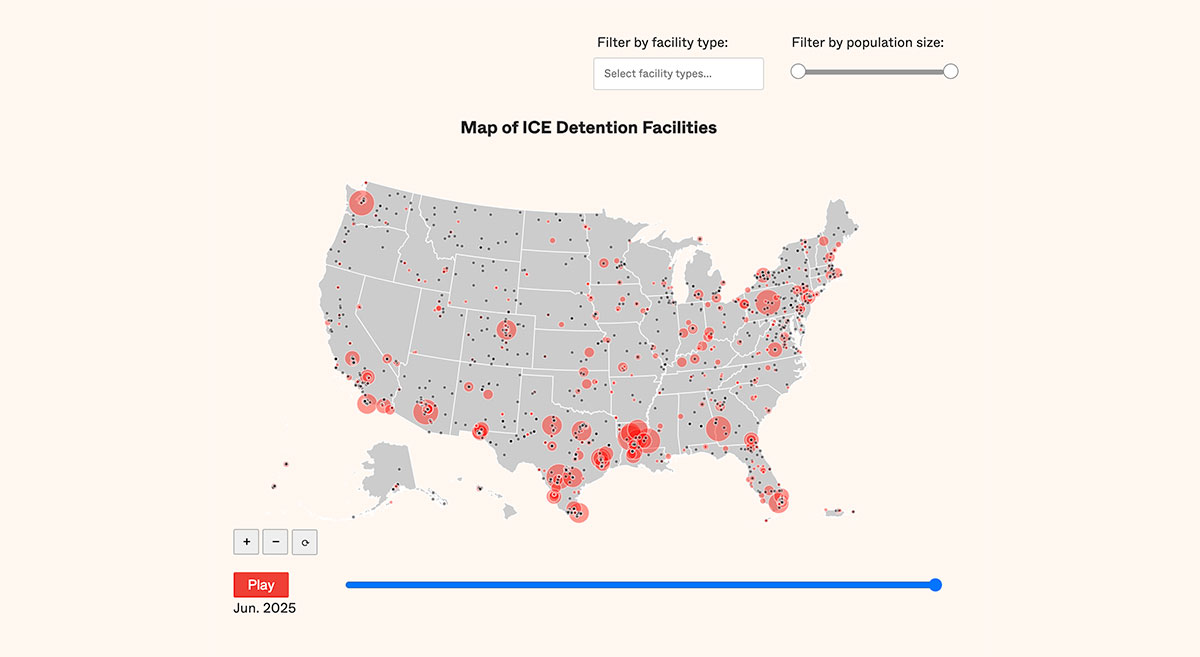
ICE Detention Trends | Vera Institute of Justice
Every year, U.S. Immigration and Customs Enforcement (ICE) subjects hundreds of thousands of people to civil immigration detention—a practice that is unjust, inhumane, and completely unnecessary. It does so under a veil of secrecy, sharing only limited, often error-prone statistics with the public. ICE’s failure to regularly release accurate, complete, and accessible data to the public enables it to operate its multi-billion-dollar detention network with impunity and little oversight.
Deportation Data Project
The Deportation Data Project obtains, posts, and analyzes internal U.S. government immigration enforcement data via public records litigation.
Tracking the Historic Rise of Habeas Cases Filed by Detained Immigrants
ProPublica is tracking the historic rise in challenges filed by immigrants claiming their detention is illegal.
