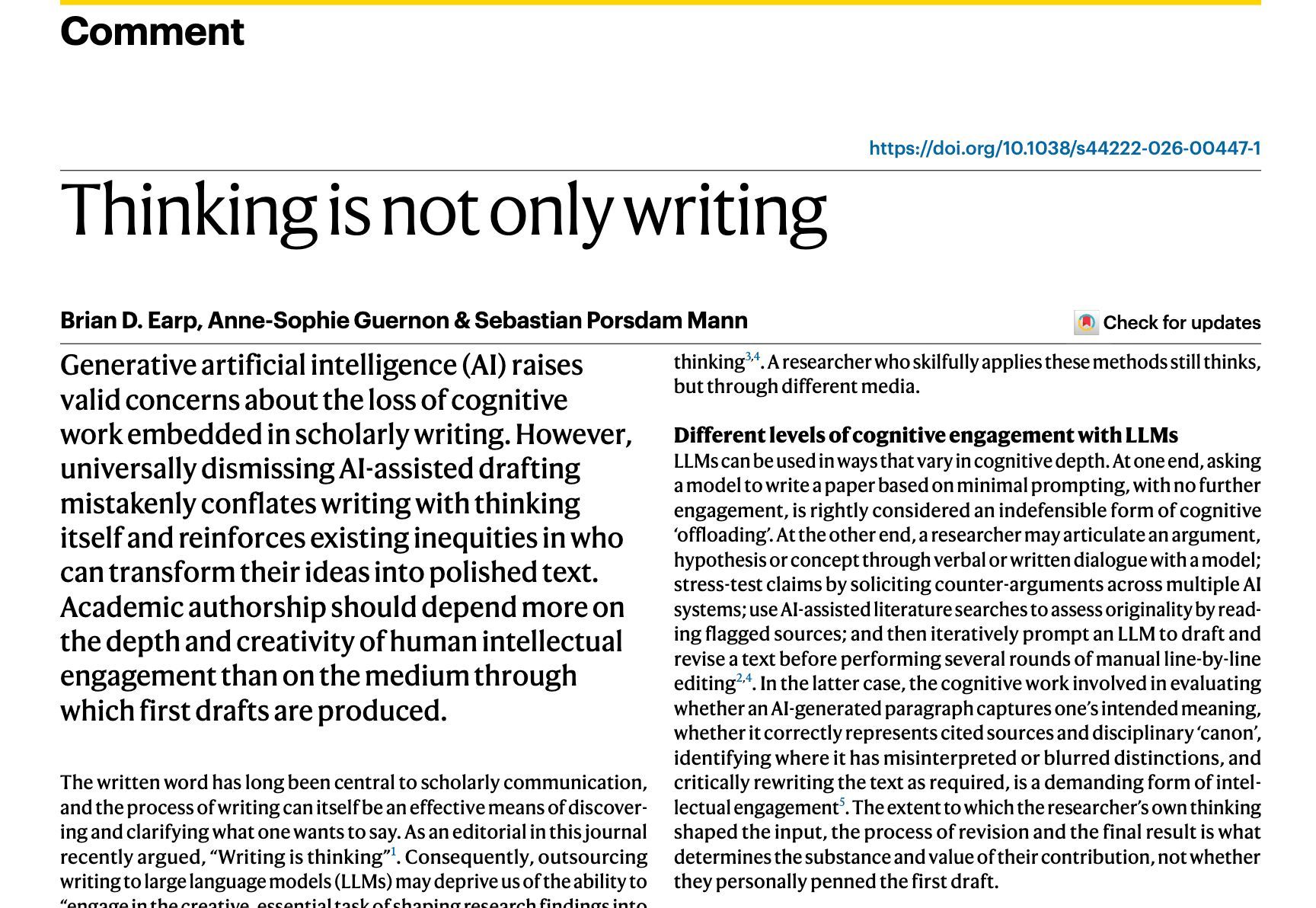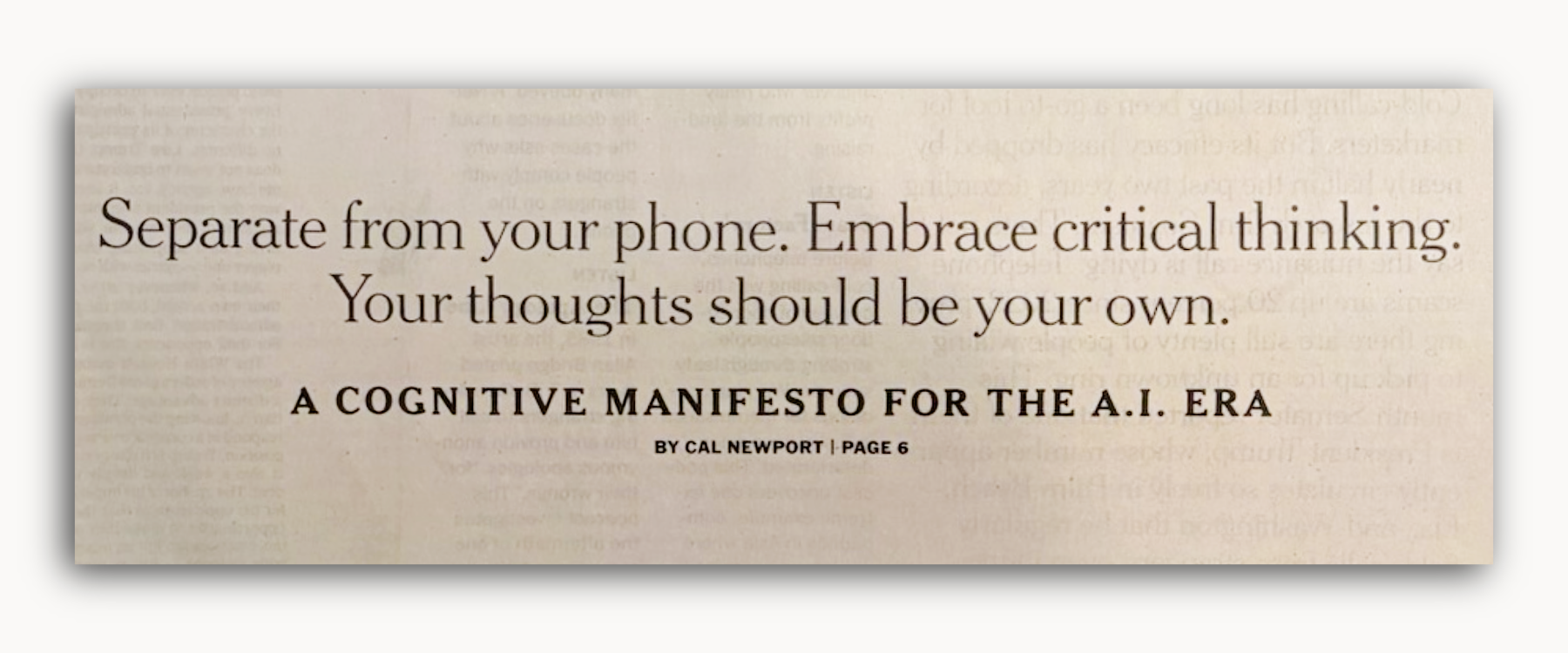
Ten years ago, I published Deep Work. It was my second mainstream hardcover idea book. The previous title, So Good They Can’t Ignore You, hadn’t ... Read more
Imagining your future projects is holding you back.
There is no book. There is only Idea Debt.


Roland-Allen.com
Home of the author of THE NOTEBOOK: A HISTORY OF THINKING ON PAPER, available now
Ultra-Processed Minds: The End of Deep Reading and What It Costs Us
A reflection on the reading life. What formed it, what threatens it, and what remains.

Summary: Thinking in Systems (by Donella H. Meadows)
The main argument of the book: Everything in this world is made of systems. While we cannot fully understand systems, we can observe them…
Opinion | Think Less, Think Better (Published 2016)
A wandering mind has less innovative thoughts.

Anti-brainrot aktion: A guide to Digital minimalism for the brokes, queers, disabled, and everyone else. - Multi-hyphenate
Cuz Cal Newport can kind of show his whole lily white rich man ass in his lil book sometimes and the subreddits are just showing off stuff people bought.
Authorship, division of labour, material and digital form; thoughts on Samuel A. Moore's Publishing Beyond the Market
On Christmas day, we had a quiet time this year. One of the things I did was to read Moore, Samuel A., Publishing Beyond the Market: Open Access, Care, and the Commons (University of Michigan Press, 2025). This is a most enjoyable book that outlines a project and worldview that I know Sam has been cultivating and refining for many years. I should stress that I am not writing a “review” here. I would be conflicted anyway as I am thanked in the acknowledgements. But it did, like all good books, make me think and I wanted to jot down some thoughts. These thoughts are not necessarily novel – sometimes Sam even explores some of them in the book – but I thought it would be enjoyable to express them nonetheless.

Dark Matters: On the Surveillance of Blackness by Simon…
Discover and share books you love on Goodreads.


The Top Idea in Your Mind
July 2010I realized recently that what one thinks about in the shower in the morning is more important than I'd thought. I knew it was a good time to have ideas. Now I'd go further: now I'd say it's hard to do a really good job on anything you don't think about in the shower.Everyone who's worked on difficult problems is probably familiar with the phenomenon of working hard to figure something out, failing, and then suddenly seeing the answer a bit later while doing something else. There's a kind of thinking you do without trying to. I'm increasingly convinced this type of thinking is not merely helpful in solving hard problems, but necessary. The tricky part is, you can only control it indirectly. [1]I think most people have one top idea in their mind at any given time. That's the idea their thoughts will drift toward when they're allowed to drift freely. And this idea will thus tend to get all the benefit of that type of thinking, while others are starved of it. Which means it's a disaster to let the wrong idea become the top one in your mind.What made this clear to me was having an idea I didn't want as the top one in my mind for two long stretches.I'd noticed startups got way less done when they started raising money, but it was not till we ourselves raised money that I understood why. The problem is not the actual time it takes to meet with investors. The problem is that once you start raising money, raising money becomes the top idea in your mind. That becomes what you think about when you take a shower in the morning. And that means other questions aren't.I'd hated raising money when I was running Viaweb, but I'd forgotten why I hated it so much. When we raised money for Y Combinator, I remembered. Money matters are particularly likely to become the top idea in your mind. The reason is that they have to be. It's hard to get money. It's not the sort of thing that happens by default. It's not going to happen unless you let it become the thing you think about in the shower. And then you'll make little progress on anything else you'd rather be working on. [2](I hear similar complaints from friends who are professors. Professors nowadays seem to have become professional fundraisers who do a little research on the side. It may be time to fix that.)The reason this struck me so forcibly is that for most of the preceding 10 years I'd been able to think about what I wanted. So the contrast when I couldn't was sharp. But I don't think this problem is unique to me, because just about every startup I've seen grinds to a halt when they start raising money � or talking to acquirers.You can't directly control where your thoughts drift. If you're controlling them, they're not drifting. But you can control them indirectly, by controlling what situations you let yourself get into. That has been the lesson for me: be careful what you let become critical to you. Try to get yourself into situations where the most urgent problems are ones you want to think about.You don't have complete control, of course. An emergency could push other thoughts out of your head. But barring emergencies you have a good deal of indirect control over what becomes the top idea in your mind.I've found there are two types of thoughts especially worth avoiding � thoughts like the Nile Perch in the way they push out more interesting ideas. One I've already mentioned: thoughts about money. Getting money is almost by definition an attention sink. The other is disputes. These too are engaging in the wrong way: they have the same velcro-like shape as genuinely interesting ideas, but without the substance. So avoid disputes if you want to get real work done. [3]Even Newton fell into this trap. After publishing his theory of colors in 1672 he found himself distracted by disputes for years, finally concluding that the only solution was to stop publishing:
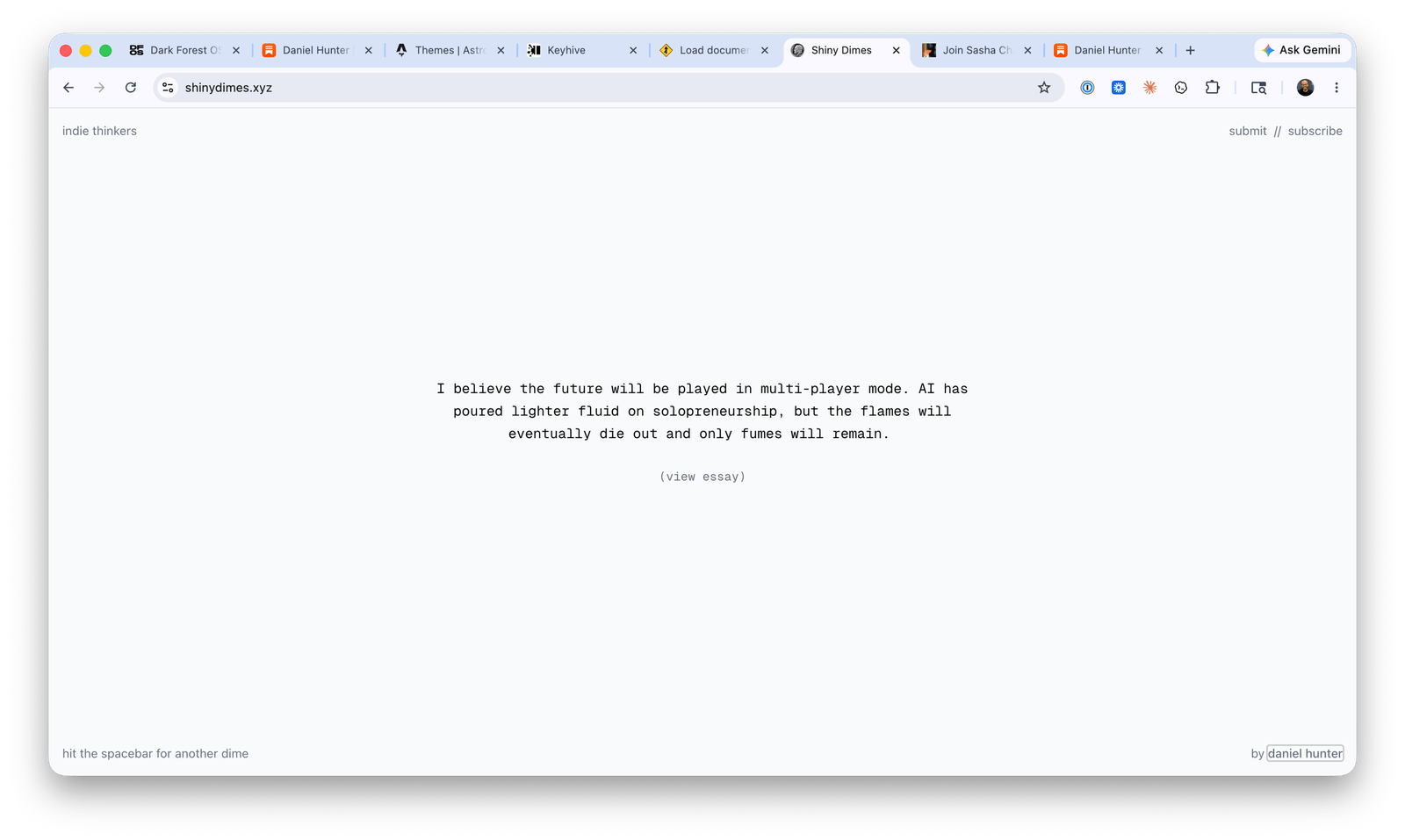
Indie Thinkers
A curated collection of quotes from the brightest minds on the internet.
Writing is Thinking: Learning to Write with Confidence
Learning to write is learning to think, because writing is thinking. They are two peas in a powerful pod. This article goes over my writing process, focused on minimizing the activation energy to get started.

The revolt of the reader | The Observation Deck
Reading is important to me. While I’m not a quick reader nor an especially voracious one, I have found that long-form reading has had a profound influence on me over my life. And because reading is important to me, writing is too: writing not only allows us to convey our ideas, but the very act forces us to test and distill them — at once making our ideas more robust while providing the vehicle by which to share them.
The Backward Mentality to Finding Victory - Mockingbird
It Doesn't Always Pay to Be a Thinker

Brian D. Earp, Ph.D. on Twitter / X
"Writing is thinking." This phrase went viral recently (from https://t.co/EQqohfhUMd), often quoted in the context of objections to use of AI in drafting academic prose. In Nature Reviews Bioengineering we respond: "Thinking is not only writing." Preview below. Shareable full… pic.twitter.com/cZtGdoSwqV— Brian D. Earp, Ph.D. (@briandavidearp) May 15, 2026