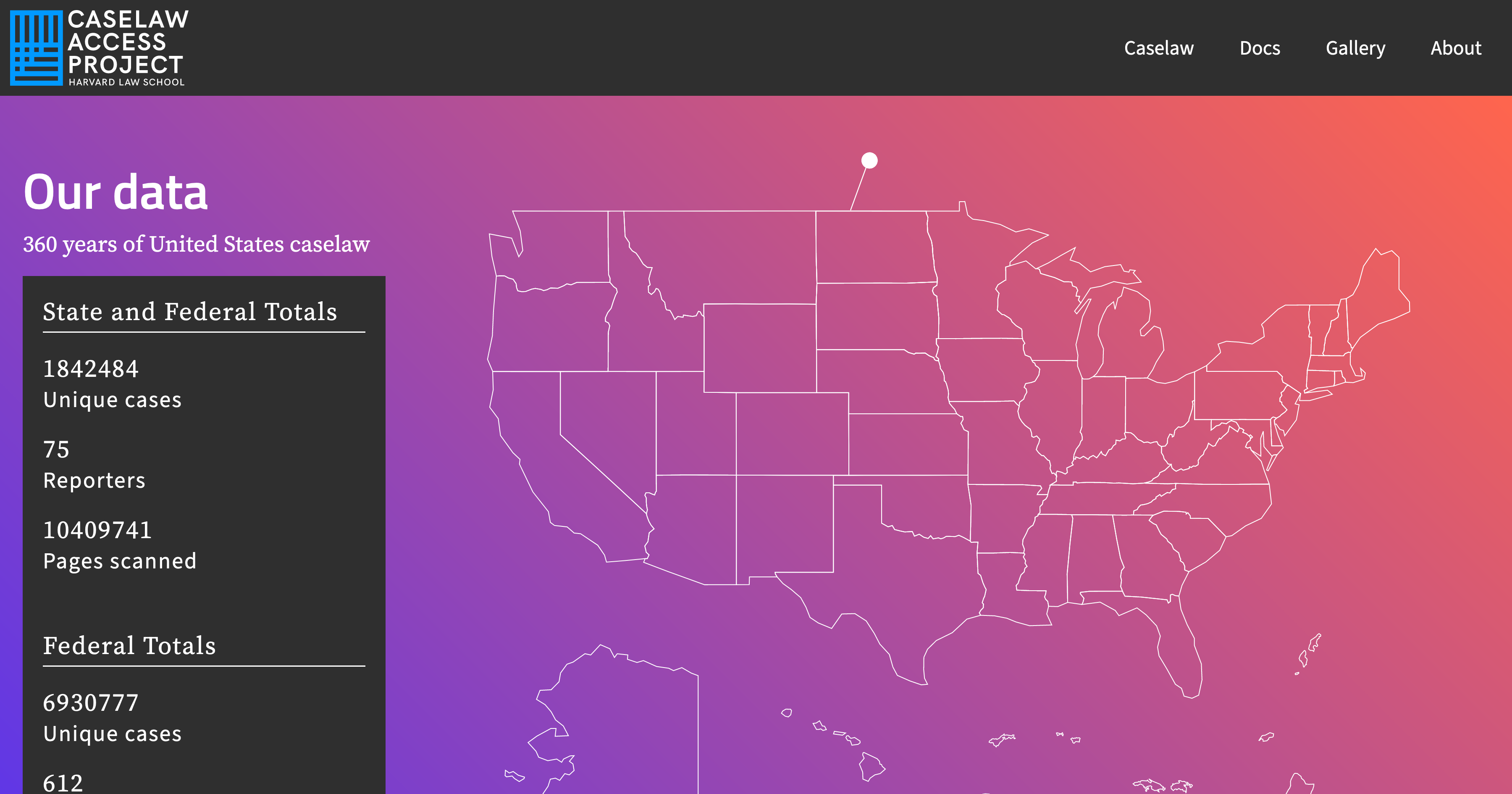
Explore American Caselaw
Law.com | The Premier Source for Global Legal News & Analysis
Law.com delivers news, insights and resources that allow legal professionals to anticipate opportunities, adapt to change, and prepare for future success.
How Police Make Up The Law (ft. LegalEagle)
Litigation Tracker: Legal Challenges to Trump Administration Actions
A public resource tracking the legal challenges to the Trump administration's executive orders and actions.

Chapter Eight—Technology and the Law: The Automobile · University of Wisconsin Law School Digital Repository · University of Wisconsin Law School Digital Repository
University of Wisconsin Law School Law Library 975 Bascom Mall Madison, WI 53706 608-262-3394
AI Hallucination Cases Database – Damien Charlotin
The most comprehensive database of AI hallucination cases in law: legal decisions from courts worldwide, searchable by country, party, AI tool, and outcome. Updated daily.
Meet the Author: Alicia Solow-Niederman
Alicia Solow-NiedermanAssociate Professor of LawGeorge Washington University Law School

Litigation Tracker
Find legal challenges to executive orders and actions from the Trump administration.
State Privacy Law Tracker | Mayer Brown
In the continued absence of a comprehensive federal statute on privacy, states are advancing their own approaches to govern the collection and use of

Homepage - Current Shift Legal
Innovation for a Just Economy Strategic legal counsel for cooperatives, nonprofits, mission-driven businesses, and values-led leaders shaping the future of ownership and enterprise. Our Services What we do Legal services for organizations building with purpose From formation to succession to ongoing counsel, we advise on
Automated Justice: Issues, Benefits and Risks in the Use of Artificial Intelligence and Its Algorithms in Access to Justice and Law Enforcement
The use of artificial intelligenceArtificial Intelligence (AI) (AI) in the field of law has generated many hopes. Some have seen it as a way of relieving courts’ congestion, facilitating investigations, and making sentences for certain offences more consistent—and therefore fairer. But while it is true that the work of investigators and judges can be facilitated by these tools, particularly in terms of finding evidenceEvidence during the investigative process, or preparing legal summaries, the panorama of current uses is far from rosy, as it often clashes with the reality of field usage and raises serious questions regarding human rightsHuman rights. This chapter will use the RobodebtRobodebt Case to explore some of the problems with introducing automationAutomation into legal systems with little human oversight. AI—especially if it is poorly designed—has biases in its data and learning pathways which need to be corrected. The infrastructures that carry these tools may fail, introducing novel bias. All these elements are poorly understood by the legal world and can lead to misuse. In this context, there is a need to identify both the users of AIArtificial Intelligence (AI) in the area of law and the uses made of it, as well as a need for transparencyTransparency, the rules and contours of which have yet to be established.
Hallucination-Free? Assessing the Reliability of Leading AI Legal Research Tools
Legal practice has witnessed a sharp rise in products incorporating artificial intelligence (AI). Such tools are designed to assist with a wide range of core legal tasks, from search and summarization of caselaw to document drafting. But the large language models used in these tools are prone to "hallucinate," or make up false information, making their use risky in high-stakes domains. Recently, certain legal research providers have touted methods such as retrieval-augmented generation (RAG) as "eliminating" (Casetext, 2023) or "avoid[ing]" hallucinations (Thomson Reuters, 2023), or guaranteeing "hallucination-free" legal citations (LexisNexis, 2023). Because of the closed nature of these systems, systematically assessing these claims is challenging. In this article, we design and report on the first preregistered empirical evaluation of AI-driven legal research tools. We demonstrate that the providers' claims are overstated. While hallucinations are reduced relative to general-purpose chatbots (GPT-4), we find that the AI research tools made by LexisNexis (Lexis+ AI) and Thomson Reuters (Westlaw AI-Assisted Research and Ask Practical Law AI) each hallucinate between 17% and 33% of the time. We also document substantial differences between systems in responsiveness and accuracy. Our article makes four key contributions. It is the first to assess and report the performance of RAG-based proprietary legal AI tools. Second, it introduces a comprehensive, preregistered dataset for identifying and understanding vulnerabilities in these systems. Third, it proposes a clear typology for differentiating between hallucinations and accurate legal responses. Last, it provides evidence to inform the responsibilities of legal professionals in supervising and verifying AI outputs, which remains a central open question for the responsible integration of AI into law.

Governing Digital Legal Systems: Insights on Artificial Intelligence and Rules as Code · MIT Computational Law Report
This article explores how AI and 'rules as code' are turning law into automated systems. It highlights the need for governance focused on transparency, explainability, and risk management to ensure these digital legal frameworks stay reliable and fair.


New Proceedings Filed in Immigration Court
Home | Laws of UX
Laws of UX is a collection of best practices that designers can consider when building user interfaces.