

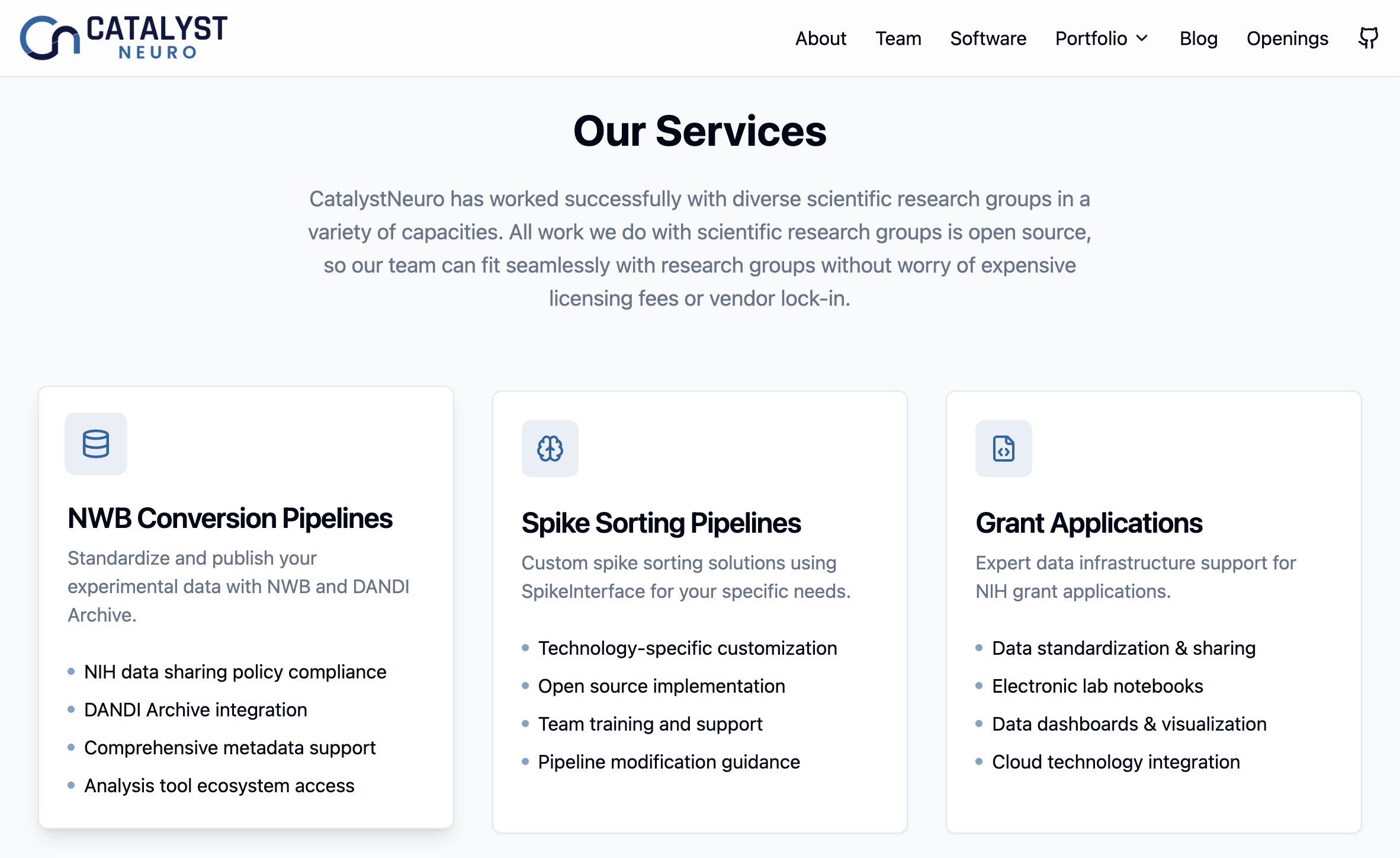
CatalystNeuro empowers neuroscience labs with data standardization, NWB conversions, spike sorting pipelines, and open-source software tools for neurophysiology research.
Inventing the future: A neuroscience research roadmap
The past decade of transformative advances in neurotechnology portends an exciting future for neuroscience. This NeuroView charts a strategic path to accelerate and integrate research discovery and speed the development of new cures for human brain disorders.

Project Overview ‹ NeuroDatasets Tool – MIT Media Lab
NeuroDatasets is tool, where one can browse and find all available neuroscience datasets for all major modalities: EEG, MRI, MEG, NIRS, PET and more. &nb…
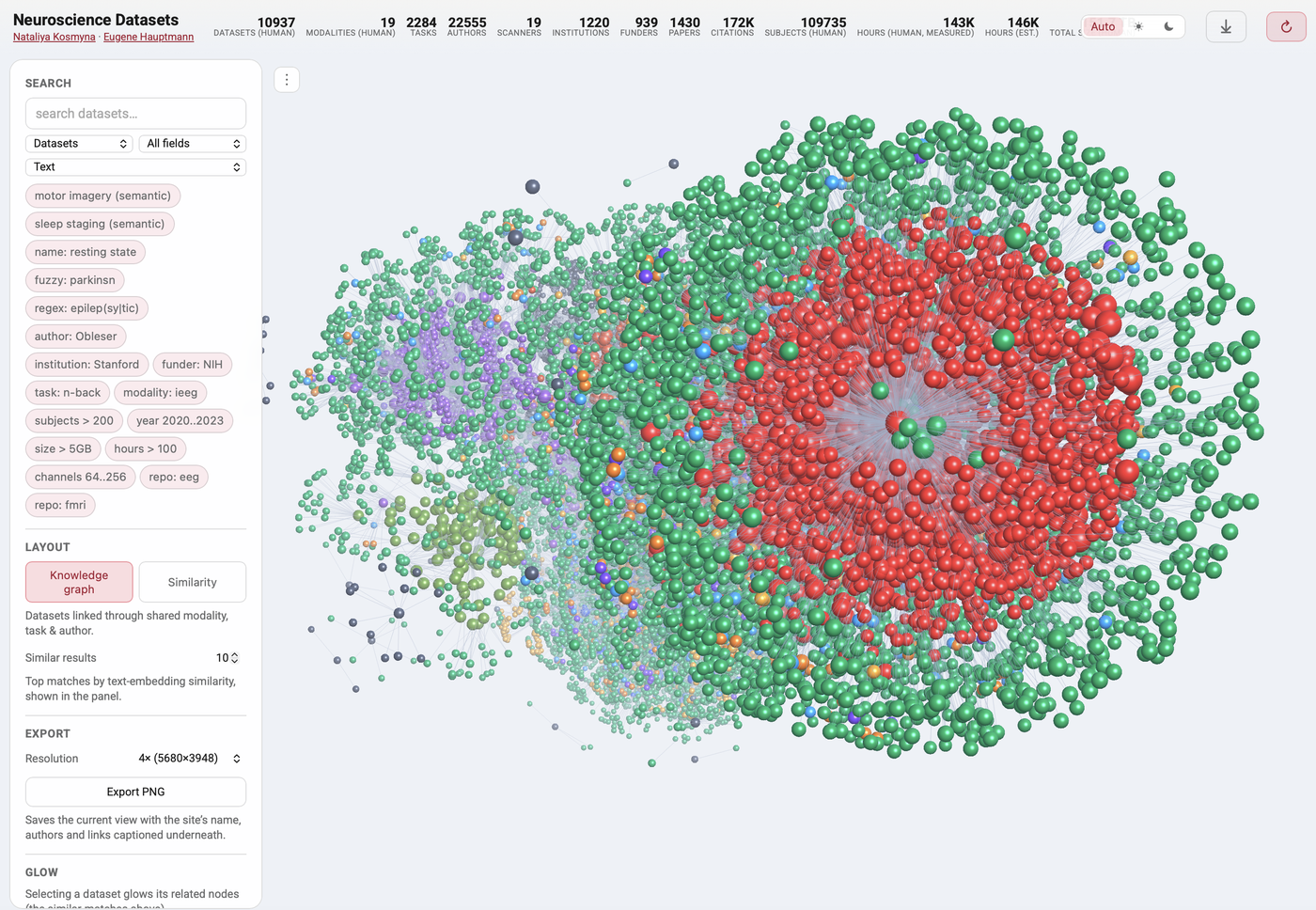
Neuropeek — Accelerating the Neuro-AI convergence
Where brain data becomes shared knowledge. A community-driven platform federating neuroscience datasets, models, and tools to accelerate discovery.

Massively Scalable Neurotechnologies
Backed by £50m, this programme sits within the Scalable Neural Interfaces opportunity space and is seeking radically new ways to deliver responsive neurotechnologies to the brain without brain surgery.
NeuralBench: A Unifying Framework to Benchmark NeuroAI Models | Hubert Banville
🧠 NeuralBench is now open source. Today we're releasing NeuralBench, a unified framework for benchmarking foundation models of brain activity, developed by the Brain & AI team at FAIR, Meta. 💻 Code: https://lnkd.in/dNJsgBgM 📄 White paper: https://lnkd.in/dvWMg7rx Brain foundation models are starting to show positive transfer to a range of downstream tasks, from brain-computer interfacing to clinical classification. But systematically evaluating them is hard: heterogeneous preprocessing pipelines, input structures, and adaptation methodologies make results difficult to compare. Most prior work also focuses on a narrow set of downstream tasks. NeuralBench addresses this by defining each task end-to-end with config files (data source, preprocessing, splits, optimiser, metrics, architecture) so all models can be evaluated on the same footing. What's in our first release, NeuralBench-EEG v1.0: ⚡ 36 EEG tasks across 94 public datasets, spanning motor imagery, clinical classification, cognitive decoding, and phenotype prediction. 🤖 Task-specific deep learning architectures (EEGNet, Deep4, EEGConformer, CTNet, ...) benchmarked side-by-side with recent EEG foundation models (BENDR, LaBraM, BIOT, CBraMod, LUNA, REVE). 🧩 Extensible to other neuroimaging modalities: the framework already runs MEG and fMRI tasks, leveraging our NeuralSet ecosystem for accessing brain imaging data and the broader neuroscientific software stack. 📜 Released under the MIT license. Help us make it better. Through our white paper, we invite the community to contribute new tasks, datasets, and models, especially for fMRI, MEG, and iEEG. The long-term goal is a fully unified benchmark across neuroimaging tasks and modalities. 🙏🙏🙏 This was a big team effort with Stéphane d'Ascoli, Simon Dahan, Jérémy RAPIN, Marlène Careil, Yohann Benchetrit, Jarod Lévy, Saarang P., Antoine Ratouchniak, Lucy (Mingfang) Zhang, Elisa Cascardi, Katie Begany, Teon Brooks, and Jean-Rémi King. Special thanks to Alexandre Gramfort, Thomas Moreau, Arnaud Delorme, Bruno A. and Pierre Guetschel for feedback and support. #Neuroscience #AI #NeuroAI #Python #OpenSource

DANDI
DANDI: Distributed Archives for Neurophysiology Data Integration The DANDI platform is supported by the BRAIN Initiative for publishing, sharing, and processing neurophysiology data. The archive accepts cellular neurophysiology data including electrophysiology, optophysiology, and behavioral time-series, and images from immunostaining experiments. The platform is now available for data upload and distribution. The storage of data in the archive is also supported by the Amazon Opendata program. The data in the archive can be browsed using the Data Portal. For detailed instructions on how to interact (view, upload, download, process) with DANDI click here.
Precision Medicine in Neuroscience: Tools, Translation, and Implementation: A Workshop
Join the web’s most supportive community of creators and get high-quality tools for hosting, sharing, and streaming videos in gorgeous HD with no ads.
Motif Neurotech — Therapeutic Brain Computer Interface For Mental Health
We're building devices to help you monitor and regulate your mental health and performance.
.png)
#neuroscience #ai #python #opensource #neuroai | Jean-Rémi King
⚡ We're happy to release NeuralSet: a fast, simple, and scalable Python framework for Neuro-AI. Already supports: 🧠 fMRI, EEG, MEG, iEEG, spikes… recordings 💬 text, 🔊 audio, ▶️ video, 🏞️ image… embeddings 📦 `pip install neuralset` 💻 Code: https://lnkd.in/eamwxBUY 📄 Paper: https://lnkd.in/epbreyDy Made possible thanks to: Hubert Banville, Katie Begany, Corentin Bel, Yohann Benchetrit, Teon Brooks, Marlène Careil, Simon Dahan, Stéphane d'Ascoli, Alexandre Défossez, Linnea Evanson, PhD, Pablo J. Diego Simón, Julien Gadonneix, Sophia Houhamdi, Shubh Khanna, Jarod Lévy, Pierre Orhan, Antoine Ratouchniak, Joséphine Raugel, Andrea Elena Santos Revilla, Alexis Thual, Lucy (Mingfang) Zhang, Jérémy RAPIN #Neuroscience #AI #Python #OpenSource #NeuroAI
#digitalbrainproject #neuroscience #artificialintelligence #openscience #callforprojects #research #ai #brain | Fondation Adolphe de Rothschild
The Rothschild Foundation Hospital is excited to launch the Digital Brain Project, a $5M collaborative research initiative to build an open source foundational model of the brain through open-access neural data. Apply by May 15th for up to $500k in funding. Help crack the neural code 👉digitalbrainproject.org Our objective is to develop a standardized, publicly available dataset of human brain recordings to accelerate fundamental research in cognitive neuroscience, AI system development, and clinical health. Our independent, multidisciplinary Scientific Committee oversees data collection, ethical review, privacy, and open science practices of our project — setting standards for large-scale brain research. The Digital Brain Project is conceived as an open collaborative infrastructure, at the intersection of neuroscience, artificial intelligence, and data science. It aims to accelerate data development, a key bottleneck to developing a foundational AI model of the human brain. Key Focus Areas: 1️⃣ Brain recording data related to visual processing, language functions and cognitive actions 2️⃣ Rigorous quality, privacy, and ethical control, along with procedures for standardizing data across sites 3️⃣ Support for teams selected by an international multidisciplinary Scientific Committee Call for applications: Research teams working in neuroscience, neuroimaging, or artificial intelligence are invited to submit their applications by May 15, 2026. Selected teams will receive up to $500k USD funding to support their work. We appreciate our Scientific Committee (Lune Bellec Anne-Marie Kermarrec Arthur Mensch Russell Poldrack Lucia Melloni Jose Alain Sahel) for their independent scientific leadership, and partners Université de Montréal and AI at Meta for collaborating on this exciting project. #DigitalBrainProject #Neuroscience #ArtificialIntelligence #OpenScience #Callforprojects #Research #AI #Brain -------------------------------------------------------------- Pierre Bourdillon Julie Boyle Elisa Cascardi Jean-Rémi King Guillaume Le Hénanff Amélie Yavchitz Julien Gottsmann Fabrice VERRIELE Charlotte Cardin-Taillia
brainlife
The platform allows to analyze Magnetic Resonance Imaging (MRI), electroencephalography (EEG) and magnetoencephalography (MEG) data. Data can either be uploaded from local computers or imported from public archives such as OpenNeuro.org. Over 400+ data processing Apps are available on brainlife.io to build custom data workflows. Thousands of jobs can be submitted using shared clusters or on users' compute resource. Users can perform group-level statistical analysis or apply machine learning methods using Jupyter notebooks. A single record containing the entire data workflow (from raw data to published figures) can be published addressed by with a unique digital object identifier (DOI).
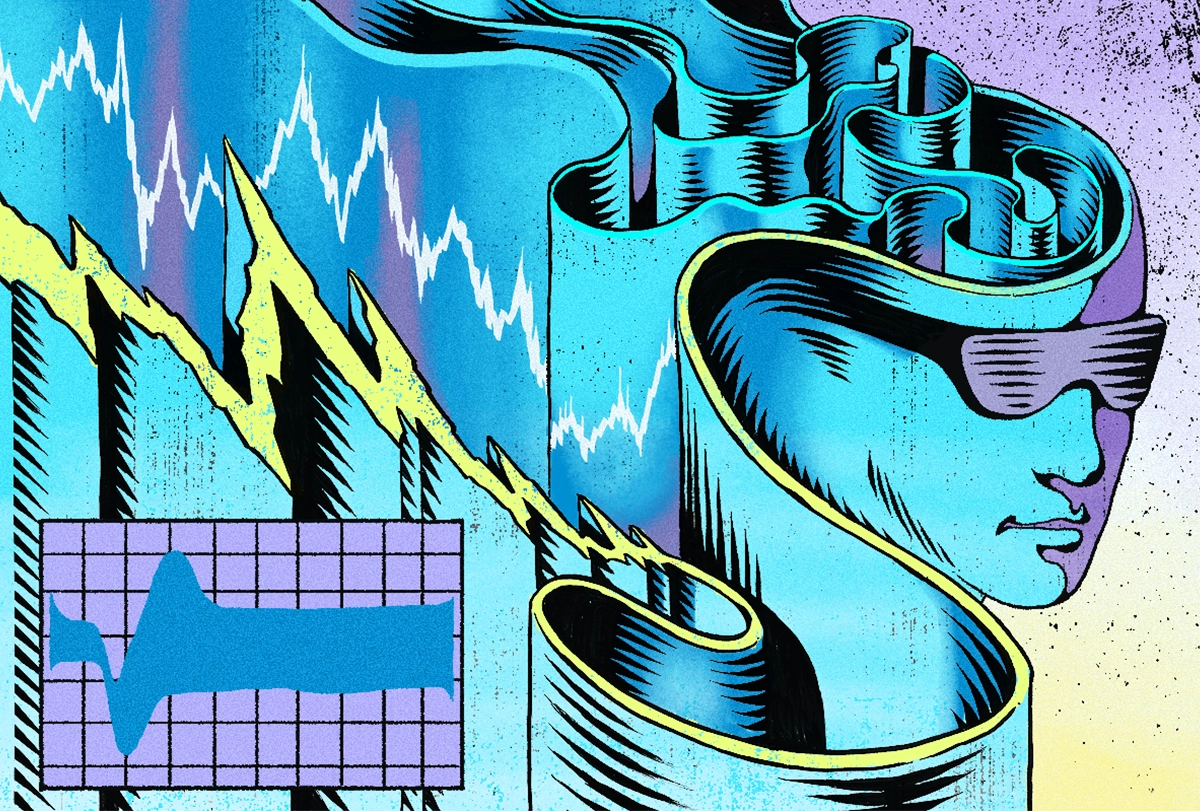
Neuroscience needs a career path for software engineers
Few institutions have mechanisms for the type of long-term positions that would best benefit the science.
Blueprint Neurotech
The Center for Innovative NeuroTech Advancement (CINTA) & NeuroTech Harbor (NTH) announce the Cycle 6 Award Competition supported by the NIH Blueprint MedTech Program. This program is seeking collaborative projects aimed at developing emerging technologies into commercially viable, clinically focused solutions for disorders of the nervous system that are aligned with the mission and interests of the participating NIH institutes and centers.
NeuroNYC
As the global leader in finance, policy, art, research, and medicine, the region is well-positioned to lead neurotech. We help foster and promote the local neurotech ecosystem: clinics, companies, funders, labs, and users.

#neuroscience #ai #python #opensource #neuroai | Jean-Rémi King | 34 comments
⚡ We're happy to release NeuralSet: a fast, simple, and scalable Python framework for Neuro-AI. Already supports: 🧠 fMRI, EEG, MEG, iEEG, spikes… recordings 💬 text, 🔊 audio, ▶️ video, 🏞️ image… embeddings 📦 `pip install neuralset` 💻 Code: https://lnkd.in/eamwxBUY 📄 Paper: https://lnkd.in/epbreyDy Made possible thanks to: Hubert Banville, Katie Begany, Corentin Bel, Yohann Benchetrit, Teon Brooks, Marlène Careil, Simon Dahan, Stéphane d'Ascoli, Alexandre Défossez, Linnea Evanson, PhD, Pablo J. Diego Simón, Julien Gadonneix, Sophia Houhamdi, Shubh Khanna, Jarod Lévy, Pierre Orhan, Antoine Ratouchniak, Joséphine Raugel, Andrea Elena Santos Revilla, Alexis Thual, Lucy (Mingfang) Zhang, Jérémy RAPIN #Neuroscience #AI #Python #OpenSource #NeuroAI | 34 comments on LinkedIn
#neuroscience #ai #python #opensource #neuroai | Jean-Rémi King | 34 comments
⚡ We're happy to release NeuralSet: a fast, simple, and scalable Python framework for Neuro-AI. Already supports: 🧠 fMRI, EEG, MEG, iEEG, spikes… recordings 💬 text, 🔊 audio, ▶️ video, 🏞️ image… embeddings 📦 `pip install neuralset` 💻 Code: https://lnkd.in/eamwxBUY 📄 Paper: https://lnkd.in/epbreyDy Made possible thanks to: Hubert Banville, Katie Begany, Corentin Bel, Yohann Benchetrit, Teon Brooks, Marlène Careil, Simon Dahan, Stéphane d'Ascoli, Alexandre Défossez, Linnea Evanson, PhD, Pablo J. Diego Simón, Julien Gadonneix, Sophia Houhamdi, Shubh Khanna, Jarod Lévy, Pierre Orhan, Antoine Ratouchniak, Joséphine Raugel, Andrea Elena Santos Revilla, Alexis Thual, Lucy (Mingfang) Zhang, Jérémy RAPIN #Neuroscience #AI #Python #OpenSource #NeuroAI | 34 comments on LinkedIn