The Evidence-Based Policing Matrix What strategies can be effective in reducing crime and disorder in policing? The Evidence-Based Policing Matrix is a research-to-practice translation tool that collects, summarizes, and organizes moderate to very rigorous evaluations of police interventions, allowing agencies and researchers to view the field of research in this area. The Matrix includes studies…
Predictive Policing and the Politics of Patterns
Abstract. Patterns are the epistemological core of predictive policing. With the move towards digital prediction tools, the authority of the pattern is rea

Predictive Policing and the Politics of Patterns
Abstract Patterns are the epistemological core of predictive policing. With the move towards digital prediction tools, the authority of the pattern is rearticulated and reinforced in police work. Based on empirical research about predictive policing software and practices, this article puts the authority of patterns into perspective. Introducing four ideal-typical styles of pattern identification, we illustrate that patterns are not based on a singular logic, but on varying rationalities that give form to and formalize different understandings about crime. Yet, patterns render such different modes of reasoning about crime, and the way in which they feed back into policing cultures, opaque. Ultimately, this invites a stronger reflection about the political nature of patterns.
[122] Arresting Flexibility: A QJE field experiment on police behavior with about 40 outcome variables
A forthcoming paper in the Quarterly Journal of Economics (QJE), “A Cognitive View of Policing” (htm), reports results from a field experiment showing that teaching police officers to &…

Criminal Justice Fact Sheet
A compilation of facts and figures surrounding policing, the criminal justice system, incarceration, and more.

Journalists and Researchers: How to Examine FBI Crime Data for Your Community
Here’s what to know about NIBRS, the FBI’s program for collecting police data from 15,000 agencies across the U.S.
Police across the US are training crime-predicting AIs on falsified data
A new report shows how supposedly objective systems can perpetuate corrupt policing practices.

Predictive Policing Explained
Attempts to forecast crime with algorithmic techniques could reinforce existing racial biases in the criminal justice system.

How the LAPD and Palantir Use Data to Justify Racist Policing
In a new book, a sociologist who spent months embedded with the LAPD details how data-driven policing techwashes bias.

A Cognitive View of Policing
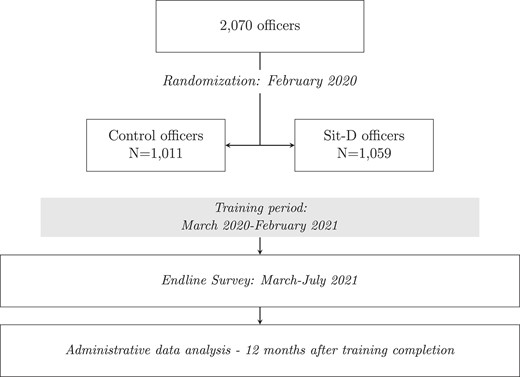
Abstract What causes adverse policing outcomes, such as excessive uses of force and unnecessary arrests? Prevailing explanations focus on problematic officers or deficient regulations and oversight. We introduce an overlooked perspective. We suggest that the cognitive demands inherent in policing can undermine officer decision making. Unless officers are prepared for these demands, they may jump to conclusions too quickly without fully considering alternative ways of seeing a situation. This can lead to adverse policing outcomes. To test this perspective, we created a new training that teaches officers to consider different ways of interpreting the situations they encounter. We evaluated this training using a randomized controlled trial with 2,070 officers from the Chicago Police Department. In a series of lab assessments, we find that treated officers were significantly more likely to consider a wider range of evidence and develop more explanations for subjects’ actions. Critically, we also find that training affected officer performance in the field, leading to reductions in uses of force, discretionary arrests, and arrests of Black civilians. Meanwhile, officer activity levels remained unchanged, and trained officers were less likely to be injured on duty. Our results highlight the value of considering the cognitive aspects of policing and demonstrate the power of using behaviorally informed approaches to improve officer decision making and policing outcomes.
Does Predictive Policing Lead to Biased Arrests? Results From a Randomized Controlled Trial
Racial bias in predictive policing algorithms has been the focus of a number of recent news articles, statements of concern by several national organizations (e.g., the ACLU and NAACP), and simulat...
Does Predictive Policing Lead to Biased Arrests? Results From a Randomized Controlled Trial
Racial bias in predictive policing algorithms has been the focus of a number of recent news articles, statements of concern by several national organizations (e.g., the ACLU and NAACP), and simulat...
Police Abolition | The Paper Pilot
The Paper Pilot's digital garden of thoughts on philosophy, politics, and sociology
Find Rated Practices | CrimeSolutions, National Institute of Justice
NoticeThis page is no longer being updated. It may contain outdated information and links may no longer function as originally intended.
The Most Violent Police Force in Europe: Police Brutality in France — The World Mind
Contributing Editor Aaron Shires explores the rise in excessive use of force by French police forces and the disparate impact this has on racial minorities in France.

What the latest research tells us about racial bias in policing
What we know, and importantly don't know, about the latest research on racial bias in policing.
Going beyond the “common suspects”: to be presumed innocent in the era of algorithms, big data and artificial intelligence
This article explores the trend of increasing automation in law enforcement and criminal justice settings through three use cases: predictive policing, machine evidence and recidivism algorithms. The focus lies on artificial-intelligence-driven tools and technologies employed, whether at pre-investigation stages or within criminal proceedings, in order to decode human behaviour and facilitate decision-making as to whom to investigate, arrest, prosecute, and eventually punish. In this context, this article first underlines the existence of a persistent dilemma between the goal of increasing the operational efficiency of police and judicial authorities and that of safeguarding fundamental rights of the affected individuals. Subsequently, it shifts the focus onto key principles of criminal procedure and the presumption of innocence in particular. Using Article 6 ECHR and the Directive (EU) 2016/343 as a starting point, it discusses challenges relating to the protective scope of presumption of innocence, the burden of proof rule and the in dubio pro reo principle as core elements of it. Given the transformations law enforcement and criminal proceedings go through in the era of algorithms, big data and artificial intelligence, this article advocates the adoption of specific procedural safeguards that will uphold rule of law requirements, and particularly transparency, fairness and explainability. In doing so, it also takes into account EU legislative initiatives, including the reform of the EU data protection acquis, the E-evidence Proposal, and the Proposal for an EU AI Act. Additionally, it argues in favour of revisiting the protective scope of key fundamental rights, considering, inter alia, the new dimensions suspicion has acquired.