

🔎 india census 2011 population by religion - Google Search

India’s Muslim population rose over 43% from 1950-2015: EAC-PM working paper
The paper is authored by EAC-PM member Shamika Ravi, Apurv Kumar Mishra, Consultant, EAC-PM and Abraham Jose, Professional, EAC-PM.
The EAC-PM's Paper on 'Muslim Population' Is a Travesty of Research Practices
Fertility rates of the poorest sections of the population of any state are impacted by the quality of educational and health services, and gender differences in regard to health and educational outcome indicators, not religion.

Citizenship (Amendment) Act, 2019
The Citizenship (Amendment) Act, 2019 (CAA) was passed by the Parliament of India on 11 December 2019. It amended the Citizenship Act, 1955 by providing an accelerated pathway to Indian citizenship for persecuted refugees of religious minorities from Afghanistan, Bangladesh and Pakistan who arrived in India by 2014. The eligible minorities were stated as Hindus, Sikhs, Buddhists, Jains, Parsis or Christians.[3][4] The law does not grant such eligibility to Muslims from these countries.[5][6][7] Additionally, the act excludes 58,000 Sri Lankan Tamil refugees, who have lived in India since the 1980s. The act was the first time that religion had been overtly used as a criterion for citizenship under Indian law, and it attracted global criticism.[7][a][b][c]
The Association of Religion Data Archives
Association of Religion Data Archives (ARDA) best reference source to find data, information, datasets on American & international religion, US Religion Census

Why Religion, Not Income, Predicts the American Vote
Inside the data that shows socioeconomic status barely matters once you know someone’s religious tradition.

More Than Half the World Is Now Urban, UN Report Says
The world’s population is now 6.6 billion, according to a new UN report, and slightly more than half live in urban areas, the majority of them in developing countries.

Data Archive
Over 1000 surveys and other data collections related to American and international religion are available for online preview and download
Praying for Rain
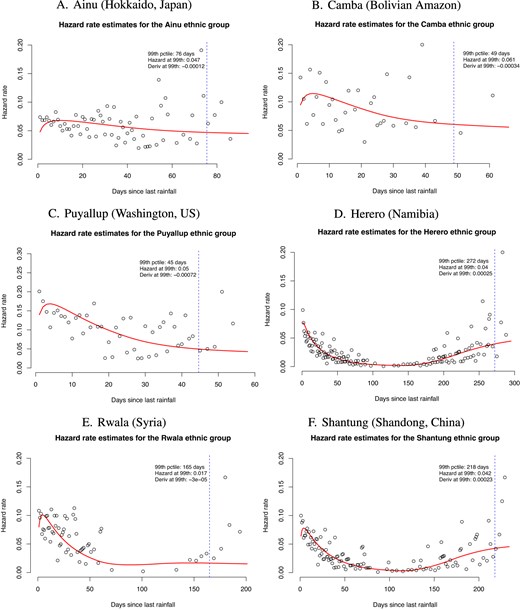
Abstract We study rainmaking as an instrumental religious belief. We present a model in which a religious leader tries to persuade people to believe. Praying for rain can persuade only where the hazard of rainfall during a dry spell is increasing over time, so that prayer is most likely to succeed when people most want rain. We present evidence from prayers for rain in Murcia, Spain, where the hazard rate is increasing, that the church’s prayers for rain predict rainfall over two centuries. To generalize this finding, we gather an original data set of whether ethnic groups around the world traditionally prayed for rain. We find that ethnic groups facing an increasing rainfall hazard are 47% more likely to pray for rain, consistent with our model’s prediction that societies are more likely to pray for rain where prayer is persuasive.
Religion matters for economic growth through various channels
Standard models of economic growth depict physical capital, human capital, population/labour, and total factor productivity as proximate determinants of economic growth. But their deeper determinants are poorly understood. This column argues that religion – as one of the most ubiquitous social phenomena – can spur or impair economic growth by affecting each of these four elements of the macroeconomic production function.

Thoughts on This ????
889 votes, 130 comments. 34K subscribers in the bengaluru_speaks community. Discuss Bangalore Nagara vaarthe, trends, city life, etc. Posts can be in…
First Nation Profiles
First Nations people refers to Status and Non-Status ‘Indian’ peoples in Canada. More than one million people in Canada identify themselves as an Aboriginal person, or 4% of the population (as of 2006). Fifty-three percent are registered Indians, 30% are Métis, 11% are Non-status Indians and 4% are Inuit. Over half (54%) of Aboriginal people live in urban areas.
Louisiana Population - 2023 Stats & Trends | Neilsberg
Explore Louisiana population by race, ethnicity, age, gender and timeline. Find latest trends in Louisiana's population.
Community Networks: Critical Infrastructure For Rural Connectivity In India
As India goes digital-first, millions remain offline. Locally run networks show how connectivity can be built where markets fall short.

Buddha and Mind
In Pānadurē in the British colony of Ceylon in 1871, a Buddhist monk and a Christian missionary debated each other in front of five thousand people over which religion was the more scientific.

Togelius: Losing my religion
In spring 2025 I had a crisis of faith. I thought about what the technology I'm helping to create might do to our future, and got scared. M...