Uncover the stock market projections for 2025. Explore the forecast for the S&P 500. Do the numbers add up?

The Value of Nothing: Capital versus Growth - American Affairs Journal
Throughout 2021, U.S. stock market valuations have hovered near all‑time highs. In June, the unadjusted price-to-earnings (P/E) ratio of the S&P 500 index eclipsed the tech boom record of 2000. Many other asset classes have attained, or nearly attained, record valuations as well. Stratospheric valuations may be partially attributable to the unique circumstances surrounding Covid-19...

ProjectionLab - Modern Financial & Retirement Planning Tools
Simulate your financial future. Modern financial and retirement planning tools to plan for early retirement, financial independence, and more.

My 2026 Open Social Web Predictions - Tim Chambers
Predictions for 2026 include growth forecasts for various social media platforms, advancements in federated technologies, and anticipated shifts in how …
Public LLM exceeds superforecaster on Forecast bench by EOY 2026?
41% chance. Resolves to YES if any LLM released in 2026 exceeds the superforecaster baseline on ForecastBench by July 2027. Resolves to NO if this does not happen, or if after January 1, 2027 we have results from enough LLMs (e.g. the leading models from the major AI labs at the time) to be confident this will not occur. If The Forecasting Research Institute tells us how this market should resolve, then we will go with what they say.

Economic futures for LLM inference
Inference providers will look for other lines of business.
Visualising AI spending: How does it compare with history’s mega projects?
AI spending is projected to reach $2.5 trillion in 2026, surpassing the largest scientific and infrastructure projects.


Assessing ExxonMobil’s global warming projections
Climate projections by the fossil fuel industry have never been assessed. On the basis of company records, we quantitatively evaluated all available global warming projections documented by—and in many cases modeled by—Exxon and ExxonMobil Corp scientists between 1977 and 2003. We find that most of their projections accurately forecast warming that is consistent with subsequent observations. Their projections were also consistent with, and at least as skillful as, those of independent academic and government models. Exxon and ExxonMobil Corp also correctly rejected the prospect of a coming ice age, accurately predicted when human-caused global warming would first be detected, and reasonably estimated the “carbon budget” for holding warming below 2°C. On each of these points, however, the company’s public statements about climate science contradicted its own scientific data. , Insider knowledge For decades, some members of the fossil fuel industry tried to convince the public that a causative link between fossil fuel use and climate warming could not be made because the models used to project warming were too uncertain. Supran et al . show that one of those fossil fuel companies, ExxonMobil, had their own internal models that projected warming trajectories consistent with those forecast by the independent academic and government models. What they understood about climate models thus contradicted what they led the public to believe. —HJS , ExxonMobil’s own climate models showed that fossil fuel use would cause climate warming. , BACKGROUND In 2015, investigative journalists discovered internal company memos indicating that Exxon oil company has known since the late 1970s that its fossil fuel products could lead to global warming with “dramatic environmental effects before the year 2050.” Additional documents then emerged showing that the US oil and gas industry’s largest trade association had likewise known since at least the 1950s, as had the coal industry since at least the 1960s, and electric utilities, Total oil company, and GM and Ford motor companies since at least the 1970s. Scholars and journalists have analyzed the texts contained in these documents, providing qualitative accounts of fossil fuel interests’ knowledge of climate science and its implications. In 2017, for instance, we demonstrated that Exxon’s internal documents, as well as peer-reviewed studies published by Exxon and ExxonMobil Corp scientists, overwhelmingly acknowledged that climate change is real and human-caused. By contrast, the majority of Mobil and ExxonMobil Corp’s public communications promoted doubt on the matter. ADVANCES Many of the uncovered fossil fuel industry documents include explicit projections of the amount of warming expected to occur over time in response to rising atmospheric greenhouse gas concentrations. Yet, these numerical and graphical data have received little attention. Indeed, no one has systematically reviewed climate modeling projections by any fossil fuel interest. What exactly did oil and gas companies know, and how accurate did their knowledge prove to be? Here, we address these questions by reporting and analyzing all known global warming projections documented by—and in many cases modeled by—Exxon and ExxonMobil Corp scientists between 1977 and 2003. Our results show that in private and academic circles since the late 1970s and early 1980s, ExxonMobil predicted global warming correctly and skillfully. Using established statistical techniques, we find that 63 to 83% of the climate projections reported by ExxonMobil scientists were accurate in predicting subsequent global warming. ExxonMobil’s average projected warming was 0.20° ± 0.04°C per decade, which is, within uncertainty, the same as that of independent academic and government projections published between 1970 and 2007. The average “skill score” and level of uncertainty of ExxonMobil’s climate models (67 to 75% and ±21%, respectively) were also similar to those of the independent models. Moreover, we show that ExxonMobil scientists correctly dismissed the possibility of a coming ice age in favor of a “carbon dioxide induced ‘super-interglacial’”; accurately predicted that human-caused global warming would first be detectable in the year 2000 ± 5; and reasonably estimated how much CO 2 would lead to dangerous warming. OUTLOOK Today, dozens of cities, counties, and states are suing oil and gas companies for their “longstanding internal scientific knowledge of the causes and consequences of climate change and public deception campaigns.” The European Parliament and the US Congress have held hearings, US President Joe Biden has committed to holding fossil fuel companies accountable, and a grassroots social movement has arisen under the moniker #ExxonKnew. Our findings demonstrate that ExxonMobil didn’t just know “something” about global warming decades ago—they knew as much as academic and government scientists knew. But whereas those scientists worked to communicate what they knew, ExxonMobil worked to deny it—including overemphasizing uncertainties, denigrating climate models, mythologizing global cooling, feigning ignorance about the discernibility of human-caused warming, and staying silent about the possibility of stranded fossil fuel assets in a carbon-constrained world. Historically observed temperature change (red) and atmospheric carbon dioxide concentration (blue) over time, compared against global warming projections reported by ExxonMobil scientists. ( A ) “Proprietary” 1982 Exxon-modeled projections. ( B ) Summary of projections in seven internal company memos and five peer-reviewed publications between 1977 and 2003 (gray lines). ( C ) A 1977 internally reported graph of the global warming “effect of CO 2 on an interglacial scale.” (A) and (B) display averaged historical temperature observations, whereas the historical temperature record in (C) is a smoothed Earth system model simulation of the last 150,000 years.

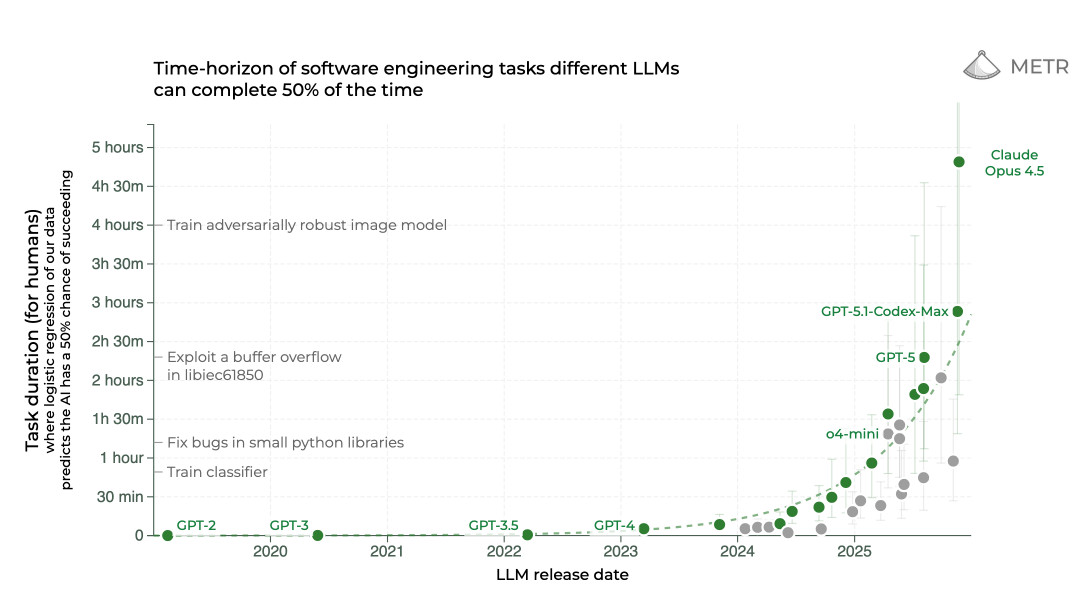
How Accurate Have AI Progress Forecasts Been So Far? – Forecasting Research Institute
We take an initial look at where median forecasts are (mostly) underestimating and (sometimes) overestimating AI progress, adoption, and impact.

The Dividend Disconnect
ABSTRACT Many individual investors, mutual funds, and institutions trade as if dividends and capital gains are disconnected attributes, not fully appreciating that dividends result in price decreases. Behavioral trading patterns (e.g., the disposition effect) are driven by price changes instead of total returns. Investors rarely reinvest dividends, and trade as if dividends are a separate, stable income stream. Analysts fail to account for the effect of dividends on price, leading to optimistic price forecasts for dividend‐paying stocks. Demand for dividends is systematically higher in periods of low interest rates and poor market performance, leading to lower returns for dividend‐paying stocks.

Opinion | We’re Measuring the Economy All Wrong (Published 2018)
The official statistics say that the financial crisis is behind us. It's not.

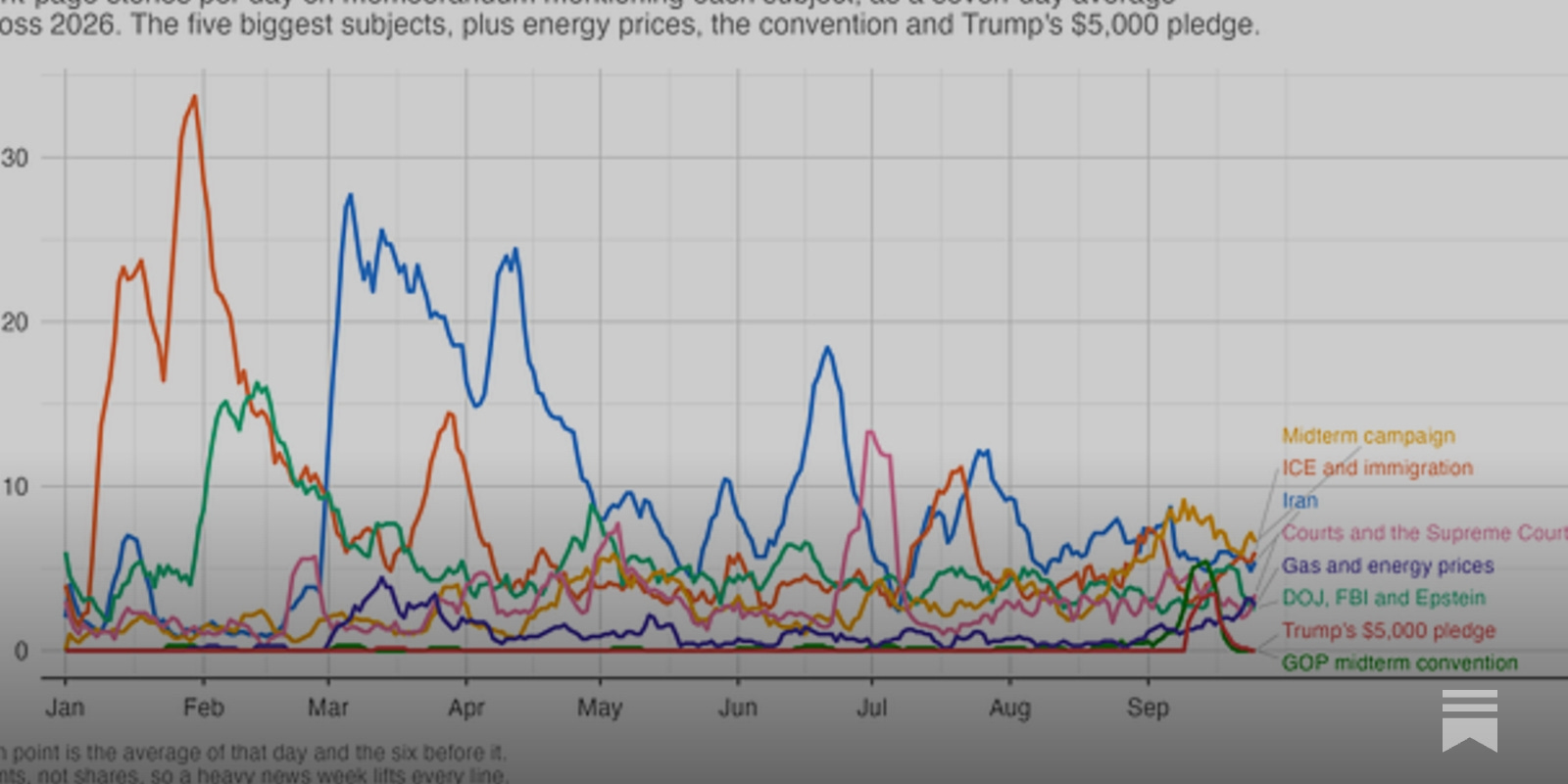
Iran, prices, ICE, and Epstein are the biggest stories of 2026
In a new database of news headlines stretching back to 2016, I show Trump's midterm convention failed to change news agendas
2025: The year in LLMs
This is the third in my annual series reviewing everything that happened in the LLM space over the past 12 months. For previous years see Stuff we figured out about …