The automation of blue-collar and office jobs using digital technologies has been an important driver of the rise in inequality since the 1980s. A new CEPR Policy Insight argues that a ‘human-complementary’ path for artificial intelligence could contribute more to productivity growth and help reduce economic inequality. The authors suggest five potential elements for policy attention to help move the US, Europe, and other economies onto this human-complementary path.
AI Adoption and Inequality
There are competing narratives about artificial intelligence’s impact on inequality. Some argue AI will exacerbate economic disparities, while others suggest it could reduce inequality by primarily disrupting high-income jobs. Using household microdata and a calibrated task-based model, we show these narratives reflect different channels through which AI affects the economy. Unlike previous waves of automation that increased both wage and wealth inequality, AI could reduce wage inequality through the displacement of high-income workers. However, two factors may counter this effect: these workers’ tasks appear highly complementary with AI, potentially increasing their productivity, and they are better positioned to benefit from higher capital returns. When firms can choose how much AI to adopt, the wealth inequality effect is particularly pronounced, as the potential cost savings from automating high-wage tasks drive significantly higher adoption rates. Models that ignore this adoption decision risk understating the trade-off policymakers face between inequality and efficiency.
Bridging the gap: inequalities that divide those who can and cannot create sustainable outcomes with AI
The widespread use of AI technologies impacts individuals, organisations, and societies in ways that warrant more comprehensive investigation. Inequalities in benefiting from AI advancements may le...

Are new technologies fuelling wage inequality? Evidence from Spain
New research shows the net effect of technological change (incl. artificial intelligence) on wages in Spain has been to fuel rising wage inequalities

A Growing Gender Divide in the AI Economy — The Honest Economist
The article argues that AI is reshaping gender inequality even before the pay gap visibly widens. Women are more concentrated in clerical and administrative roles where AI can restructure work, while men are more concentrated in technical, AI-complementary roles. Among college graduates, the exposur

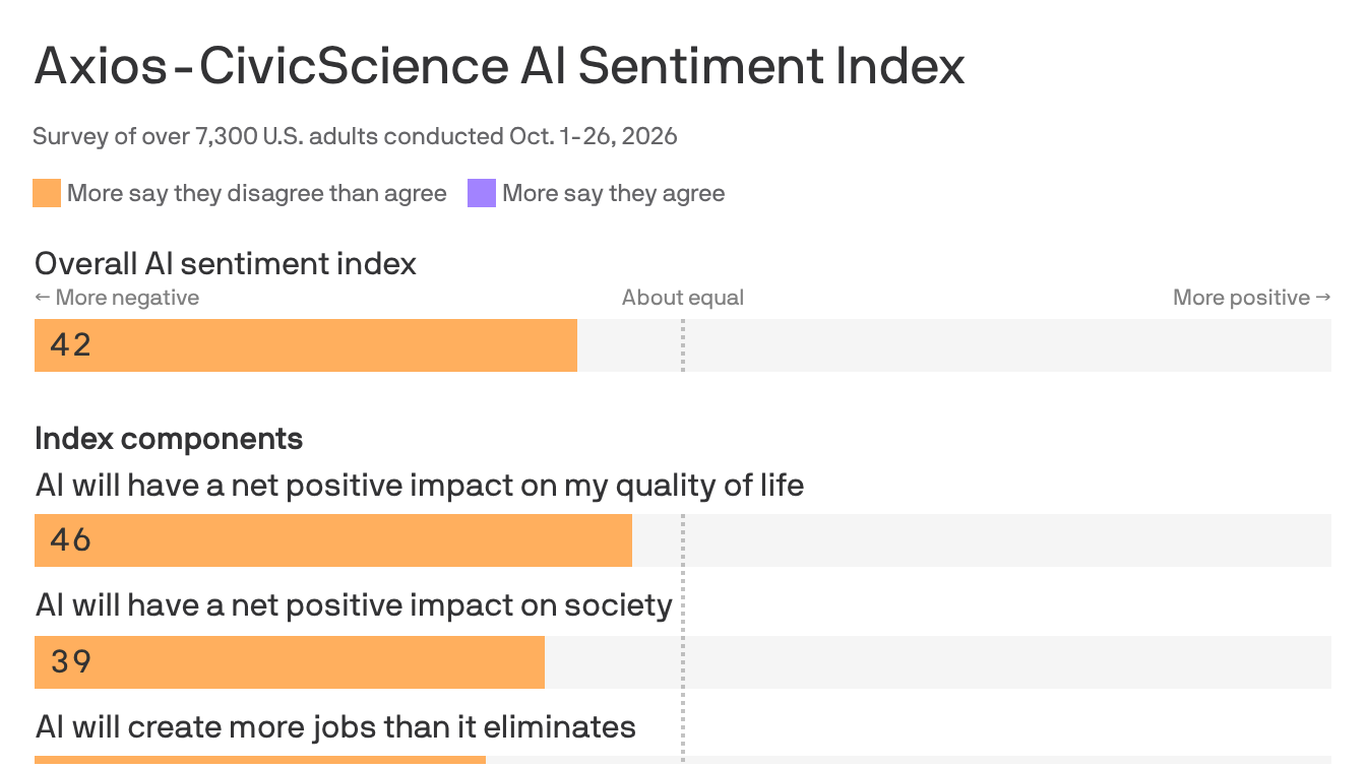
Exclusive: Americans expect a jobless AI boom
There's a huge gap in sentiment when it comes to the benefits of AI.
Will AI Destroy the Economy? (According to Economists: No.) | AI Reality Check | Cal Newport
AI's economic peril to democracy | Brookings
Bell and Korinek argue that increasing use of AI in industry will create a dangerous cycle of rising inequality and weakened democratic norms.

Technological Disruption in the US Labor Market • The Aspen Institute Economic Strategy Group
DAVID DEMING, CHRISTOPHER ONG, LAWRENCE H. SUMMERS This paper explores past episodes of technological disruption in the US labor market, with the goal of learning lessons about the likely future impact of artificial intelligence (AI). The authors measure changes in the structure of the US labor market going back over a century in two ways. ...

“How to Think About AI”: Cory Doctorow on Big Tech, Understanding AI, Labor Automation & More
Democracy Now! speaks with science fiction author, activist and journalist Cory Doctorow about AI and his latest book, The Reverse Centaur’s Guide to Life After AI: How to Think About Artificial Intelligence — Before It’s Too Late. Doctorow comments on AI’s “bad unit economics” and the connection between automation and labor. “When labor drives automation, it’s usually in service to making the product better, and when capital drives automation, it’s usually in service to making more of the product,” says Doctorow.

Globally, More People Expect AI to Cause Job Loss Than Growth
Amid a mix of concern and excitement about AI, a 37-country survey finds pessimism about its potential impact on jobs and economic inequality.
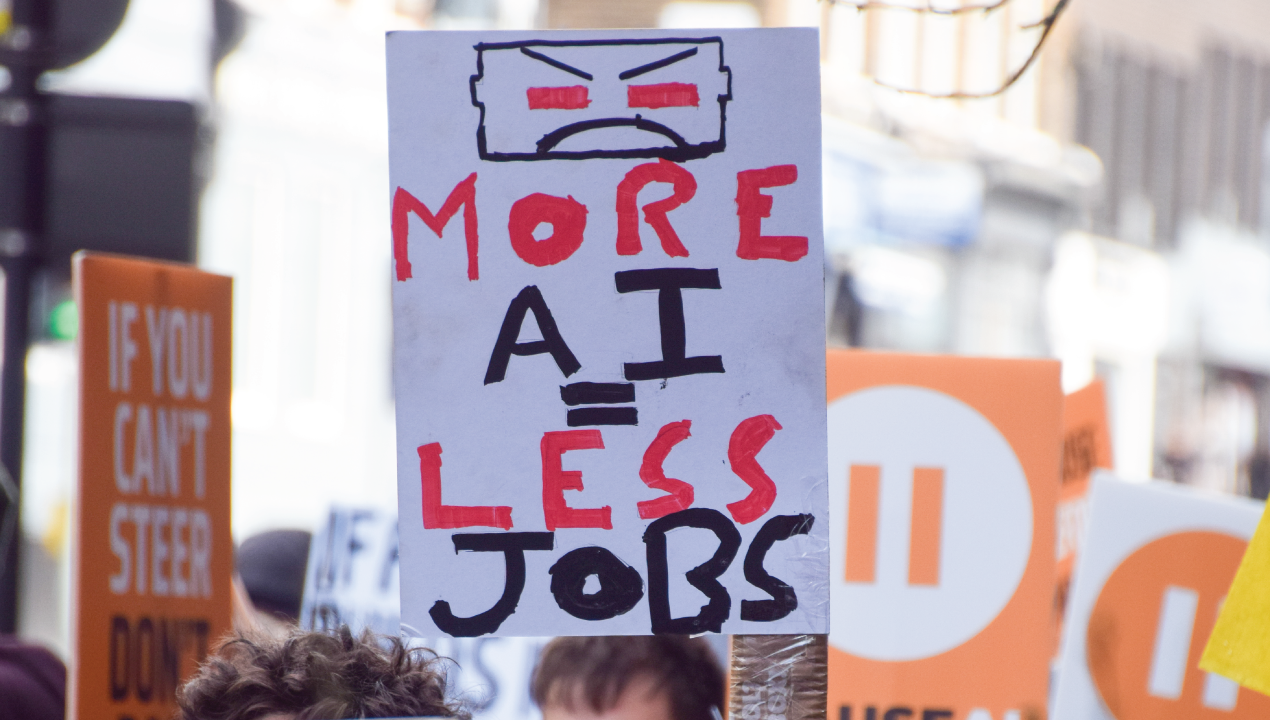
"AI" is Automated Inequality
Tech bros still dominate the discussions about so-called "AI" with false claims. Even most "AI"-critical researchers spend much of their time meticulously debunking (always only a subset of) claims, leaving vast areas of the economic consequences of "AI" unexplored. (Even the "AI"-evangelist Economi

In the image of their tools
In the United States, spending on AI infrastructure now dwarfs investment in the Internet and railroads combined, but spending on the institutions that would let societies absorb that technology is, by comparison, negligible. This asymmetry creates a paradox. Models post striking benchmark scores while aggregate economic output barely moves: Economist Daron Acemoglu projects a total factor productivity gain of well under one percent over a decade, and firm-level studies find that task-level gains do not necessarily add up at the firm or economy level. This paradox follows from an institutional mismatch that can be addressed by reverse alignment, the deliberate redesign of institutions, norms, and skills, rather than of models, so that societies can absorb new forms of machine cognition.

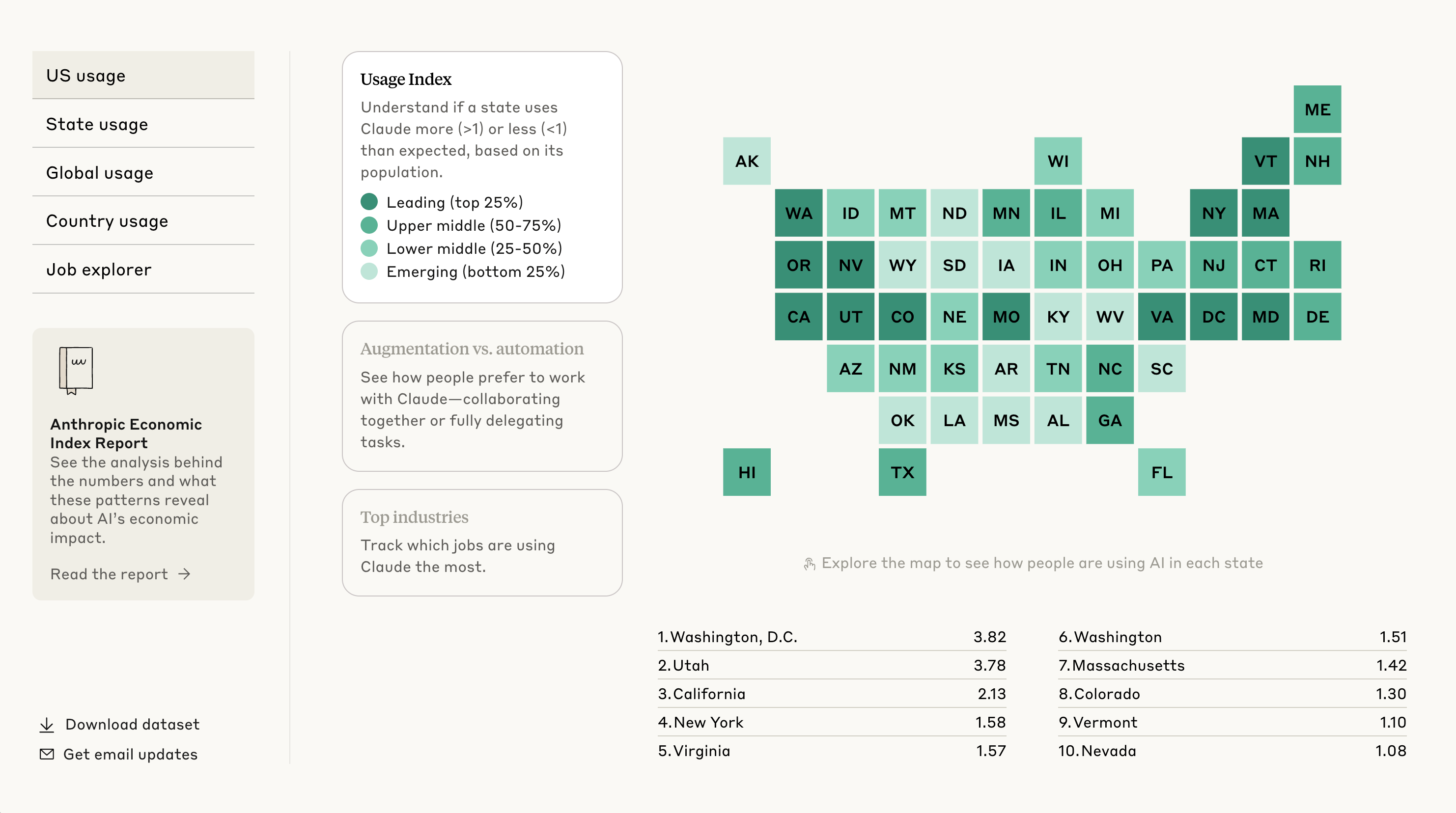
The Anthropic Economic Index
The Anthropic Economic Index reveals the shape of AI adoption across the world. Here, you can explore the data behind our research to understand how people are using Claude across every US state and hundreds of occupations. Track the topics that are trending where you live, and see how people are using AI to augment or automate their work—that is, whether they prefer to collaborate with, or delegate to, Claude.
Building Pro-Worker Artificial Intelligence
This paper defines pro-worker technologies, including Artificial Intelligence, as technologies that make human skills and expertise more valuable by expanding worker capabilities. Our conceptual framework distinguishes among five categories of technological change: labor-augmenting, capital-augmenting, automating, expertise-leveling, and new task-creating. Only the last category is unambiguously pro-worker, generating demand for novel human expertise rather than commodifying it. We illustrate these distinctions through hypothetical and real-world examples spanning aviation maintenance, electrical services, custodial work, education, patent examination, and gig delivery. While AI’s capacity to automate work is substantial, we argue that its potential to serve as a collaborator, by extending human judgment, enabling new tasks, and accelerating skill acquisition, is equally transformative and currently underexploited. We identify market failures, including misaligned firm and developer incentives, path dependence, and a pervasive pro-automation ideology, that may lead to underinvestment in pro-worker AI. We consider nine policy directions that would change incentives, including targeted investments in health care and education, tax code reform, antitrust enforcement, and intellectual property protections for worker expertise.

The real AI economy is being built by ordinary people
Far from Silicon Valley pitch decks, workers across Asia and Africa are bypassing tech industry hype to quietly rewire their daily jobs — one prompt, workflow, and local problem at a time.

Import AI 452: Scaling laws for cyberwar; rising tides of AI automation; and a puzzle over gDP forecasting
How much could AI revolutionize the economy?