


Standard models of economic growth depict physical capital, human capital, population/labour, and total factor productivity as proximate determinants of economic growth. But their deeper determinants are poorly understood. This column argues that religion – as one of the most ubiquitous social phenomena – can spur or impair economic growth by affecting each of these four elements of the macroeconomic production function.
Why Religion, Not Income, Predicts the American Vote
Inside the data that shows socioeconomic status barely matters once you know someone’s religious tradition.

Brett Scott (@brettscott)
A lot of economists want to claim that economic growth is, at some deep level, driven by human greed. In this worldview, we always desire more and more, and so collectively seek to endlessly boost production I don’t buy this worldview at all I think economic growth is driven - at a deep level - by fear. It stems from the extreme insecurity of life in a capitalist market system, where you’re always on the verge of being cut out of society, and so need to over-secure your position through any means possible One of the most compelling pieces of evidence for this is the history of colonial beliefs around laziness. In many colonial regions, colonizers would complain about tribal people being lazy - in other words, not seeking to increase production when they could. The reason for this, however, was that such people had access to subsistence farming and secure social structures that did not require endless competition. Secure people are, by definition, ‘lazier’, in the sense that they do not perceive a visceral need to fight for survival The colonial mission then, was the cut them off from older means of survival, make them dependent on insecure market structures, and thereby boost production as they all turn up at the mines to elbow each other out of the way as they compete for jobs. Security, in other words, is the enemy of economic growth

Praying for Rain
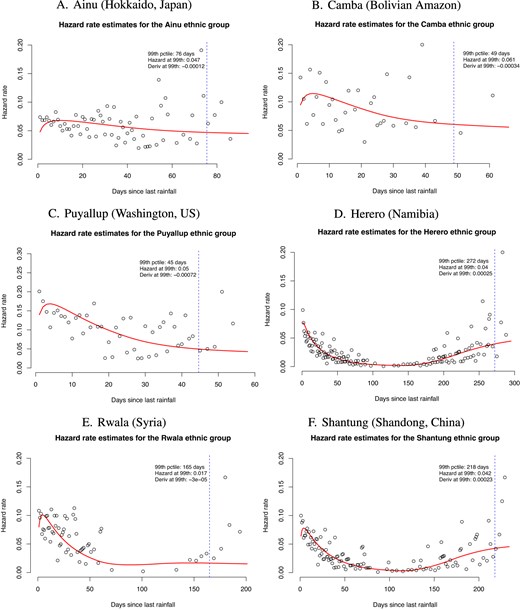
Abstract We study rainmaking as an instrumental religious belief. We present a model in which a religious leader tries to persuade people to believe. Praying for rain can persuade only where the hazard of rainfall during a dry spell is increasing over time, so that prayer is most likely to succeed when people most want rain. We present evidence from prayers for rain in Murcia, Spain, where the hazard rate is increasing, that the church’s prayers for rain predict rainfall over two centuries. To generalize this finding, we gather an original data set of whether ethnic groups around the world traditionally prayed for rain. We find that ethnic groups facing an increasing rainfall hazard are 47% more likely to pray for rain, consistent with our model’s prediction that societies are more likely to pray for rain where prayer is persuasive.
Post-growth
Post-growth is an umbrella term that refers to a broad family of economic, ecological, and political perspectives responding to the limits-to-growth dilemma —the recognition that infinite economic growth is biophysically unsustainable on a finite planet. Central to post-growth thinking is the shift of the focus out of GDP growth as the main goal of the economy. Instead, well-being becomes the main objective. Post-growth puts emphasis on decoupling societal well-being from economic growth, advocating for the possibility of prosperity beyond growth.

(Working Paper) Good Faith Design: Religion as a Resource for Technologists
Previous work has found a lack of research in HCI on religion, partly driven by misunderstandings of values and practices between religious and technical communities. To bridge this divide in an empirically rigorous way, we conducted an interview study with 48 religious people and/or experts from 11 faiths, and we document how religious people experience, understand, and imagine technologies. We show that religious stakeholders find non-neutral secular embeddings in technologies and the firms and people that design them, and how these manifest in unintended harms for religious and nonreligious users. Our findings reveal how users navigate technoreligious practices with religiously informed mental models and what they desire from technologies. Informed by this, we distill six design values -- wonder, humility, space, embodiedness, community, and eternity -- to guide technologists in considering and leveraging religion as an additional, valid sociocultural resource when designing for a holistic user. We further spell out directions for future research.

The Fallacy of Endless Economic Growth
What economists around the world get wrong about the future.

Can Religions Be Reborn? | Over The Mountains to Civilizational Renewal #9
The King of Kings
Evolutionary Morality, the Judgment of Law, and the Necessity of God

Denizen
What are some of the fundamental flaws of capitalism? How might we instantiate a market-based economy that is growth agnostic?
Opinion: What the case of Jeffrey Epstein tells us about America's sickening worship of billionaire gods
The religion of money goes back centuries in America. Our country has always believed that you can do anything with human lives so long as you have enough cash to throw around

Post-growth: the science of wellbeing within planetary boundaries
There are increasing concerns that continued economic growth in high-income countries might not be environmentally sustainable, socially beneficial, or economically achievable. In this Review, we explore the rapidly advancing field of post-growth research, which has evolved in response to these concerns. The central idea of post-growth is to replace the goal of increasing GDP with the goal of improving human wellbeing within planetary boundaries. Key advances discussed in this Review include: the development of ecological macroeconomic models that test policies for managing without growth; understanding and reducing the growth dependencies that tie social welfare to increasing GDP in the current economy; and characterising the policies and provisioning systems that would allow resource use to be reduced while improving human wellbeing.

Uneconomic growth
Uneconomic growth is economic growth that reflects or creates a decline in the quality of life. The concept is used in human development theory, welfare theory, and ecological economics. It is usually attributed to ecological economist Herman Daly, though other theorists may also be credited for the incipient idea, According to Daly, "uneconomic growth occurs when increases in production come at an expense in resources and well-being that is worth more than the items made." The cost, or decline in well-being, associated with extended economic growth is argued to arise as a result of "the social and environmental sacrifices made necessary by that growing encroachment on the eco-system."
Ideology and Ideological State Apparatuses by Louis Althusser 1969-70
I must now expose more fully something which was briefly glimpsed in my analysis when I spoke of the necessity to renew the means of production if production is to be possible. That was a passing hint. Now I shall consider it for itself.
The EAC-PM's Paper on 'Muslim Population' Is a Travesty of Research Practices
Fertility rates of the poorest sections of the population of any state are impacted by the quality of educational and health services, and gender differences in regard to health and educational outcome indicators, not religion.

What Policymakers and the Public Need to Know About the Cult of AI
Nathalie Maréchal asks, why are we betting the economy and the future of democracy on cult-like beliefs?
CFP: Religion, Politics, and Cognitive Warfare | The Journal for Cultural and Religious Theory | JCRT
This call for papers invites work on religion, politics, and cognitive warfare, exploring how belief, media, conspiracy, identity, and power shape struggles over reality, interpretation, and life in an age of disinformat
