


Recent fiscal projections for the US forecast a rising debt-GDP ratio which exceeds the peak at the end of World War II. This column shows that over the last 20 years, there is no longer evidence of a stabilising fiscal feedback, where higher projected deficits lead to more deficit reduction. It argues that the current fiscal trajectory is unstable, and adverse fiscal shocks would only worsen the prospects. However, if a gradual fiscal feedback were to be re-established, then the trajectory would be stable. This feedback would imply deficit reductions in the range of 0.5% to 1.1% of GDP over the next decade.
Fiscal stagnation
Public debt-to-GDP ratios have climbed to historic highs in most advanced economies. This column studies the connection between productivity growth, fiscal policy, and public debt. Using a theoretical model, it argues that a feedback loop is possible between fiscal policy and growth. Large primary surpluses are associated with fiscal distortions which depress investment and productivity growth, and lead to further pressure on public debt-to-GDP ratios. A fall into fiscal stagnation can result from hysteresis effects or pessimistic animal spirits. Meanwhile, exiting fiscal stagnation requires large policy interventions that reduce the public debt-to-GDP ratio, such as credible pro-growth strategies.

Opinion | We’re Measuring the Economy All Wrong (Published 2018)
The official statistics say that the financial crisis is behind us. It's not.

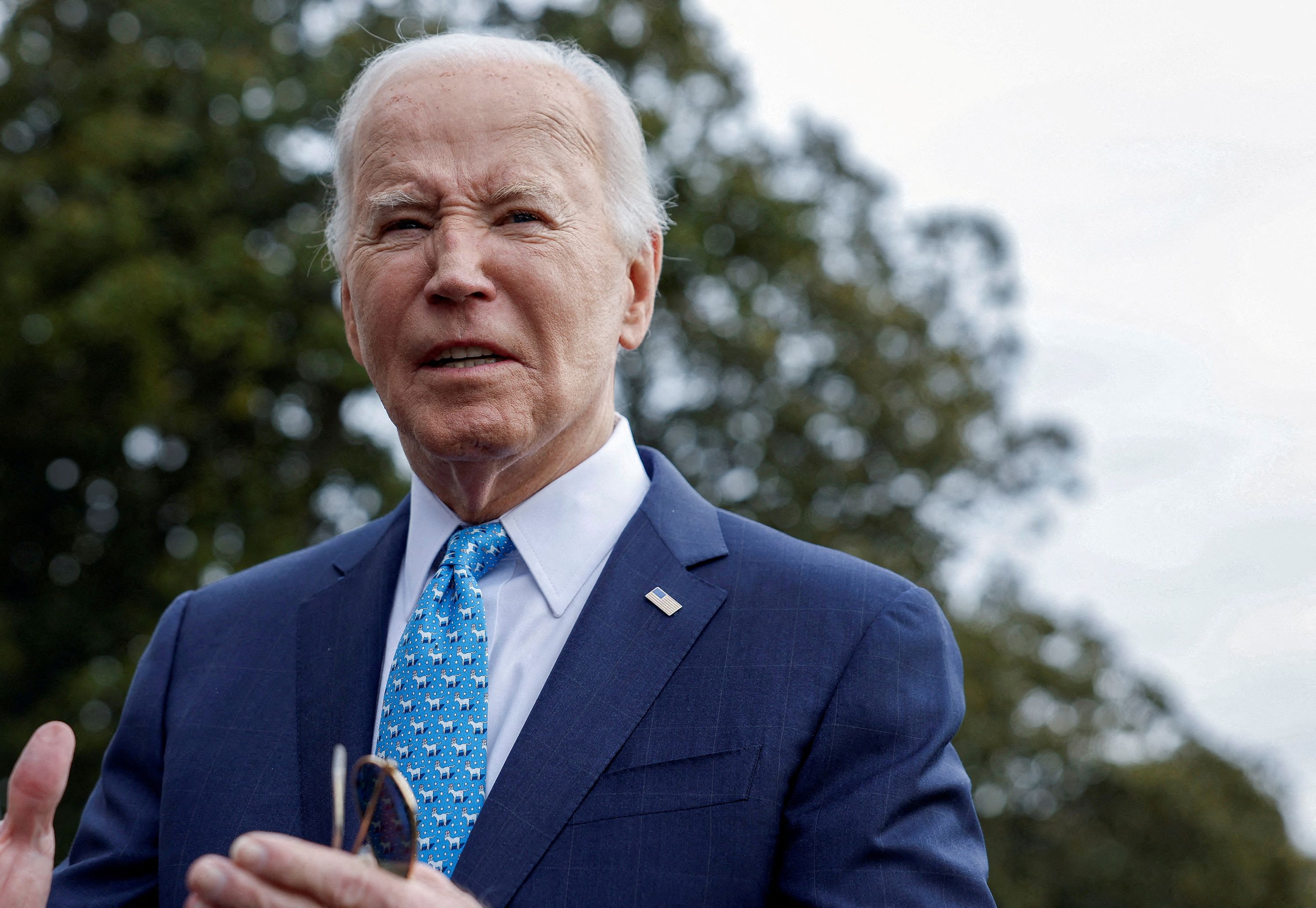
The US economy is doing well. President Biden wants to know why so many Americans are still feeling bad | CNN Politics
By many metrics, the US economy is humming along. The jobs market is robust; consumers are spending again; and inflation has eased to a three-year low.
annotations: La faiblesse des taux d’intérêt nous oblige à reconsidérer la politique budgétaire
Traduction française du billet de blog "Why low interest rates force us to revisit the scope and role of fiscal policy: 45 takeaways" d'Olivier Blanch
Consumption and Debt Response to Unanticipated Income Shocks: Evidence from a Natural Experiment in Singapore
This paper uses a unique panel dataset of consumer financial transactions to study how consumers respond to an exogenous unanticipated income shock. Consumption rose significantly after the fiscal policy announcement: during the ten subsequent months, for each $1 received, consumers on average spent $0.80. We find a strong announcement effect—19 percent of the response occurs during the first two-month announcement period via credit cards. Subsequently, consumers switched to debit cards after disbursement before finally increasing spending on credit cards in the later months. Consumers with low liquid assets or with low credit card limit experienced stronger consumption responses. (JEL D12, D14, E21)
Lower-income country debt payments hit highest level in 30 years - Debt Justice
Lower-income country debt payments have trebled in the last decade, according to figures calculated by Debt Justice based on IMF and World Bank data

Looking for a “fair” international monetary system
President Trump’s Chief Economic Adviser, Stephen Miran, has claimed that the international monetary system in which the US provides the rest of the world with a safe, liquid asset is “unfair” as it supposedly prevents the US from eliminating its current account deficit. His proposed solution is to lower the value of the dollar through coordinated currency market intervention by foreign central banks. This column finds the idea that there could be lasting reversal of exchange rates following an international currency agreement highly speculative, and argues that a multipolar system would attenuate the Triffin dilemma and provide the US with a deficit-adjustment tool.

Harnessing naturally occurring data to measure the response of spending to income
Balancing your incomings and outgoings Economic theory predicts that when someone receives money should have little effect on their spending patterns. Gelman et al. constructed a data set of 60 million transactions made by 75,000 people to test this theory. People do seem to go on a mini–spending spree after they get their paychecks or pensions. However, closer inspection reveals that that's mostly explained by the convenience of linking regular payments, such as rent and utilities, to regular income. Unsurprisingly, cash-strapped people are more likely to increase their spending in response to receiving income. Science , this issue p. 212 , How do theoretical predictions of individual fiscal behaviors match up against real-world, real-time data? , This paper presents a new data infrastructure for measuring economic activity. The infrastructure records transactions and account balances, yielding measurements with scope and accuracy that have little precedent in economics. The data are drawn from a diverse population that overrepresents males and younger adults but contains large numbers of underrepresented groups. The data infrastructure permits evaluation of a benchmark theory in economics that predicts that individuals should use a combination of cash management, saving, and borrowing to make the timing of income irrelevant for the timing of spending. As in previous studies and in contrast to the predictions of the theory, there is a response of spending to the arrival of anticipated income. The data also show, however, that this apparent excess sensitivity of spending results largely from the coincident timing of regular income and regular spending. The remaining excess sensitivity is concentrated among individuals with less liquidity.
Le dollar n’est pas responsable du déficit courant américain
Traduction française du billet "Don't blame America's current account deficit on the dollar" de Maurice Obstfeld

Gauging the Strength of China’s Economy in Uncertain Times
An update on China’s recent economic performance and policy changes, focusing on aggregate credit as a measure to gauge policy stimulus.

Germany’s fiscal stimulus plan shows Europe is learning the wrong lesson from Ukraine | Brookings
Robin Brooks considers the feasibility and impact of Germany's planned spending on the military and infrastructure.

Analytique des déficits commerciaux et de l'emploi manufacturier
traduction française du billet de blog "Analytics of trade deficits and manufacturing employment" de Paul Krugman

Credit Crises, Precautionary Savings, and the Liquidity Trap*
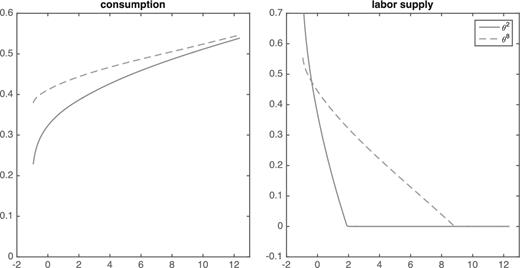
Abstract We study the effects of a credit crunch on consumer spending in a heterogeneous-agent incomplete-market model. After an unexpected permanent tightening in consumers’ borrowing capacity, constrained consumers are forced to repay their debt, and unconstrained consumers increase their precautionary savings. This depresses interest rates, especially in the short run, and generates an output drop, even with flexible prices. The output drop is larger with sticky prices, if the zero lower bound prevents the interest rate from adjusting downward. Adding durable goods to the model, households take larger debt positions and the output response can be larger.
annotations: La BCE doit financer les déficits publics du COVID-19
Traduction française de Paul De Grauwe (2020), « The ECB must finance COVID-19 deficits »
Does Monetary Policy Tightening Reduce Inflation?
Recent research has identified periods when the Federal Reserve intentionally acted to slow inflation when it exceeded desired levels. The success of these disinflation attempts reveals the extent of policymakers’ commitment to lowering inflation. An extension of this analysis indicates that successful disinflations are associated with a decline in the demand-driven component of inflation. This was especially evident during recent monetary policy tightening, with contributions to core inflation from demand declining 2 percentage points since the summer of 2022—the largest decline for any deliberate disinflation attempt since 1969.

Le dollar et le déficit commercial américain
traduction française du billet de blog "The dollar and the trade deficit" de Paul Krugman
