

A joint Request for Proposals from the Effective Institutions Project and the Collective Intelligence Project on AI, civil liberties, and the distribution of power.
A Roadmap to Democratic AI — The Collective Intelligence Project
Our roadmap outlines concrete steps that can be taken in 2024 to build a more democratic AI ecosystem that is adaptive, accountable, processes decentralized information, provides public goods, and safeguards human wellbeing. We describe what the ecosystem could build, research, advocate for, and fun

Open Call for Proposals - Humanity AI
Open Call for Proposals: Communities Leading on AI $10M Investment in U.S.-Based Community-Led AI Initiatives Humanity AI, an initiative spearheaded […]

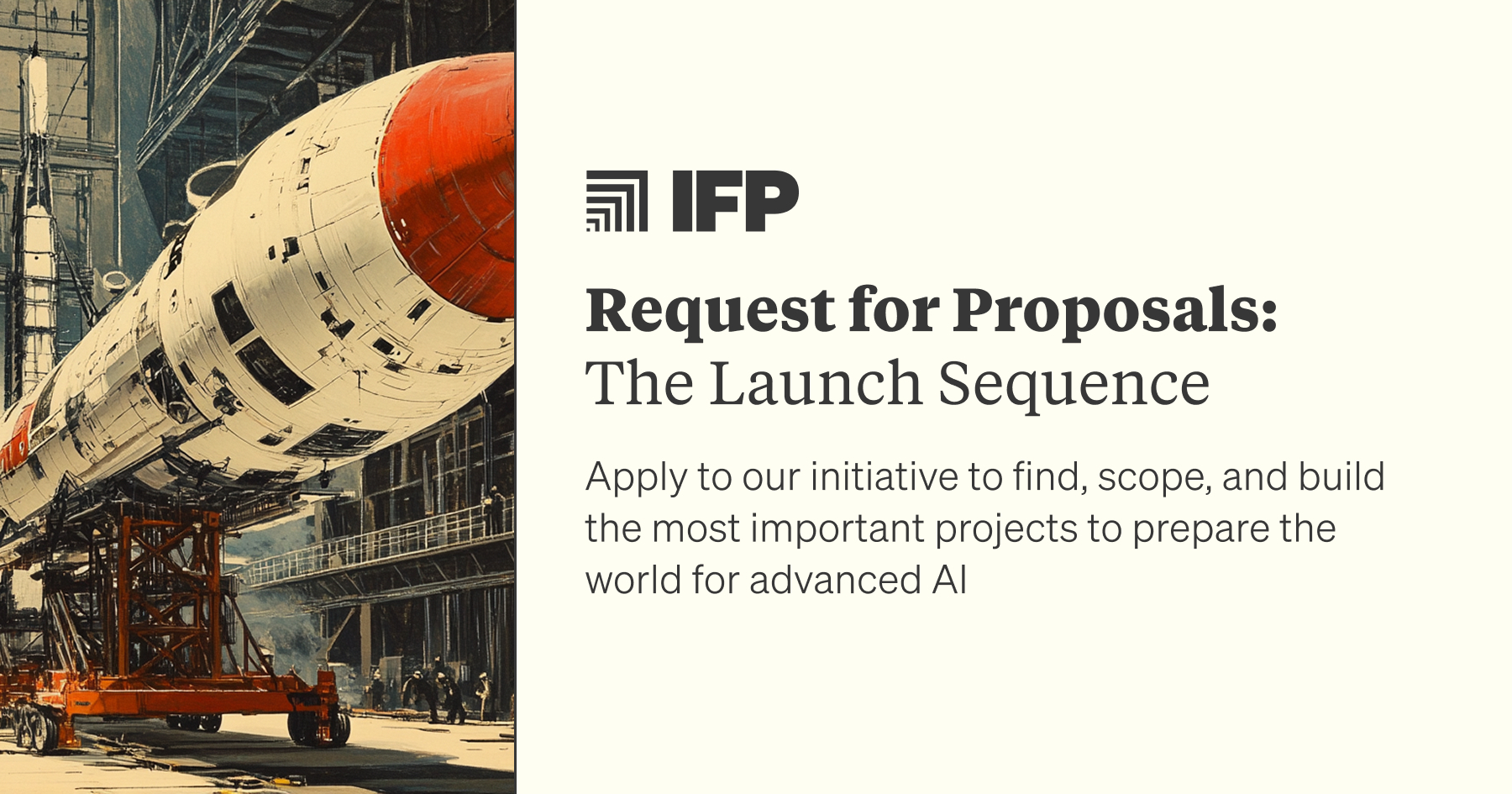
Request for Proposals: The Launch Sequence | IFP
Apply to our rolling effort to find, scope, and build the most important projects to prepare the world for advanced AI
Building a Solidarity Ecosystem for AI (SSIR)
How cooperatives, public institutions, and social movements can come together to intentionally build a practical, community-owned alternative to extractive AI systems. <meta property=

3: Consulting the Record: AI Consistently Fails the Public - AI Now Institute
Amid the excitement over AI’s (speculative, hypothetical) potential, we have lost sight of the sobering reality of its present and recent past. AI is already intermediating critical social infrastructures, materially reshaping our institutions in ways that ratchet up inequality and concentrate power in the hands of the already powerful. It is consistently deployed in ways […]

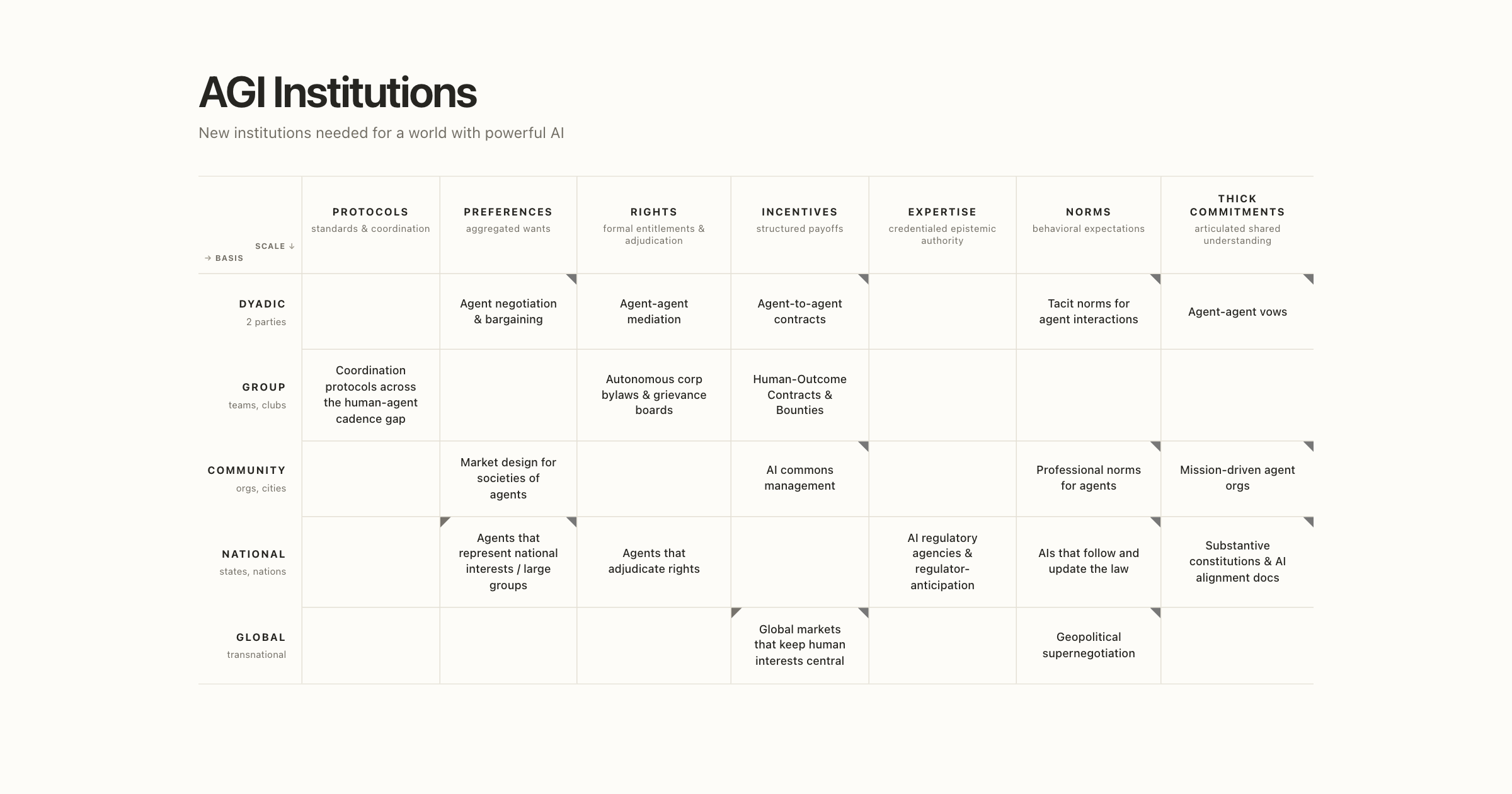
Existing Human Institutions — AGI Institutions Wiki
How existing human institutions handle coordination across scales — and how autonomous AI agents break them. Maps protocols, preferences, rights, incentives, expertise, norms, and thick commitments from dyadic to global.
From chatbots to assistants: governance is key for AI agents
AI's shift into agentic technology ushers in a new set of governance and security challenges that will mean defining to what extent they should be autonomous

Human-Computer Insurrection: Notes on an Anarchist HCI
The HCI community has worked to expand and improve our consideration of the societal implications of our work and our corresponding responsibilities. Despite this increased engagement, HCI continues to lack an explicitly articulated politic, which we argue re-inscribes and amplifies systemic oppression. In this paper, we set out an explicit political vision of an HCI grounded in emancipatory autonomy - an anarchist HCI, aimed at dismantling all oppressive systems by mandating suspicion of and a reckoning with imbalanced distributions of power. We outline some of the principles and accountability mechanisms that constitute an anarchist HCI. We offer a potential framework for radically reorienting the field towards creating prefigurative counterpower - systems and spaces that exemplify the world we wish to see, as we go about building the revolution in increment.

Human-Computer Insurrection: Notes on an Anarchist HCI
The HCI community has worked to expand and improve our consideration of the societal implications of our work and our corresponding responsibilities. Despite this increased engagement, HCI continues to lack an explicitly articulated politic, which we argue re-inscribes and amplifies systemic oppression. In this paper, we set out an explicit political vision of an HCI grounded in emancipatory autonomy - an anarchist HCI, aimed at dismantling all oppressive systems by mandating suspicion of and a reckoning with imbalanced distributions of power. We outline some of the principles and accountability mechanisms that constitute an anarchist HCI. We offer a potential framework for radically reorienting the field towards creating prefigurative counterpower - systems and spaces that exemplify the world we wish to see, as we go about building the revolution in increment.
AI leaders sign a statement asking the government to do something about automated AI
More than 1,100 employees have signed the letter.

Field Theory: AI as Social Science Question, Object & Tool
Uses of advanced artificial intelligence are changing how societies organize labor, govern, produce knowledge, and make meaning. In light of these developments, this essay argues that AI models, tools, and systems pose three interrelated imperatives for social science: they demand renewed attention to social theories of how technology, human experience, and social order are entangled; they require study as objects of inquiry in their own right; and they offer capabilities that may transform—or upend—the practice of social investigation itself. From Weber’s analysis of rationalization to Du Bois’s study of technology and inequality to contemporary scholarship on algorithmic governance, the essay examines what social science distinctively offers: the capacity to historicize the apparently unprecedented, to trace connections across scales, and to center those most affected by technological change. It identifies how algorithmic systems are remaking the distribution of opportunity and risk as a central task of social inquiry and asks what futures social science might help bring into being.
Our Approach to Artificial Intelligence
We are experimenting with using AI tools to extend our work as a small nonprofit, so that we can focus our time on reinforcing human connections, conversations, and communities that have eroded.

How public involvement can improve the science of AI
As AI systems from decision-making algorithms to generative AI are deployed more widely, computer scientists and social scientists alike are being called on to provide trustworthy quantitative evaluations of AI safety and reliability. These calls have included demands from affected parties to be given a seat at the table of AI evaluation. What, if anything, can public involvement add to the science of AI? In this perspective, we summarize the sociotechnical challenge of evaluating AI systems, which often adapt to multiple layers of social context that shape their outcomes. We then offer guidance for improving the science of AI by engaging lived-experience experts in the design, data collection, and interpretation of scientific evaluations. This article reviews common models of public engagement in AI research alongside common concerns about participatory methods, including questions about generalizable knowledge, subjectivity, reliability, and practical logistics. To address these questions, we summarize the literature on participatory science, discuss case studies from AI in healthcare, and share our own experience evaluating AI in areas from policing systems to social media algorithms. Overall, we describe five parts of any quantitative evaluation where public participation can improve the science of AI: equipoise, explanation, measurement, inference, and interpretation. We conclude with reflections on the role that participatory science can play in trustworthy AI by supporting trustworthy science.

AI and the future of digital public squares
Two substantial technological advances have reshaped the public square in recent decades: first, the advent of the internet and second, the recent introduction of large language models (LLMs). LLMs offer opportunities to reimagine and redesign more decentralized, participatory online spaces that can be used to facilitate deliberative dialogues at scale, but LLMs without proper governance can also exacerbate societal schisms. Here, we explore four applications of LLMs to improve digital public squares: collective dialogue systems, bridging systems, community moderation, and proof-of-humanity systems. Building on the input from over 70 civil society experts and technologists, we argue that LLMs both afford promising opportunities to shift the paradigm for conversations at scale and pose distinct risks for digital public squares. Given that people are shaped through their interactions in public squares, there is an important opportunity to build individual capacities and collective cohesion by transforming these digital public spaces. We lay out an agenda for future research and investments in AI that will strengthen digital public squares and safeguard against potential misuses of AI.

The Collective Intelligence Project
We’ve launched an open, collaborative platform to build evaluations that test what matters to you. We empower a global community to create qualitative benchmarks for any domain—from medical chatbots to legal assistance. Just as Wikipedia democratized knowledge, Weval aims to democratize evaluation, ensuring that AI works for, and represents, everyone.