

Servo v4.1 is a debug device in the Servo family and is a superset of the v4 device.
"self embedding" Servo in a custom element · servo servo · Discussion #32883
Over in versotile-org/verso#79 there is some discussion about how to build a Servo based browser with a "chrome" UI written in HTML. The direction that the Verso team is exploring involve...
lala-hakobyan/front-end-debugging-handbook
A comprehensive guide to debugging tools for modern, complex front-end applications. This handbook provides practical, real-world guidance on a complete suite of tools, from Chrome DevTools and framework extensions to integrated IDE debuggers.
This month in Servo: new webview API, relative colors, canvas buffs, and more! - Servo aims to empower developers with a lightweight, high-performance alternative for embedding web technologies in applications.
Servo is becoming truly embeddable this year.

NLnet; Servo Webview for Tauri
The web ecosystem lacks a cross-platform, non-corporate controlled system for running web content. Tauri is a system for distributing cross-platform applications that relies on engines present on a system - effectively those owned by Apple, Google, and Microsoft. These permit varying levels of user control. The Servo project is a cross-platform, open source web engine.
WebAssembly browser preview · V8
WebAssembly or Wasm is a new runtime and compilation target for the web, now available behind a flag in Chrome Canary!
GoogleChromeLabs/wpt-gen
A CLI tool to analyze feature specs and generate the required web platform tests
Chrome
Google Chrome is a browser that combines a minimal design with sophisticated technology to make the web faster, safer, and easier.
Chrome DevTools (MCP) for your AI agent | Blog | Chrome for Developers
Public preview for the new Chrome DevTools MCP server, bringing the power of Chrome DevTools to AI coding assistants.
Digital Sovereignty in Practice: Web Browsers as a Reality Check
Servo, a memory-safe browser engine, is kept alive by five engineers and a trickle of donations. A reality check on what an independent browser would actually cost the digital-sovereignty talk.
Servo Baseline Readiness
Servo is falling behind the web. It completes ~22 features/year at production quality, while the Baseline “Widely Available” set grows at ~52 features/year. At this pace, Servo plateaus around 80% by ~2037 and never catches up. Full velocity parity requires ~44 FTE (€8.8M/yr, €26.3M over 3yr). BWA features vary widely in real-world usage — a phased approach that prioritizes high-usage features first could reduce the initial headcount and cost by up to 40% while building toward full parity. The highest-leverage actions are unstalling 141 blocked features and fixing 51 regressions (features that lost >5 percentage points). This is a work-in-progress analysis focusing on one aspect of web engine development — feature-level readiness — and is not exhaustive. It is designed to orient thinking about cost and timelines. The central question: what would it cost in engineering investment alone to bring Servo to velocity parity within 3 years, excluding non-engineering and operational costs?
Chrome Dev for Desktop Update
The Dev channel has been updated to 140.0.7299.0 for Windows, Mac and Linux. A partial list of changes is available in the Git log . Interes...

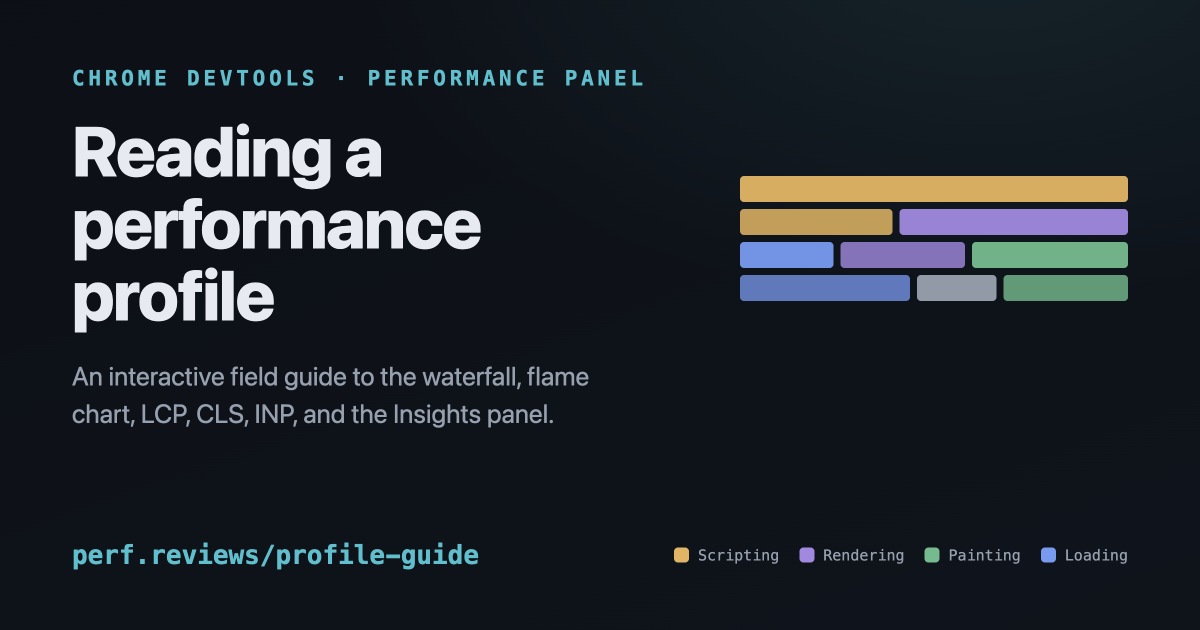
Reading a Performance Profile: Field Guide
An interactive field guide to the Chrome DevTools Performance panel: waterfall, flame chart, LCP, CLS, INP, and the Insights panel.
Craft your Chrome Devtools Protocol (CDP) commands efficiently with the new command editor | Blog | Chrome for Developers
To make it easier to type Chrome Devtools Protocol (CDP) commands, DevTools introduced a new user-friendly editor so that you don't have to use JSON.
