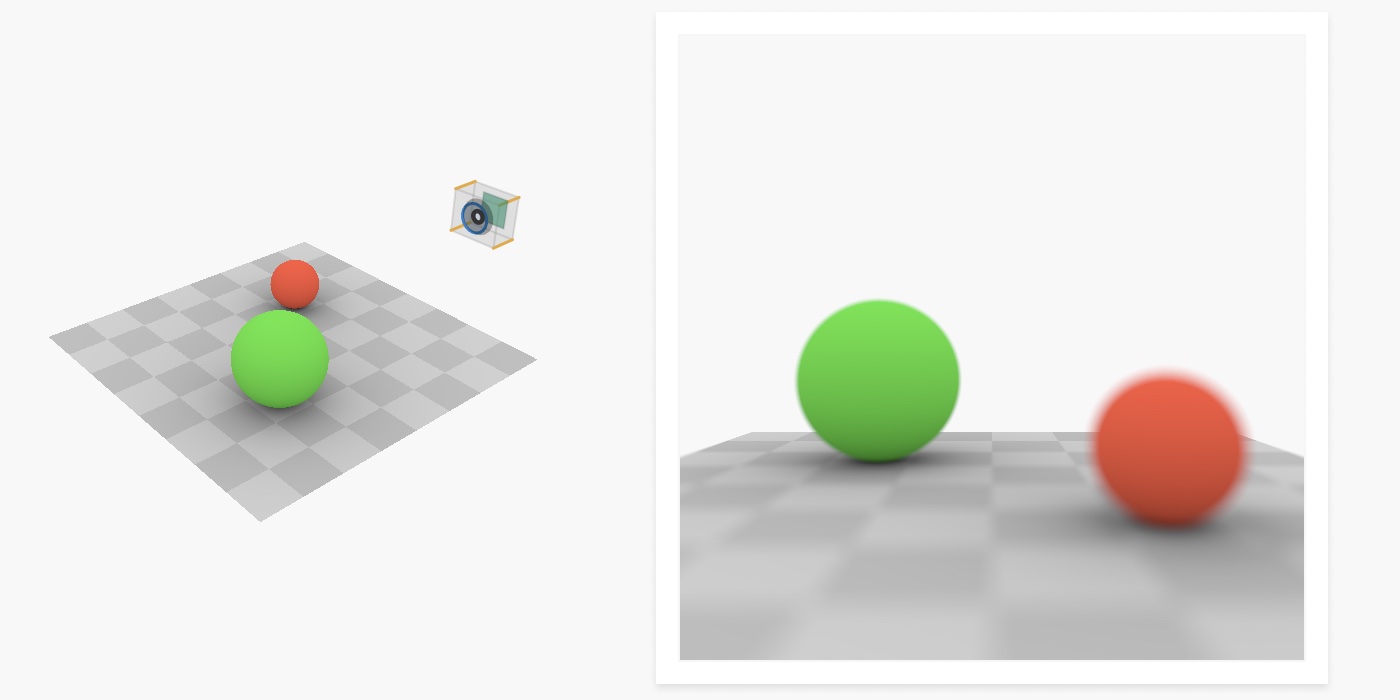
Interactive article explaining how cameras and lenses work.

The Art of Lomography Lens Aesthetics: A Side-by-side Comparison of Classics and Newcomers
With the arrival of our Joseph Petzval Métamorphose Focus-coupled Bokeh Control Art Lens, we're reflecting on the Lomography Art Lens aesthetic over the years in a side-by-side visual comparison of our most iconic camera lens characteristics and their design history.

Event Cameras: a New Way of Sensing - Davide Scaramuzza - ICCP 2024 Keynote
Generalized Lens Categories via functors $\mathcal{C}^{\rm op}\to\mathsf{Cat}$
Lenses have a rich history and have recently received a great deal of attention from applied category theorists. We generalize the notion of lens by defining a category $\mathsf{Lens}_F$ for any category $\mathcal{C}$ and functor $F\colon \mathcal{C}^{\rm op}\to\mathsf{Cat}$, using a variant of the Grothendieck construction. All of the mathematics in this note is straightforward; the purpose is simply to see lenses in a broader context where some closely-related examples, such as ringed spaces and open continuous dynamical systems, can be included.

The Plane of Focus — a lens, opened up
Everyone knows when a photo is blurry. Almost nobody has seen the exact plane where it turns sharp. Open a lens, turn the focus ring and watch that plane sweep through a tiny world.

Working notes on the role of vision papers in basic science
Many of the papers I most admire are vision papers1. Rather than abstractly define what a vision paper is, here's a list of a few examples of such papers, to convey the gist:
A geek's guide to photography
An interactive tutorial focused on lighting and effective photographic techniques. Entirely non-commercial, written for beginners and seasoned hobbyists alike.

Quotient lenses | Proceedings of the 13th ACM SIGPLAN international conference on Functional programming
Bidirectional programming languages are a practical approach to the view update problem. Programs in these languages, called lenses, define both a view and an update policy - i.e., every program can be read as a function mapping sources to views as well ...

Symmetric lenses | Proceedings of the 38th annual ACM SIGPLAN-SIGACT symposium on Principles of programming languages
A lens is a bidirectional transformation between a pair of connected data structures, capable of translating an edit on one structure into an appropriate edit on the other. Many varieties of lenses have been studied, but none, to date, has offered a ...


A Camera, Not an Engine II
Further thoughts on photography in latent space, now with agents!

Gazing through a lens, I invent as much as I reveal | Psyche Turning Points
For years I watched people through cameras and screens, filling in the blanks and calling it truth

The iPhones 16
What more proof of the camera’s singular importance to the iPhone would one need than the ever-growing block of camera lenses on the back of each year’s new models, or the “Shot on iPhone” ad campaign? A dedicated hardware button?

Project Cambria: Translate your data with lenses
Changing schemas in distributed software is hard. Could adopting bidirectional lenses help?