


Moderators of online communities, often volunteers, work hard to protect their communities from harassment, misinformation, trolls, and other online harms. But which policies and procedures actually work?
Gathering the Custodians of the Internet: Lessons from the First CivilServant Summit - Citizens and Technology Lab
An agenda for citizen behavioral science to maintain and protect the communities we love online.

The Citizen Lab - The Citizen Lab
The Citizen Lab is an interdisciplinary research unit at the Munk School of Global Affairs & Public Policy, University of Toronto. We apply our collective expertise in the fields of law, computer science, cybersecurity, political science, and social sciences to investigate complex issues of the 21st century. Explore focus areas Get the latest research in […]
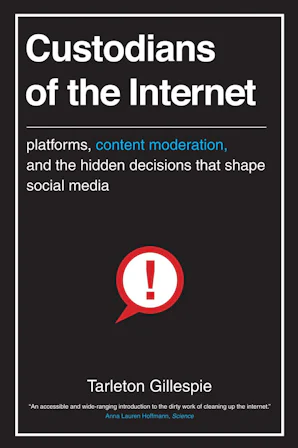
Custodians of the Internet
A revealing and gripping investigation into how social media platforms police what we post online—and the large societal impact of these decisions Most use...
Trust: Foundation of Human Knowledge yet online Platforms won't allow | David Karger | TEDxMIT Salon
New Paradigms in Trust and Safety: Navigating Defederation on Decentralized Social Media Platforms
Defederation on decentralized social media offers new possibilities for online governance. Experts consider how it can be used responsibly, in a way that balances speech and safety.

Empowering science communities with open, democratic, researcher-owned infrastructure.
We’re building communities and tech for publishing, curating, sharing, and discussing research online using ATProto and other decentralized protocols.
Empowering science communities with open, democratic, researcher-owned infrastructure.
We’re building communities and tech for publishing, curating, sharing, and discussing research online using ATProto and other decentralized protocols.
Toward People’s Community Control of Technology: Race, Access, and Education
This field review explores how the benefits of access to computing for racialized and minoritized communities has become an accepted fact in policy and research, despite decades of evidence that technical fixes do not solve the kinds of complex social problems that disproportionately affect these communities.

Morally Motivated Networked Harassment as Normative Reinforcement
While online harassment is recognized as a significant problem, most scholarship focuses on descriptions of harassment and its effects. We lack explanations of why people engage in online harassment beyond simple bias or dislike. This article puts forth an explanatory model where networked harassment on social media functions as a mechanism to enforce social order. Drawing from examples of networked harassment taken from qualitative interviews with people who have experienced harassment ( n = 28) and Trust & Safety workers at social platforms ( n = 9), the article builds on Brady, Crockett, and Bavel’s model of moral contagion to explore how moral outrage is used to justify networked harassment on social media. In morally motivated networked harassment, a member of a social network or online community accuses a target of violating their network’s norms, triggering moral outrage. Network members send harassing messages to the target, reinforcing their adherence to the norm and signaling network membership. Frequently, harassment results in the accused self-censoring and thus regulates speech on social media. Neither platforms nor legal regulations protect against this form of harassment. This model explains why people participate in networked harassment and suggests possible interventions to decrease its prevalence.

Digital Social Norm Enforcement: Online Firestorms in Social Media
Actors of public interest today have to fear the adverse impact that stems from social media platforms. Any controversial behavior may promptly trigger temporal, but potentially devastating storms of emotional and aggressive outrage, so called online firestorms. Popular targets of online firestorms are companies, politicians, celebrities, media, academics and many more. This article introduces social norm theory to understand online aggression in a social-political online setting, challenging the popular assumption that online anonymity is one of the principle factors that promotes aggression. We underpin this social norm view by analyzing a major social media platform concerned with public affairs over a period of three years entailing 532,197 comments on 1,612 online petitions. Results show that in the context of online firestorms, non-anonymous individuals are more aggressive compared to anonymous individuals. This effect is reinforced if selective incentives are present and if aggressors are intrinsically motivated.
ModGov - Governance for online communities
A simple, flexible framework that helps online communities create shared rules, elect representative moderators, and ensure stability.
Getting Started | @skyware/labeler
The power of community moderation at your fingertips.
Build Community Online with Decentralized Tools | Blacksky
Decentralized tools to build community online. The intercommunal net where communities govern, pool funds and stay safe on their own terms.
Build Community Online with Decentralized Tools | Blacksky
Decentralized tools to build community online. The intercommunal net where communities govern, pool funds and stay safe on their own terms.