

Cut-free, ISO-directed Prolog embedded in Python
Unifying fold left and fold right with Prolog
Here's a rather cool trick we noticed during a recent discussion in the NUS PLSE Lab.1
Finite-Choice Logic Programming | Proceedings of the ACM on Programming Languages
Logic programming, as exemplified by datalog, defines the meaning of a program as its unique smallest model: the deductive closure of its inference rules. However, many problems call for an enumeration of models that vary along some set of choices while ...

SciPy 1.0: fundamental algorithms for scientific computing in Python
SciPy is an open-source scientific computing library for the Python programming language. Since its initial release in 2001, SciPy has become a de facto standard for leveraging scientific algorithms in Python, with over 600 unique code contributors, thousands of dependent packages, over 100,000 dependent repositories and millions of downloads per year. In this work, we provide an overview of the capabilities and development practices of SciPy 1.0 and highlight some recent technical developments.

NLTK Book
This version of the NLTK book is updated for Python 3 and NLTK 3. The first edition of the book, published by O'Reilly, is available at http://nltk.org/book_1ed/. (There are currently no plans for a second edition of the book.)
Packrat parsing: | Proceedings of the seventh ACM SIGPLAN international conference on Functional programming
For decades we have been using Chomsky's generative system of grammars, particularly context-free grammars (CFGs) and regular expressions (REs), to express the syntax of programming languages and protocols. The power of generative grammars to express ...

Structured CoT: Shorter Reasoning with a Grammar File
Constrain only the think block with a tiny grammar. On Qwen3.6 coding evals, explicit reasoning gets 22x-43x shorter without losing pass@1 in these runs.
Datalog
Datalog is a declarative logic programming language. While it is syntactically a subset of Prolog, Datalog generally uses a bottom-up rather than top-down evaluation model. This difference yields significantly different behavior and properties from Prolog. It is often used as a query language for deductive databases. Datalog has been applied to problems in data integration, networking, program analysis, and more.
FlowLog - Efficient and Extensible Datalog | FlowLog
FlowLog: Efficient and Extensible Datalog via Incrementality
Combinators for bidirectional tree transformations: A linguistic approach to the view-update problem: ACM Transactions on Programming Languages and Systems: Vol 29, No 3
We propose a novel approach to the view-update problem for tree-structured data: a domain-specific programming language in which all expressions denote bidirectional transformations on trees. In one direction, these transformations---dubbed lenses---map ...

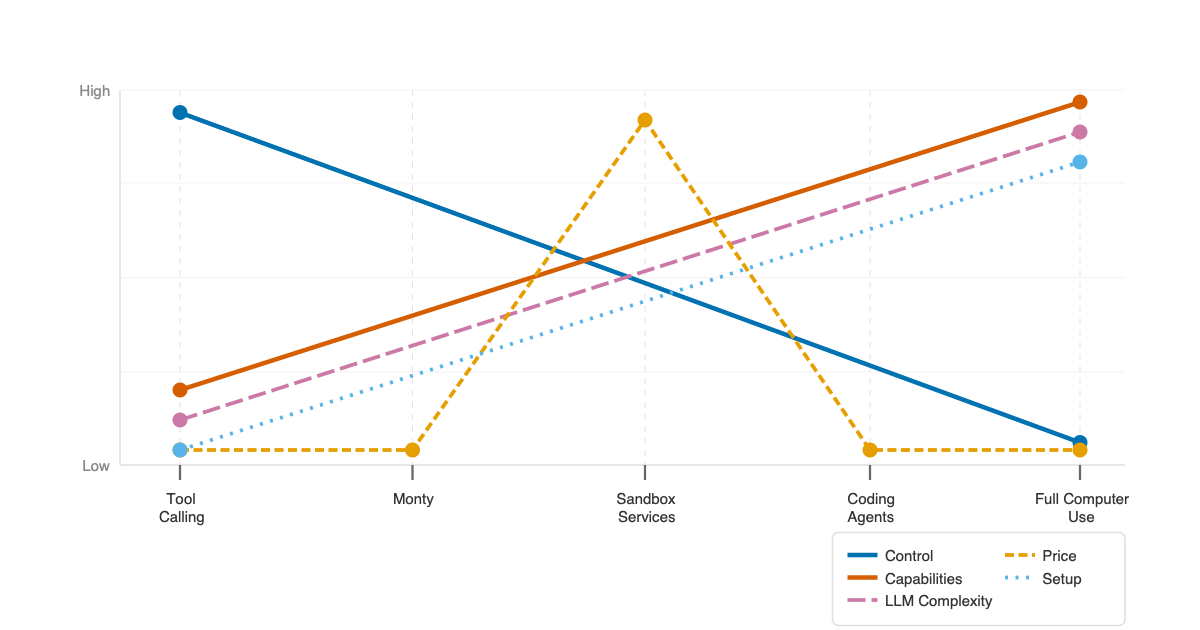
Pydantic Monty: A Minimal Python Sandbox for AI Agents | Pydantic
Meet Monty — a secure, minimal Python interpreter written in Rust for running AI-generated code. Learn where it sits between tool calling and full computer use, and why CodeMode matters for AI agents.
Satisfiability Modulo Theories: A Beginner’s Tutorial — Satisfiability Modulo Theories: A Beginner's Tutorial documentation
Great minds have long dreamed of creating machines that can function as general-purpose problem solvers. Satisfiability modulo theories (SMT) has emerged as one pragmatic realization of this dream, providing significant expressive power and automation. This tutorial is a beginner’s guide to SMT. It includes an overview of SMT and its formal foundations, a catalog of the main theories used in SMT solvers, and illustrations of how to obtain models and proofs. Throughout the tutorial, examples and exercises are provided as hands-on activities for the reader. They can be run using either Python or the SMT-LIB language, using either the cvc5 or the z3 SMT solver.