

Statically prevent deadlocks
Surelock
NOTE Hello r/rust! Thank you for the interest in this work and for the delightful conversation ❤️ I hate deadlocks. Maybe you do too.
Landlock: unprivileged access control — The Linux Kernel documentation
The goal of Landlock is to enable restriction of ambient rights (e.g. global filesystem or network access) for a set of processes. Because Landlock is a stackable LSM, it makes it possible to create safe security sandboxes as new security layers in addition to the existing system-wide access-controls. This kind of sandbox is expected to help mitigate the security impact of bugs or unexpected/malicious behaviors in user space applications. Landlock empowers any process, including unprivileged ones, to securely restrict themselves.
timelocked secrets
Encrypt messages that can only be decrypted after a specific time. Powered by drand timelock encryption and stored on your atproto PDS.
DropLock
The link below is like an open lock box that belongs to you. Anyone you share it with can put a secret inside and create a locked link that only you can open.
Credible exit
To avoid lock in, you need the ability for the user to credibly exit.

Time-lock puzzle
A time-lock puzzle, or time-released cryptography, encrypts a message that cannot be decrypted until a specified amount of time has passed. The concept was first described by Timothy C. May,[1] and a solution first introduced by Ron Rivest, Adi Shamir, and David A. Wagner in 1996.[2] Time-lock puzzle are useful in cases where confidentiality of information is determined by time, such as a diarist who does not want their views released until 50 years after their death, an auction where bids are sealed until the bidding period is closed, electronic voting, and contract signing.[1][3] They can additionally be used in creating further cryptographic primitives, such as verifiable delay functions and zero knowledge proofs.[3]
Preserving Order in Concurrent Go Apps: Three Approaches Compared
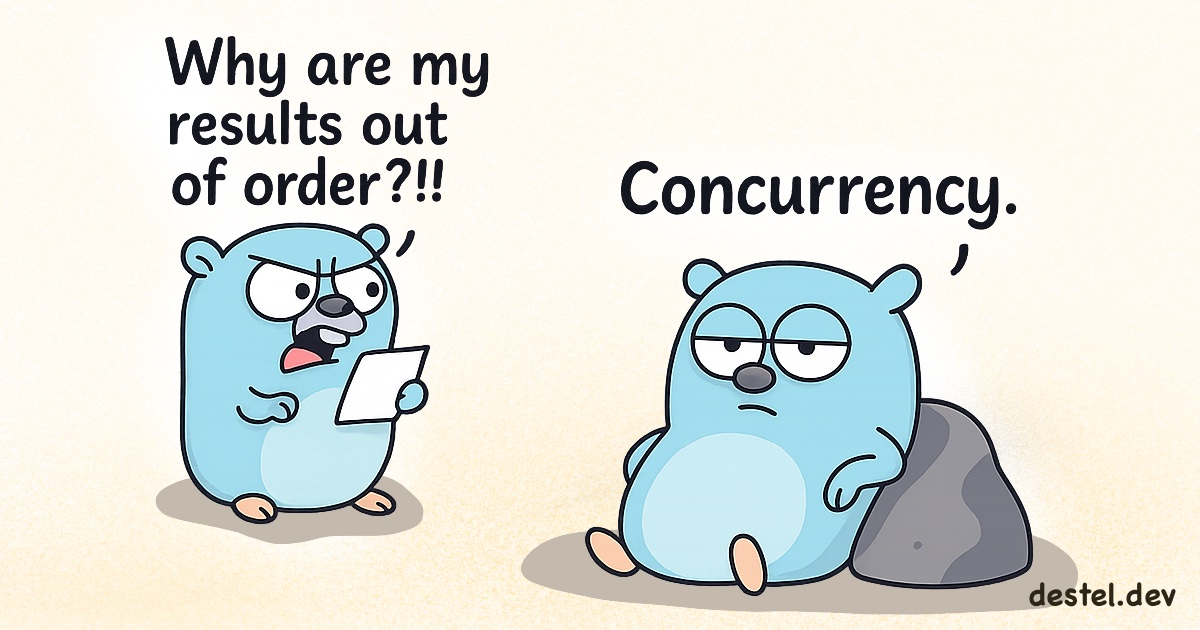
Concurrency breaks ordering by design, but sometimes we need both. Explore three methods to preserve order in concurrent Go applications, from standard ReplyTo channels to sophisticated permission passing, with benchmarks and real-world trade-offs.
Concurrency is not Parallelism by Rob Pike
Notes on structured concurrency, or: Go statement considered harmful — njs blog
Every concurrency API needs a way to run code concurrently. Here's some examples of what that looks like using different APIs:
Automated Verification of Proofs in the Universal Composability Framework with Markov Decision Processes
Designing cryptographic protocols and proving these rigorously secure is an arduous and challenging task. Among the methods commonly used to prove security of cryptographic protocols, formalizing it in Canneti's Universal Composability (UC) Framework offers several benefits: (1) Modular design, (2) demonstrating that security remains under arbitrary composition and concurrent execution, (3) the security against any computationally polynomially bound adversary. However, working within the UC Framework can be cumbersome, requires a long time commitment by the prover, and it is prone to errors. While utilization of proof assistants in Cryptography and IT Security is a prominent research area, proof assistants for UC are still in their infancy. Here we show our ongoing work to utilize model checking for verification of proofs in the UC Framework, which to the best of our knowledge is the first attempt to do so. In this work we (1) formally create a Markov Decision Process (MDP) encoding a given proof in the UC Framework, (2) define and proof notions of soundness and completeness for the constructed MDP, (3) implement a proof of concept and (4) demonstrate practical feasibility through experimental evaluation. In summary, in this work we lay out the formal foundations for model checking UC proofs and create a tool that can not only be used for proof verification but also as an assistant for developing proofs in the UC Framework.

In defense of lock poisoning in Rust · sunshowers
It's worth retaining one of multithreaded Rust's most valuable features.

LEAF: Compact and Efficient Blind Signature from Code-based Assumptions
Recently, recent advancement in Asiacrypt'25, gives new blind signature frameworks, collectively named Tanuki(s), built upon cryptographic group actions. Their work introduces novel techniques and culminates in a concurrently secure blind signature framework. Straightforward instantiations based on CSIDH (CSI-FiSh) and LESS yield signature sizes of 4.5 KB and 64 KB respectively, providing the first efficient blind signatures in the isogeny-based and code-based literature allowing concurrent executions. In this work, we improve the code-based instantiations by using the canonical form of linear equivalent codes by a careful treatment. However, the canonical form does not naturally support a group action structure, which is central to the security proofs of Tanuki(s). Consequently and unfortunately, the original security guarantees do not directly apply. To address this, we develop two distinct non-black-box reductions for both blindness and the one-more unforgeability. In the end, the improvements do not compromise the security. This results in a concurrently secure code-based blind signature scheme with a compact signature size of 4.4 KB, which is approximately 1% smaller than the isogeny-based one. We also provide a C implementation where the signing time in 99ms and 268 Mcycles on an Intel i7 2.3~GHz CPU. We also look forward to our approaches benefiting advanced constructions built on top of LESS in the future.
On the Hardness of Detecting Macroscopic Superpositions
When is decoherence "effectively irreversible"? Here we examine this central question of quantum foundations using the tools of quantum computational complexity. We prove that, if one had a quantum circuit to determine if a system was in an equal superposition of two orthogonal states (for example, the $|$Alive$\rangle$ and $|$Dead$\rangle$ states of Schrödinger's cat), then with only a slightly larger circuit, one could also $\mathit{swap}$ the two states (e.g., bring a dead cat back to life). In other words, observing interference between the $|$Alive$\rangle$and $|$Dead$\rangle$ states is a "necromancy-hard" problem, technologically infeasible in any world where death is permanent. As for the converse statement (i.e., ability to swap implies ability to detect interference), we show that it holds modulo a single exception, involving unitaries that (for example) map $|$Alive$\rangle$ to $|$Dead$\rangle$ but $|$Dead$\rangle$ to -$|$Alive$\rangle$. We also show that these statements are robust---i.e., even a $\mathit{partial}$ ability to observe interference implies partial swapping ability, and vice versa. Finally, without relying on any unproved complexity conjectures, we show that all of these results are quantitatively tight. Our results have possible implications for the state dependence of observables in quantum gravity, the subject that originally motivated this study.

encryption rant
Robustly-secured data that can surprisingly vanish at a moments notice.

How Notion handles concurrent editing with CRDTs
Building a CRDT-based rich-text system that merges concurrent edits across Notion blocks—without losing anyone’s work

OpenAI unveils Lockdown Mode to protect sensitive data from prompt injection attacks | TechCrunch
Even with Lockdown Mode, ChatGPT could be vulnerable to prompt injections, but the goal is to reduce the likelihood that sensitive data gets shared in the process.
