

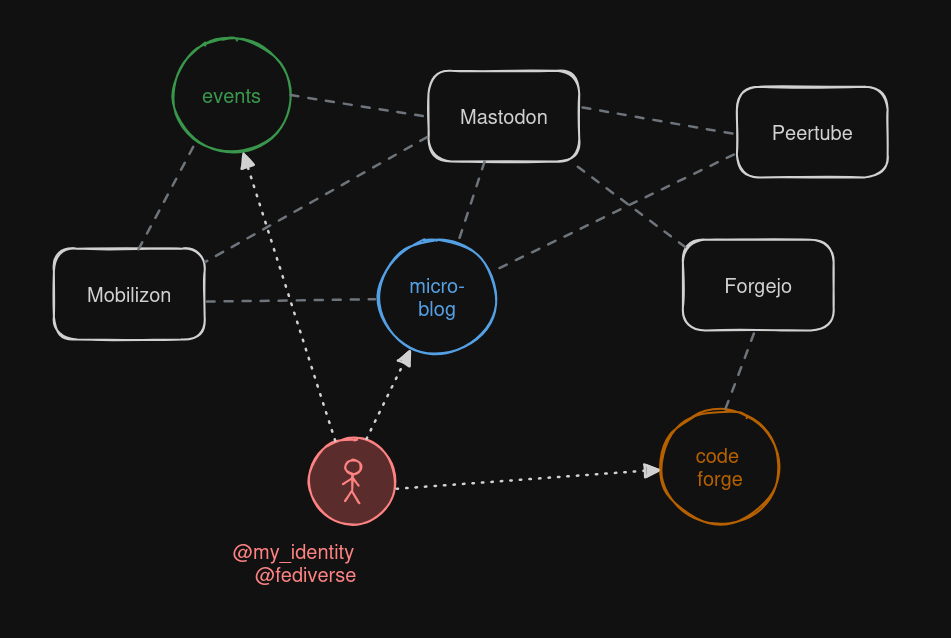
Only humans make the social web social.
Building A Prosocial Media Ecosystem | NOEMA
There’s never been a better time to make social media what it always should have been: a tool to strengthen rather than strip-mine the social fabric.

The 'normal' response to the Social Web
How (mostly) 'normal' people respond to the ideas of the Social Web Marketing the Social Web is a headache. Only heightened by the clashing of heads as everyone offers an opinion. Picture those dinosaurs that have their skull on the outside. That's us. No wonder it's a headache.

The Prosocial Ranking Challenge: Reducing Polarization on Social...
We report the first direct comparisons of multiple alternative social media algorithms on multiple platforms on outcomes of societal interest. We used a browser extension to modify which posts...

FediForum | Growing the Open Social Web un-workshop, 2026/03/02

FediForum | Growing the Open Social Web:<br>An Online Un-Workshop
Since the Twitter takeover by Elon Musk over three years ago, the Open Social Web has been adopted by an enthusiastic community. People world-wide are building and using open social platforms and open social protocols to better interact with others online.
W Social is TruthSocial with a European accent. - We Can Just Do Things
Different politics, identical structure: wealthy insiders, community infrastructure they didn't build, and openness performed just long enough to matter. The establishment always wants its own internet.
Pluralistic: Social media without socializing (19 Jan 2026) – Pluralistic: Daily links from Cory Doctorow
From the earliest days of social media, social media bosses have been at war with sociability. To create a social media service is to demarcate legitimate and illegitimate forms of sociability. It's a monumental act of hubris, really.
Social Media Is Now Parasocial Media
When practitioners used the term “social media” to describe the internet tools that emerged in the mid-aughts, they were giving a name to the kinds of platforms and protocols that allowed people to socialize with friends and communities of interest by using digital technologies. Twenty years later, users of social media are far more likely to scroll than post – and the content that they consume is often strategically produced and algorithmically curated. In this essay, I argue that the very essence of social media has changed. To more effectively interrogate what we are witnessing, we need to stop presuming that these tools are “social media” and begin recognizing that they are now “parasocial media.” Doing so raises new questions about digitally mediated sociality, not to mention the politics and governance of these platforms.

How Online Mobs Act Like Flocks Of Birds
A growing body of research suggests human behavior on social media is strikingly similar to collective behavior in nature.

Growing the Social Web
I'm going to be participating in the Growing the Open Social Web workshop at Fediforum on March 2, 2026. I'm excited to talk to other people who care about the Fediverse about ways to connect more people through ActivityPub. Fediforum invited attendees to publish position papers before the workshop. SWF has a number of hypotheses…

🗣️🗣️🗣️ THE OPEN SOCIAL WEB IS THE LONG GAME If we win, it'll be for the next generations. Sit with that thought, move accordingly.

Rude1 Haunted Badness. ⁂
Many builders in the Open Social Web are discouraged by the lack of funding in the ecosystem, slow pace of feature development (e.g. private accounts), and “low” adoption relative to incumbents like Meta. In my keynote I emphasized multi-generational struggle & movement building. People who faced…
The web was always social Diving into the idea of bridging different social networks and protocols like ATproto and ActivityPub to enhance the web. Looking back at my personal web journey, from Web 2.0 to now, emphasizing that building connections... herve.bzh/the-web-was-always-social/
The web was always social
herve.bzhThe same-origin paradigm has unfortunately become a local maxima of the web. I'd argue the capture of the internet's search, social spaces, and data lock-in, as well as the lack of open protocols counter this capture can be directly attributed to building on top of the same-origin paradigm.

𝕮
Thinking about atproto as an identity and data *substrate* of the web. RSS couldn't go all the way because it built within the boundaries of the same-origin paradigm, just like the closed platforms that ended up enclosing most of the web.
I now fully believe that the open social web will be more key to the agentic web than folks think. #AgenticWeb


