


The community-built wiki documenting anti-ownership, anti-consumer practices ranging from right-to-repair restrictions, planned obsolescence, subscription traps, & digital rights issues.
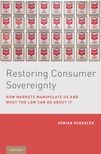
Restoring Consumer Sovereignty: How Markets Manipulate Us and What the Law Can Do About It
Abstract. For decades, there has been broad consensus within antitrust, intellectual property, and consumer law scholarship that consumers make decisions i
A Day in the Life of an Ensh*ttificator
Consumer Rights Wiki – Get this Extension for 🦊 Firefox (en-GB)
Download Consumer Rights Wiki for Firefox. Shows a popup and notifications when the current site may have an article on the Consumer Rights Wiki.

Consumer Reports unveils 'Consumer Finance AI Standard' a first-of-its-kind framework defining what consumers are owed from AI-powered financial products
Washington, DC – Consumer Reports today published the Consumer Finance AI Standard, a first-of-its-kind framework defining the rights, protections, and design practices consumers are owed…

Consumerism | The Paper Pilot
The Paper Pilot's digital garden of thoughts on philosophy, politics, and sociology
Licensing terms for data in the Atmosphere
I’d like to raise a fun and interesting topic, and that’s intellectual property and content licensing. The data that flies around the Atmosphere is all visible and public. We’re at a stage within the Atmosphere where services are beginning to grow, and we’re beginning to see lexicons and data that express creative works that extend in length beyond microblogging. I think that the Standard.site lexicons are a great example. But these creations lead to further questions. Who has permission to...

When Purchase Means License: Digital Ownership's Quiet Erosion — Koios
When Purchase Means License: Digital Ownership's Quiet Erosion
Your Data, Your Control
How data portability can unlock competition and empower consumers January 15, 2026 Copyright and permission to reproduce For information on the Competition Bureau's activities, please contact: Information Centre Competition Bureau 50 Victoria Street Gatineau QC K1A 0C9
WebPreferences Object | Electron
The OpenJS Foundation | Terms of Use | Privacy Policy | Bylaws | Code of Conduct | Trademark Policy | Trademark List | Cookie Policy
MET:Main Page - UBC Wiki
This Wikispace is a shared resource made available as an archived collection of wiki entries from previous iterations of the course. The Media/Education/Design wiki takes the form of an online set of entries that follow the standard Wikipedia encyclopedia entry genre. Wikipedia represents an important contemporary example of how a specific medium and a particular environment intersect in such a way as to enable the most prolific and significant example to-date of public knowledge production that blurs the boundaries between producers and consumers. At present, the design Wiki is primarily text-based, with some entries incorporating photographs and links to outside media.
消費者白書等 | 消費者庁
Copyright © Consumer Affairs Agency, Government of Japan. All Rights Reserved.
Establishing Trusted Representation | CAA
Labelling of quality and price is an important key for selecting goods or services. False or misleading representations may sway consumers into buying goods or services that are actually poor quality or overvalued. The Act against Unjustifiable Premiums and Misleading Representations prohibits such misleading representations. The Consumer Affairs Agency is addressing to ensure proper environment for shopping according to the Act.

Restoring Consumer Sovereignty
For decades, there has been broad consensus within antitrust, intellectual property, and consumer law scholarship that consumers make decisions in their own best interests by consciously weighting the market’s relative prices, quantities, and qualities against each other. That consensus is unraveling in light of novel findings from cognitive and social psychology that explain how individuals’ concepts of what they prefer drive the global economy. At the same time, producers nowadays no longer merely satisfy consumers’ needs but also communicate their values, identities, and aspirations through the sale and marketing of products. As part of the growing interest in observations such as these, a wealth of psychological studies challenge the fundamental teaching of economics that the interplay of demand and supply of goods in a free market economy provides us with material wealth. This book provides a normative defense of that assumption and a theoretical framework for understanding its contradictions. It argues that the erosion of consumer sovereignty through the ability of product manufacturers and sellers to systematically take advantage of individuals’ psychological weaknesses demands a twenty-first-century reconceptualization of the consumer and a modern account of how the law should regulate the digital economy. Such an account is justified to ensure a diverse marketplace in which consumers can influence how our societies are structured and arranged. By examining the role that market manipulation plays, it offers ingredients for a realistic descriptive and normative market regulatory theory that is aware of its political economy, its behavioral suppositions, and its distributional consequences.
Consumer Boycotts | The Paper Pilot
The Paper Pilot's digital garden of thoughts on philosophy, politics, and sociology
