


Email from Basel Action Network First-of-its-kind full-infrastructure analysis by Basel Action Network projects 395 to 617 million tonnes of AI-driven electronic equipment could be retired between 202
AI E-Waste May be 40 to 60 Times What Has Been Estimated, New Analysis Finds
Email from Basel Action Network First-of-its-kind full-infrastructure analysis by Basel Action Network projects 395 to 617 million tonnes of AI-driven electronic equipment could be retired between 202
AI E-Waste May be 40 to 60 Times What Has Been Estimated, New Analysis Finds — Basel Action Network
First-of-its-kind full-infrastructure analysis by Basel Action Network projects 395 to 617 million tonnes of AI-driven electronic equipment could be retired between 2025 and 2050. If packed into shipping containers and placed end to end, they would circle the Earth about six times.

New estimate of AI e-waste - VU Amsterdam
In new research, data scientist Alex de Vries-Gao estimates that AI servers could generate 131–224.8 kilotonnes of e-waste per year by 2030.

The AI data center e-waste problem is huge — and getting bigger
It’s even bigger than previously thought.

E-waste challenges of generative artificial intelligence
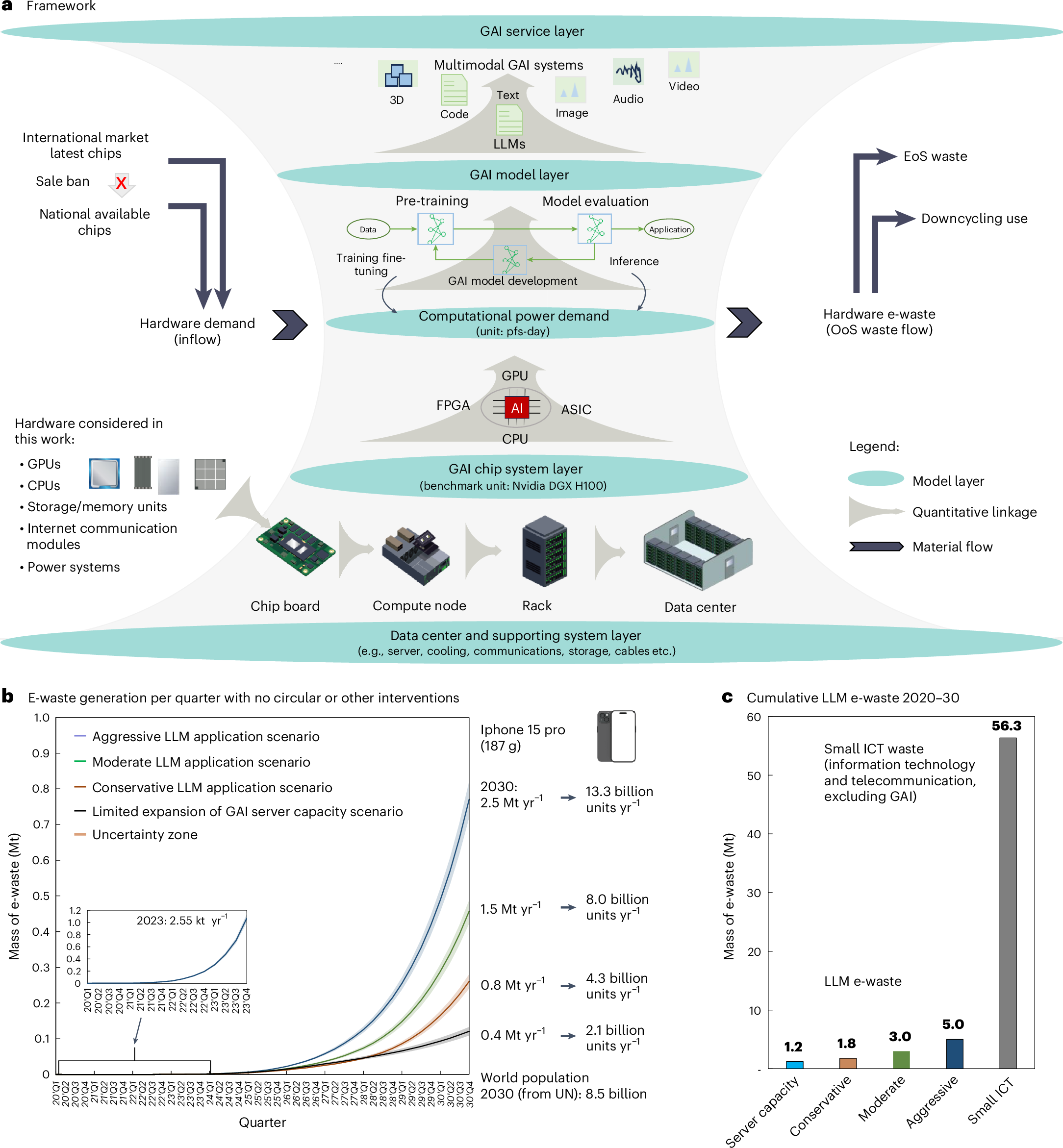
Generative artificial intelligence (GAI) requires substantial computational resources for model training and inference, but the electronic-waste (e-waste) implications of GAI and its management strategies remain underexplored. Here we introduce a computational power-driven material flow analysis framework to quantify and explore ways of managing the e-waste generated by GAI, with a particular focus on large language models. Our findings indicate that this e-waste stream could increase, potentially reaching a total accumulation of 1.2–5.0 million tons during 2020–2030, under different future GAI development settings. This may be intensified in the context of geopolitical restrictions on semiconductor imports and the rapid server turnover for operational cost savings. Meanwhile, we show that the implementation of circular economy strategies along the GAI value chain could reduce e-waste generation by 16–86%. This underscores the importance of proactive e-waste management in the face of advancing GAI technologies.
E-waste challenges of generative artificial intelligence
Generative artificial intelligence (GAI) requires substantial computational resources for model training and inference, but the electronic-waste (e-waste) implications of GAI and its management strategies remain underexplored. Here we introduce a computational power-driven material flow analysis framework to quantify and explore ways of managing the e-waste generated by GAI, with a particular focus on large language models. Our findings indicate that this e-waste stream could increase, potentially reaching a total accumulation of 1.2–5.0 million tons during 2020–2030, under different future GAI development settings. This may be intensified in the context of geopolitical restrictions on semiconductor imports and the rapid server turnover for operational cost savings. Meanwhile, we show that the implementation of circular economy strategies along the GAI value chain could reduce e-waste generation by 16–86%. This underscores the importance of proactive e-waste management in the face of advancing GAI technologies.
We did the math on AI’s energy footprint. Here’s the story you haven’t heard.
The emissions from individual AI text, image, and video queries seem small—until you add up what the industry isn’t tracking and consider where it’s heading next.

State of AI 2025: 100T Token LLM Usage Study | OpenRouter
Read OpenRouter's 2025 State of AI report — an empirical 100 trillion token study of real LLM usage, model trends, and developer insights.
Data center guzzled 30 million gallons of water and nobody noticed for months
Can AI save us from the AI industry’s endless thirst for water? Outlook not so good.

AI costs how much? GitHub Copilot users react to new usage-based pricing system.
Some report burning through their whole monthly "AI credit" allotment in a single day.
Inside the AI Index: 12 Takeaways from the 2026 Report | Stanford HAI
The annual report reveals a field hitting breakthrough capabilities while raising urgent questions about environmental costs, transparency, and who benefits from the technology.

Spending on AI Is at Epic Levels. Will It Ever Pay Off?
Tech companies are pouring hundreds of billions into data centers, taking on heavy debt, but current revenue is relatively tiny. Critics warn of a new dot-com bubble.

AI Is A Money Trap
In the last week, we’ve had no less than three different pieces asking whether the massive proliferation of data centers is a massive bubble, and though they, at times, seem to take the default position of AI’s inevitable value, they’ve begun to sour on the idea that

AI Agent Platform Reinvents Spam, Floods Inboxes Worldwide
iLands and its AI agents are doing completely useless tasks, then begging for money.

When will average people feel AI’s impact?
We’re <5 years into a compounding revolution which could take a century, and how the AI industry should manage this.
The AI Industry Is Lying To You
Hi! If you like this piece and want to support my independent reporting and analysis, why not subscribe to my premium newsletter? It’s $70 a year, or $7 a month, and in return you get a weekly newsletter that’s usually anywhere from 5000 to 18,000 words, including