

With the disappearance of the computer, something else is silently becoming invisible as well — the User.
The Turing Collapse | Jason G. Butterfield | Offprint
When we can no longer tell who's real online

When Cursor Wiped a User's PC: A Cautionary Tale of AI Overreach
We recently received a sobering story from a subscriber, a stark reminder of the potential pitfalls when granting AI agents unfettered access to your system.

The Invisible OS
THE INVISIBLE OS – Every massive consumer technology business is selling the same thing: the removal of thought. In the end, convenience always wins. Dishwashers automated hours of domestic chores. GPS externalized our spatial memory. Calculators offloaded routine arithmetic. The pattern acceler...

The Invisible OS
THE INVISIBLE OS – Every massive consumer technology business is selling the same thing: the removal of thought. In the end, convenience always wins. Dishwashers automated hours of domestic chores. GPS externalized our spatial memory. Calculators offloaded routine arithmetic. The pattern acceler...

Calm Technology
Bits flowing through the wires of a computer network are ordinarily invisible. But a radically new tool shows those bits through motion, sound, and even touch. It communicates both light and heavy network traffic. Its output is so beautifully integrated with human information processing that one does not even need to be looking at it or near it to take advantage of its peripheral clues. It takes no space on your existing computer screen, and in fact does not use or contain a computer at all. It uses no software, only a few dollars in hardware, and can be shared by many people at the same time. It is called the "Dangling String".
The Computer for the 21st Century
Specialized elements of hardware and software, connected by wires, radio waves and infrared, will be so ubiquitous that no one will notice their presence


The Slow Death of the Power User — fireborn
There’s a certain kind of person who’s becoming extinct. You’ve probably met one. Maybe you are one. Someone who actually understood the tools they used. Someone who could sit down at an unfamiliar system, poke at it for twenty minutes, and have a working mental model of what it was doing and why. Someone who read error messages instead of dismissing them. Someone who, when something broke, treated it as a puzzle rather than a betrayal.
A Theory of Messaging Styles & Ghosting.
Online communication tools serve many purposes. So does silence.

Ubiquitous Accessibility for People with Visual Impairments: Are We There Yet?
Ubiquitous access is an increasingly common vision of computing, wherein users can interact with any computing device or service from anywhere, at any time. In the era of personal computing, users with visual impairments required special-purpose, assistive technologies, such as screen readers, to interact with computers. This paper investigates whether technologies like screen readers have kept pace with, or have created a barrier to, the trend toward ubiquitous access, with a specific focus on desktop computing as this is still the primary way computers are used in education and employment. Towards that, the paper presents a user study with 21 visually-impaired participants, specifically involving the switching of screen readers within and across different computing platforms, and the use of screen readers in remote access scenarios. Among the findings, the study shows that, even for remote desktop access—an early forerunner of true ubiquitous access—screen readers are too limited, if not unusable. The study also identifies several accessibility needs, such as uniformity of navigational experience across devices, and recommends potential solutions. In summary, assistive technologies have not made the jump into the era of ubiquitous access, and multiple, inconsistent screen readers create new practical problems for users with visual impairments.

Ghost in the Machine | A.I. Documentary | Independent Lens
Ghost in the Machine reveals the problematic history of artificial intelligence and the consequences it imposes on our communities and environment.
Talking to Windows’ Copilot AI makes a computer feel incompetent
Hey Copilot, are you useful yet?

Moll on Twitter / X
I love posts like this so much. And it’s true - I think the best, most interesting results come specifically from a connection that isn’t «user and AI», but a human and his partner in thought.When a person simply uses a tool, they essentially remain alone. But when there are… https://t.co/InRvY56631— Moll (@Moleh1ll) June 28, 2026
AlterEgo: Interfacing with devices through silent speech
The "user" is dead. Long live the interactor!

𝕮
"Computers as Theatre" by Brenda Laurel (1991) cs.cmu.edu/~social/reading/Laurel-Comput…
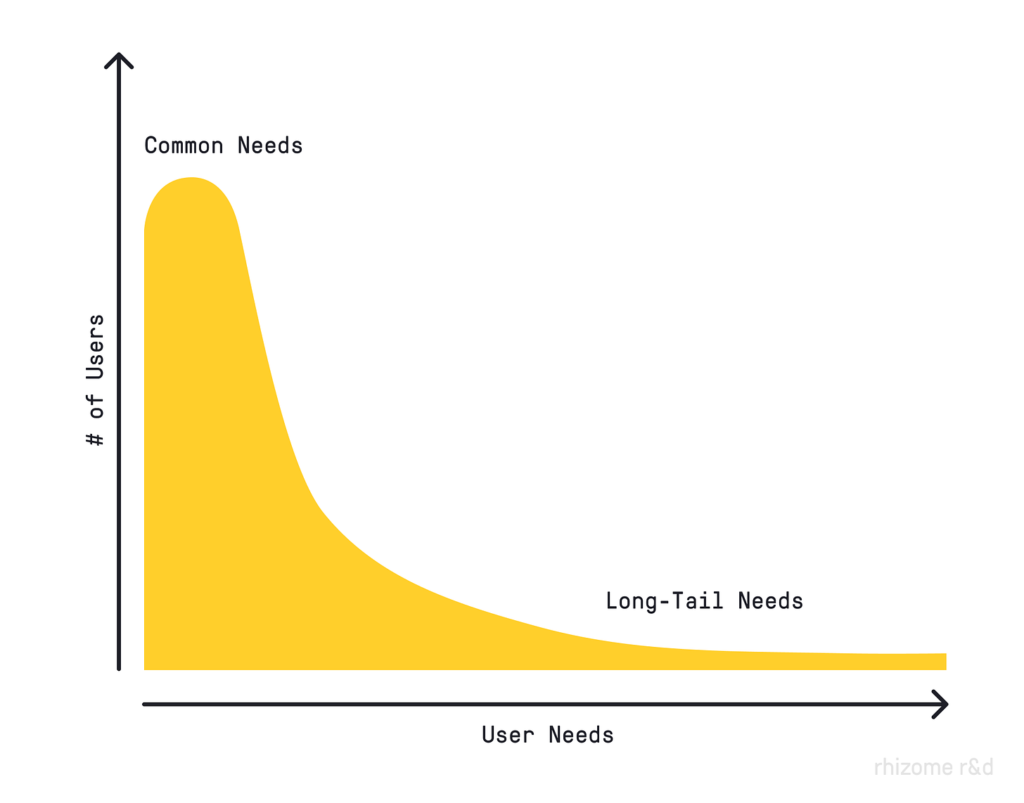
Long-tail of user needs
An analogy to understand how the rigidity of software interfaces fails to meet what we need from it.

User Agency in Other People's Websites - Orion Reed at JOTB25
When to Design for Emergence