Contours of can’t-be-evil futures
other futures: tech, resistance & imagining otherwise
big tech wants to control our future, but there are other paths we can choose instead. on "other futures" we bring together leading tech researchers, organizers, critics, and storytellers to help us imagine what more liberatory and human-centered tech futures could look like—and how we can build them together. brought to you by DAIR and the All Tomorrows Institute.
Four Futures
We are in a moment where the future is both wildly exciting and highly uncertain. The future state and greatest opportunities are likely determined by the axes: rate of advancement and the openness of the frontier models.

Perpetual futures, explained
Capital efficiency for pros, leverage for bettors, rich yields for market makers, and a dangerous failure mode.

How to Future
A good futurist focuses on the 3 time phases: past, present, future.

A Manifesto for a Future Philosophy (guest post) - Daily Nous
“This project of re-envisaging, looking at past ideas, and developing new ones to deal with our difficult situation will take the work of many people…” […]
The Once and Future Metaverse: Part Two
This is part two of a two-part article. Read part one here.

Who Owns the Future? Ways to Understand Power, Technology, and the Moral Commons
Thomas Meier and Kristina Khutsishvili argue for a reorientation to revive the democratic lifeblood of shared meaning, moral cultivation, and civic agency.

THE CALIFORNIAN IDEOLOGY by Richard Barbrook and Andy Cameron | Imaginary Futures
“Not to lie about the future is impossible and one can lie about it at will” – Naum Gabo [1]
Prophecy And Future Coding
Preface: On Prophecy and the Search for Certainty in an Age of Reflexive Time

Reality Blind - Vol. 1
Integrating the Systems Science Underpinning Our Collective Futures
From risk to flourishing: Seeds for responding to a complex world
Flourishing is the actualization of all beings toward their good -- not only individually but collectively, answering the question of `how do we live well with and for each other?'. In science as in society, the tendency to reduce, segregate, specialize, and settle has precluded embracing the concept of flourishing as a guiding principle. We aim to identify an approach to risk science research that promotes the flourishing of socio-ecological-technological systems (SETS). We discuss the normative role of an orientation toward flourishing for the field of risk science. We explore the possibility that (risk) science could be done in a way that is capable of pointing society toward a different future, one more resilient and more capable of flourishing. Our exploration mirrors the conversational nature of flourishing itself: examine ideologies traditionally believed to be rigidly in opposition and consider what emerges in the space(s) and conversation between them. We call this a dialectical approach. Within this paradigm grounded in conversation, pluralism, and pragmatism, we revisit three longstanding tensions in risk science: physical$|$social, determinism$|$uncertainty, contextuality$|$generality. Although these tensions are not new, revisiting them together through the lens of complexity science, and with explicit attention to the normative commitments that shape risk research, reveals underexplored possibilities for the field. Examining them in conversation with the other allows us to explore the provisional seeds for what might be termed complex risk science: interdependence, responsivity, participation, pluralism, openness, and ongoingness. Enacting the dialectical paradigm towards a risk science for a flourishing world will depend on creating collectives toward complex risk science, supporting them with skillfully governed commons, and centering care in our research.

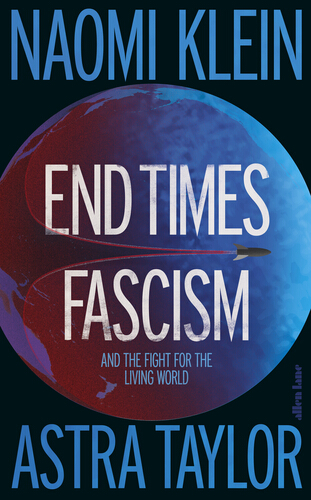
End Times Fascism
The far right is on the march again – but this time it’s different from anything we’ve seen before. A new, apocalyptic alliance of religious fundamentalists, billionaire Silicon Valley tech kings and ethno-nationalists is on the move. They’re united in their belief that some kind of cleansing cataclysm is coming, and they welcome a future of shocks, scarcity and collapse, convinced they’ll be among the saved on the other side. This is the world of End Times Fascism. In this blistering reckoning with our age, Naomi Klein and Astra Taylor take us deep into this man-made Armageddon complex – and show us how to resist it. Around the globe, they investigate how those who are making our world unliveable through climate chaos and job-consuming AI are preparing to protect themselves from the fallout, whether it’s by repairing to luxurious private islands for the super-rich, rocketing off to Mars or bunkering nations against a dehumanized ‘other’. But, Klein and Taylor reveal, the new supremacist survivalists are far from impregnable. They have no vision of a shared future. All they offer are remixes of a bygone past: the nihilistic, sadistic pleasures of domination. If we’re to meet this critical moment and defend what’s left of democracy before it’s smashed up beyond repair, we must break the doom loop, and find a new way of living together, rooted in our existence on this earth, in the here and now. A story not of end times – but of better times. This book shows us how.
How are we writing the future of humanity?
Consciousness spinning