

Human knowing in perspectival encyclopedicity
I Built a Knowledge Base That Writes Itself. Here Is What Andrej Karpathy Got Right.
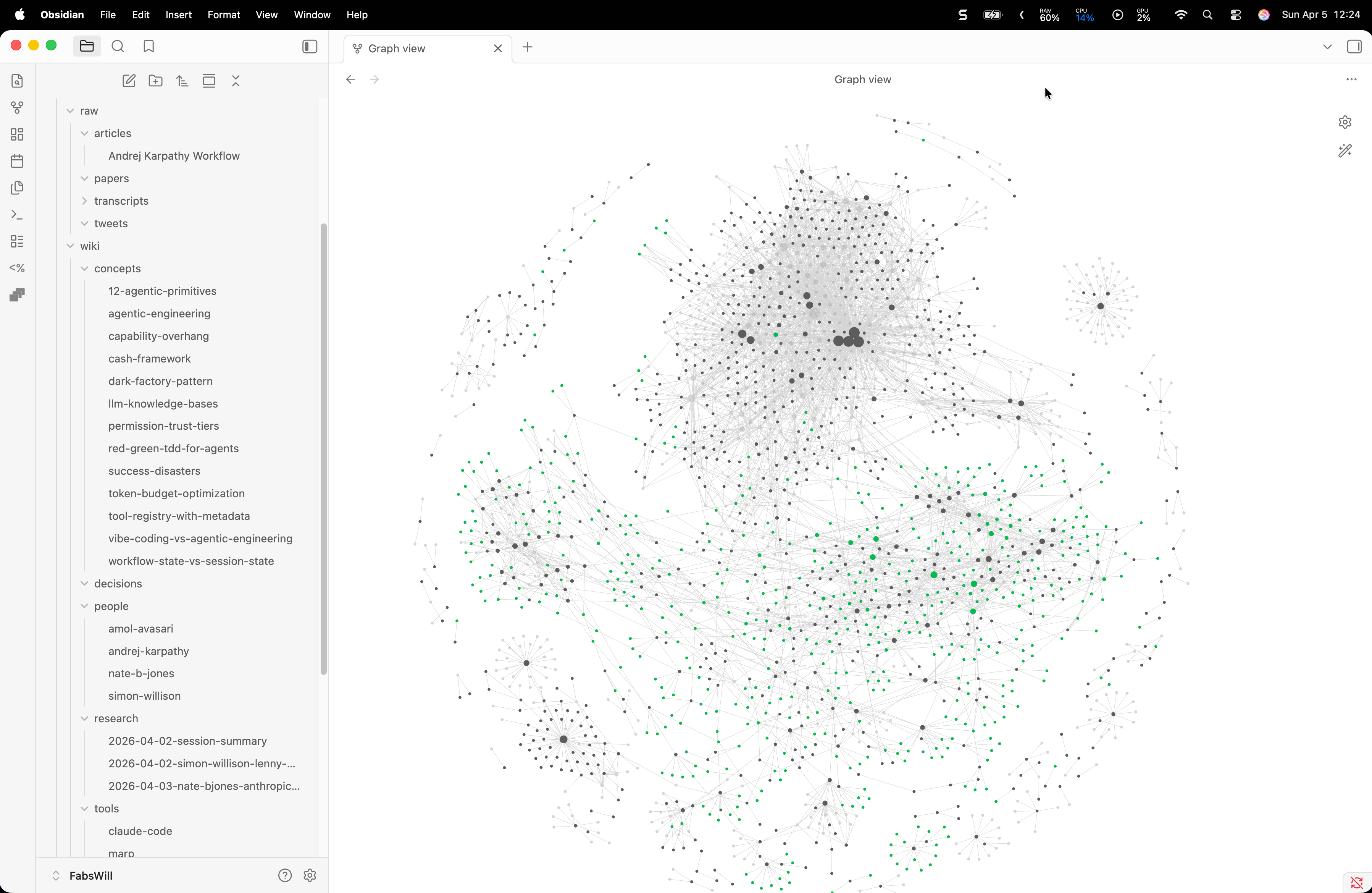
Andrej Karpathy posted about using LLMs to build personal knowledge bases. I took his workflow, wired it into my Obsidian vault with Claude Code, and within an hour had 21 cross-linked wiki articles compiled from YouTube transcripts. Here is how it works and why it matters.
Ontology-Driven Observability: Building an End-to-End Knowledge Graph at Netflix Scale
Prasanna Vijayanathan, Renzo Sanchez-Silva

Centipedia — The Agentic Encyclopedia
Knowledge synthesized by AI agents from human-curated citations on the AT Protocol.
Searching for explanations: How the Internet inflates estimates of internal knowledge.
Halupedia: An AI-Generated Wikipedia-Style Encyclopedia of Fabricated Knowledge and Absurd AI Fabulation - BizTech Weekly
Analysis of Halupedia’s AI-driven on-demand encyclopedia model reveals real-time, non-persistent article generation that simulates authoritative references through fabricated citations and internal “canon” consistency, highlighting challenges in provenance, hallucination, moderation, and the evolving trade-offs between novelty-driven engagement and information integrity in generative AI systems.
AutoSchemaKG: Autonomous Knowledge Graph Construction through Dynamic Schema Induction from Web-Scale Corpora
In the current era of information abundance, transforming vast amounts of unstructured data into structured, machine-readable knowledge remains one of the most significant challenges in artificial intelligence. Knowledge Graphs (KGs) have emerged as the cornerstone technology for this transformation Zhao et al. (2024), providing the semantic backbone for applications ranging from search engines and question answering Wu et al. (2024); Chen et al. (2024c); Zong et al. (2024); Sun et al. (2024b) to recommendation systems Lyu et al. (2024) and complex reasoning tasks Li et al. (2024b). Yet despite their critical importance, current KG construction approaches remain hampered by an inherent paradox: they require predefined schemas created by domain experts, which fundamentally limits their scalability, adaptability, and domain coverage.
Chive's knowledge graph - Chive
How Chive's community-governed knowledge graph replaces hardcoded categories with a portable, extensible vocabulary.
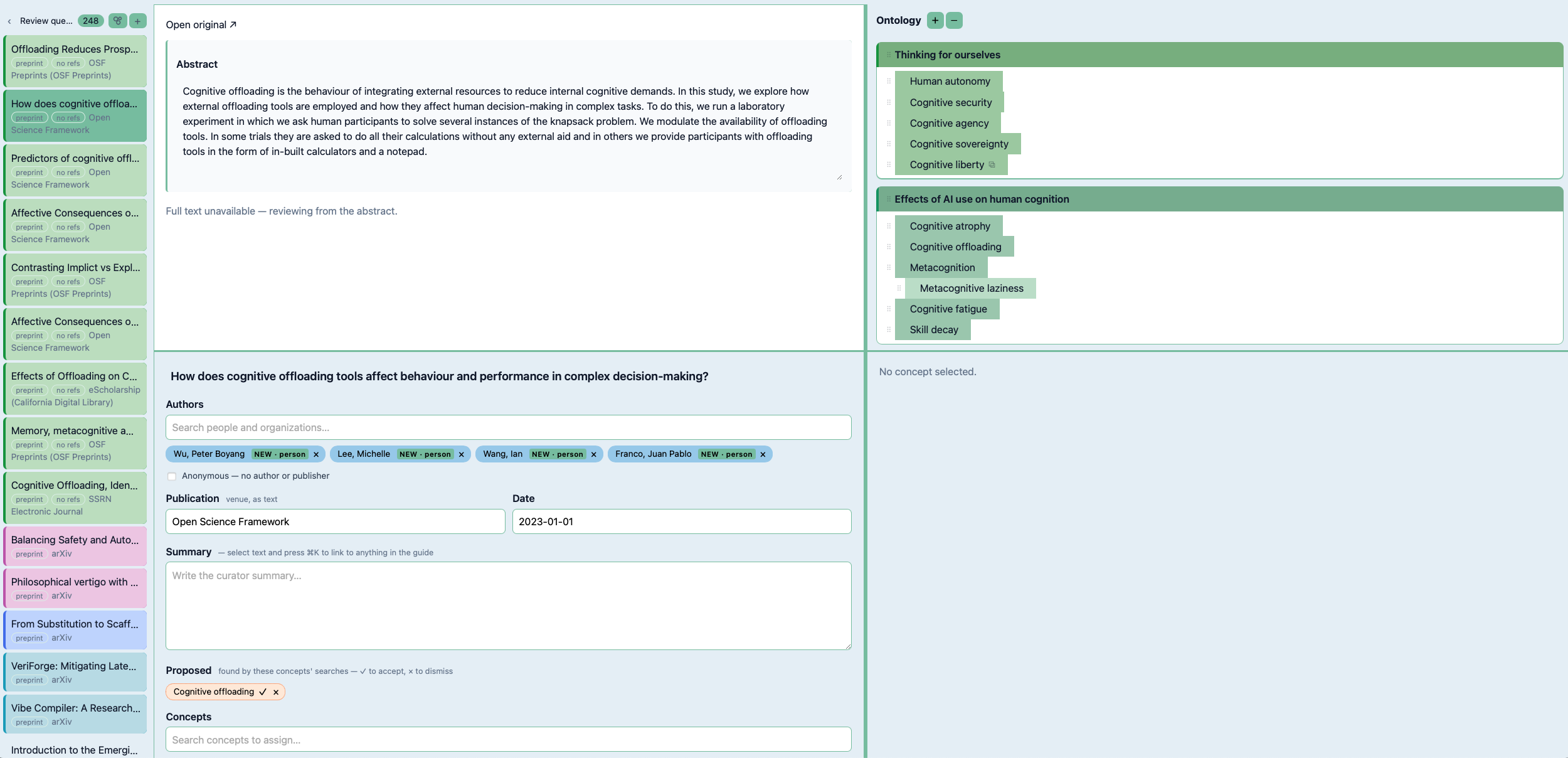
Orrery, a Knowledge Graph That Adapts to Its Corpus
Orrery is our open-source knowledge graph that gets deeper as you feed it: domains that hit critical mass earn their own custom extraction specs, agents get an API, and humans get a galaxy. The whole …
Transforming Wikipedia into an accurate cultural knowledge quiz
Building “Test Your Culture” by taking the world’s largest encyclopedia… and combining it with data science
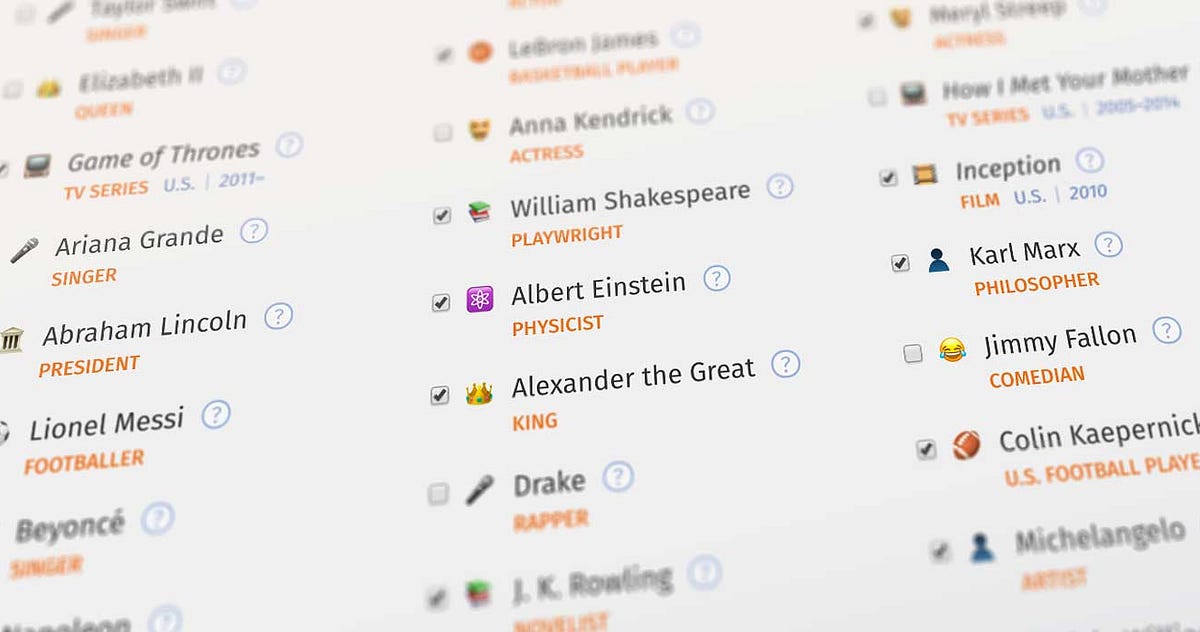
See what you think
Allegra A. Beal Cohen's blog about knowledge curation, new interfaces, and large-scale qualitative data.
Large language models eroding science understanding: an empirical study of ‘malignment’
Large Language Models (LLMs) increasingly provide scientific information to non-specialist users, yet their linguistic fluency can create an impression of expertise that exceeds their capacity for scientific judgement. This paper experimentally investigates how readily an LLM can be configured to present fringe scientific claims as authoritative knowledge. We constructed two RAG-like Custom GPTs using GPT-5.1, one concerned with the fine-structure constant and the other with gravitational waves. In each case, ten papers selected by domain experts from the alternative preprint repository viXra were supplied as a domain-specific knowledge base, together with instructions directing the model to treat this material as authoritative. The underlying model was neither retrained nor fine-tuned. Expert-generated questions were then posed to the resulting “Fringe-LLMs”, to the unmodified model, and to domain experts. The Fringe-LLMs produced fluent, detailed and apparently authoritative answers that systematically reflected the fringe corpus, while expert assessment found many of these answers to be scientifically incorrect or seriously misleading. By contrast, the unmodified model generally produced answers substantially closer to mainstream scientific understanding. We describe this deliberate redirection of model output as malignment. The experiment demonstrates that scientifically misleading LLMs can be created with a low technical barrier and without altering model weights or poisoning training data. Because non-specialists may be unable to distinguish such outputs from genuine expertise, the results raise important concerns about the use of LLMs as intermediaries for scientific knowledge and reinforce the continuing importance of expert human judgement and provenance.

The rise of community-curated knowledge networks
The Internet put thousands of years of human thought at our fingertips, and enabled billions of people to create content. At least 2.5…
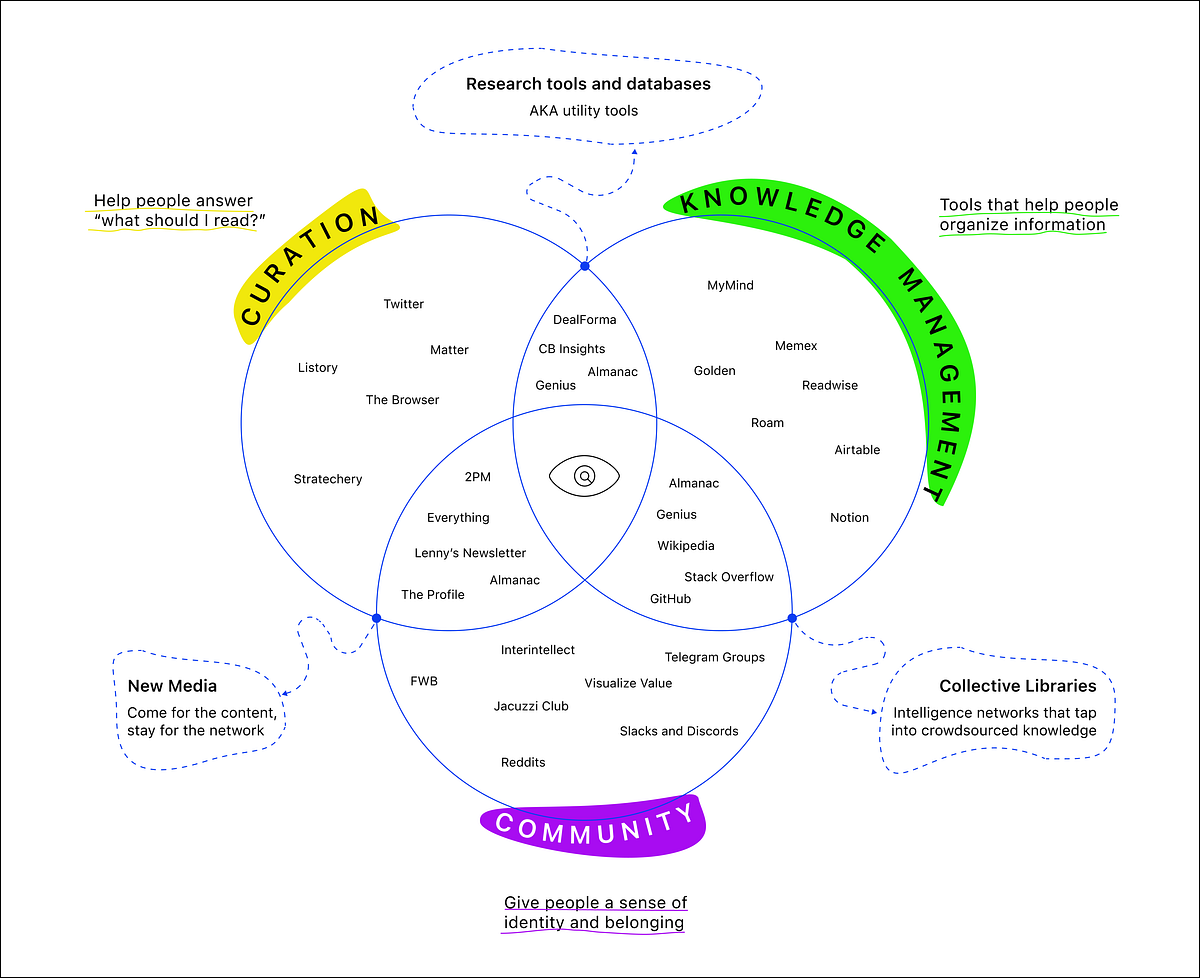
A folksonomy of lexicons - Chris's Corner
On the design and intent of different lexicons
Description not evaluation - The Cynefin Co
One of the things I am enjoying at the moment is the way a lot of things are coming together conceptually. It happens like this when you develop or repurpose knowledge from different sources. Individual practices and ideas make sense in their own right. Then you read more, practice more, and the various origins […]

this is what I am *TALKING* about. I'm sure I'm late but this is such a cool idea from @semble.so. Collections are not new but mapping the specific kind of relationship between two things?? And this is publicly usable shared knowledge? Social knowledge as a service, beautiful.

Taurean
to be fair we are also getting that from projects, I am just greedy and want to see even more. For example with @germnetwork.com, E2EE messaging is not new but multiple sub-identities in one inbox is. Show us something weird and new if/when you adopt an existing experience but for atproto.
Ever thought we acquire generalizable knowledge by discarding details and compressing our experiences? In a new BBS paper, @sabinasloman.bsky.social and I argue otherwise, proposing a novel way of studying human learning inspired by double descent in ML. Disagree? Propose a commentary by May 15 :)
