
Progress as a non-stationary argument
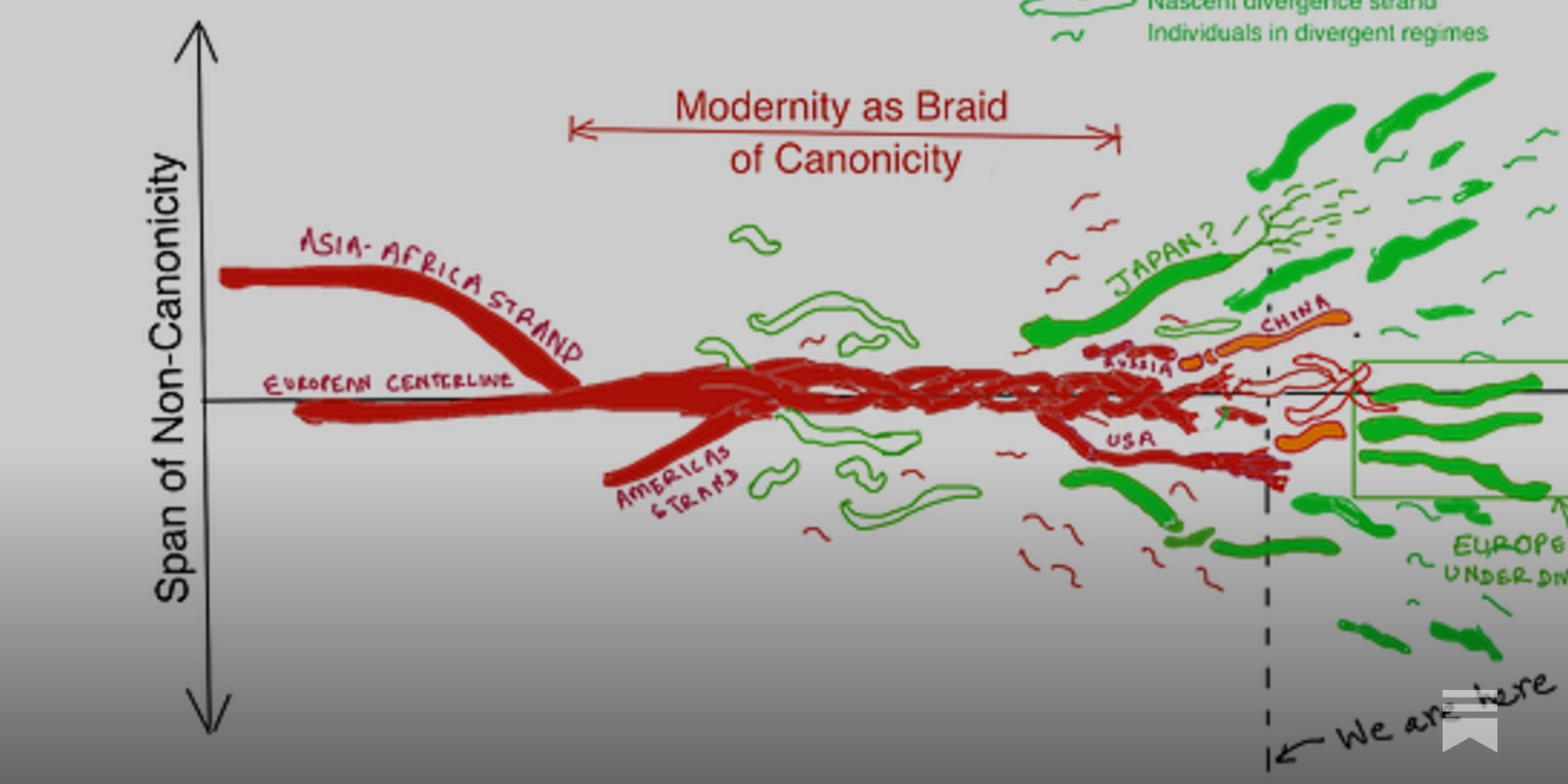
La Grande Divergence
Blog de sciences économiques et sociales de Martin Anota. Traductions, revues de presse.

On the Navier–Stokes Millennium Prize Problem
We’re sharing an AI-generated solution to the Navier–Stokes Millennium Prize Problem, including a writeup and a formal proof in Lean.
Navier-Stokes lost in translation: Why Lean verification of AI...
Autoformalisation is increasingly used to verify mathematical texts, including those generated by AI, as in OpenAI's announced proof of blow-up of solutions to the Navier-Stokes equations. In this...

Valerio Capraro on Twitter / X
BREAKING: OpenAI’s solution to Navier–Stokes does not match its Lean verification.The most important article to read today is not one of OpenAI’s 700 AI-generated math papers.It is this other paper, making a deep and worrying point:A Lean-verified proof does not… pic.twitter.com/bU7TQdv594— Valerio Capraro (@ValerioCapraro) October 8, 2026

No, AI hasn’t officially solved Navier–Stokes. Yet
PropAIganda, now with a Millennium Prize Problem
Spirits and the incompleteness of physics
Complexity, renormalization, and the spirits beyond the horizon of theory

Optimal and Diffusion Transports in Machine Learning
Slides for a general introduction to the use of Optimal Transport methods in learning, with an emphasis on diffusion models, flow matching, training 2 l…

Implementation Divergences · Issue #12 · DavidBuchanan314/millipds
The concrete behaviour of this implementation may diverge from that of the reference impl (that lives in https://github.com/bluesky-social/atproto), sometimes on purpose, sometimes accidentally, so...
Exponential Economist Meets Finite Physicist | Do the Math
[An updated treatment of some of this material appears in Chapter 2 of the Energy and Human Ambitions on a Finite Planet (free) textbook, also mirrors a 2022 article in Nature Physics..]
Early science acceleration experiments with GPT-5
AI models like GPT-5 are an increasingly valuable tool for scientists, but many remain unaware of the capabilities of frontier AI. We present a collection of short case studies in which GPT-5 produced new, concrete steps in ongoing research across mathematics, physics, astronomy, computer science, biology, and materials science. In these examples, the authors highlight how AI accelerated their work, and where it fell short; where expert time was saved, and where human input was still key. We document the interactions of the human authors with GPT-5, as guiding examples of fruitful collaboration with AI. Of note, this paper includes four new results in mathematics (carefully verified by the human authors), underscoring how GPT-5 can help human mathematicians settle previously unsolved problems. These contributions are modest in scope but profound in implication, given the rate at which frontier AI is progressing.
Computational OT #4 - Gradient flow and diffusion models
A course on computational Optimal Transport

Descent-to-Delete: Gradient-Based Methods for Machine Unlearning
We study the data deletion problem for convex models. By leveraging techniques from convex optimization and reservoir sampling, we give the first data deletion algorithms that are able to handle an arbitrarily long sequence of adversarial updates while promising both per-deletion run-time and steady-state error that do not grow with the length of the update sequence. We also introduce several new conceptual distinctions: for example, we can ask that after a deletion, the entire state maintained by the optimization algorithm is statistically indistinguishable from the state that would have resulted had we retrained, or we can ask for the weaker condition that only the observable output is statistically indistinguishable from the observable output that would have resulted from retraining. We are able to give more efficient deletion algorithms under this weaker deletion criterion.
OpenAI solves Navier–Stokes, but research misconduct concerns remain | Olga Holtz posted on the topic | LinkedIn
OpenAI says its AI has solved a Millennium Prize Problem: Navier–Stokes. A human mathematician asks whether OpenAI committed research misconduct. As a mathematician working at the intersection of mathematics and AI, I find this truly messy while also potentially historic. Three things deserve attention. 1. The fine print IS the mathematics. The claimed construction starts with a three-dimensional incompressible fluid at rest. Under a smooth external force, its velocity becomes unbounded in finite time, even while its kinetic energy stays bounded. Crucially, the force itself remains smooth through the singularity. Forcing is explicitly permitted in Clay’s official breakdown alternatives C and D. Its presence does not disqualify the result. But this construction does not establish blow-up for unforced Navier–Stokes. That distinction matters. 2. This was a research system, not one clever prompt. OpenAI reports roughly 10,000 concurrent agents in the successful group and a result after about 88 hours. The Navier–Stokes effort used approximately 130 billion output tokens; Lean formalization and verification took another 17 hours. Human researchers redirected the effort and used tools to consolidate intermediate insights. The salient part here, as I already wrote earlier, is a new organization of mathematical discovery using an enormous amount of compute, not a faster chatbot. The published Lean formalization is important: there is something concrete for others to check. Let‘s see independent scrutiny of both the proof and whether the formal statement matches the intended theorem. 3. Proof verification is not provenance verification. The result follows the line of attack designed by Spanish mathematicians Diego Córdoba and Luis Martínez Zoroa, who appeared to be close to solving the problem themselves. Tristan Buckmaster has raised concerns about research priority and possible use of private Codex material (his statement is linked to the comment by Guillermo Núñez Ponasso below). Those concerns are not automatic proof of misconduct, yet: OpenAI recognizes Buckmaster and Levent Alpöge’s priority on forced Euler, a related but different problem. It denies accessing their unpublished work. But it also cannot rule out de-identified data from their OpenAI product usage helping improve its models, though it calls that unlikely. Is it though? That ‚leakage’ is quite possible, in my view. If correct, this is an extraordinary result. Let’s get independent verification. And let’s protect unpublished research — but exactly how to protect it from an AI lab if using its tools for this research? Recall that a verified theorem can settle a mathematical question. It cannot, by itself, settle scientific credit or establish that the discovery process was fair. Are you comfortable using an AI lab’s tools when that lab could also become your research competitor? https://lnkd.in/g4HzzUNp #AI #Mathematics #AIforScience #MillenniumProblems #NavierStokes | 54 comments on LinkedIn

The Next Great Divergence: How AI could split the world again if we don’t intervene | Brookings
Michael Muthukrishna and Philip Schellekens argue that AI, like past general-purpose technologies, could drive a new global divergence unless deliberate action ensures its benefits are broadly shared rather than geographically concentrated.

AI Has Solved One of Math’s $1 Million Millennium Prize Problems | Quanta Magazine
Mathematicians at OpenAI showed that the Navier-Stokes equations, which describe how fluids flow, can sometimes “blow up.” But the massive result is not without controversy.