

This toolkit contains tools to extract conversational features and analyze social phenomena in conversations, using a single unified interface inspired by (and compatible with) scikit-learn. Several large conversational datasets are included together with scripts exemplifying the use of the toolkit on these datasets. The latest version is 4.1.2 (released June 26, 2026); follow the project on GitHub to keep track of updates.
LibreChat - The Open-Source AI Platform
LibreChat brings together all your AI conversations in one unified, customizable interface.
Introducing Convo — Hippo
Last week, I released Convo, a messaging app for feature phones (of the button variety). That has generated quite a bit of interest—and already racked up a hundred downloads within 24 hours!—so I decided to write a bit more about it here.
Luozhu on Twitter / X
I taught a speech model to understand context in conversation. This is what happenedIt adjusts voice and tone to express urgency, comfort, understanding from the dialogue. Just like a real human being520M model. Runs locally on consumer devicesHow this is achieved 🧵 pic.twitter.com/oMgSh2TKbO— Luozhu (@LuozhuZhang) February 27, 2026

AI tools make things up a lot, and that’s a huge problem | CNN Business
Artificial intelligence-powered tools like ChatGPT have mesmerized us with their ability to produce authoritative, human-sounding responses to seemingly any prompt. But as more people turn to this buzzy technology for things like homework help, workplace research, or health inquiries, one of its biggest pitfalls is becoming increasingly apparent: AI models sometimes just make things up.
ChatGPT is bullshit
Ethics and Information Technology - Recently, there has been considerable interest in large language models: machine learning systems which produce human-like text and dialogue. Applications of...

Why ChatGPT Keeps Interrupting You — Dr. Tom Shapland, LiveKit
On-screen and now IRL: FSU researchers find evidence of ChatGPT buzzwords turning up in everyday speech
Within five days of ChatGPT’s release in 2022, the artificial intelligence chatbot gained more than a million users. Today, more than half of all adults

PII-TRACE: Detecting Personal Data Before It Leaves a Device
Discover how PII-TRACE tests recurring PII detection in long multilingual conversations with a compact 0.6B local model.

This Conversation Is Being Recorded. They All Are.
People in tech use AI apps to record and transcribe meetings, workplace chats and even dates—all in the name of productivity.

DeepL AI Platform: Translation, Voice & API
Explore our AI suite and get more done: Translate speech, text, and media, or integrate the DeepL API.
Investigating Affective Use and Emotional Well-being on ChatGPT
As AI chatbots see increased adoption and integration into everyday life, questions have been raised about the potential impact of human-like or anthropomorphic AI on users. In this work, we investigate the extent to which interactions with ChatGPT (with a focus on Advanced Voice Mode) may impact users' emotional well-being, behaviors and experiences through two parallel studies. To study the affective use of AI chatbots, we perform large-scale automated analysis of ChatGPT platform usage in a privacy-preserving manner, analyzing over 3 million conversations for affective cues and surveying over 4,000 users on their perceptions of ChatGPT. To investigate whether there is a relationship between model usage and emotional well-being, we conduct an Institutional Review Board (IRB)-approved randomized controlled trial (RCT) on close to 1,000 participants over 28 days, examining changes in their emotional well-being as they interact with ChatGPT under different experimental settings. In both on-platform data analysis and the RCT, we observe that very high usage correlates with increased self-reported indicators of dependence. From our RCT, we find that the impact of voice-based interactions on emotional well-being to be highly nuanced, and influenced by factors such as the user's initial emotional state and total usage duration. Overall, our analysis reveals that a small number of users are responsible for a disproportionate share of the most affective cues.

Announcing CSML, a new open-source language to easily build full-featured chatbots
We are building the framework to support the chatbots of the future

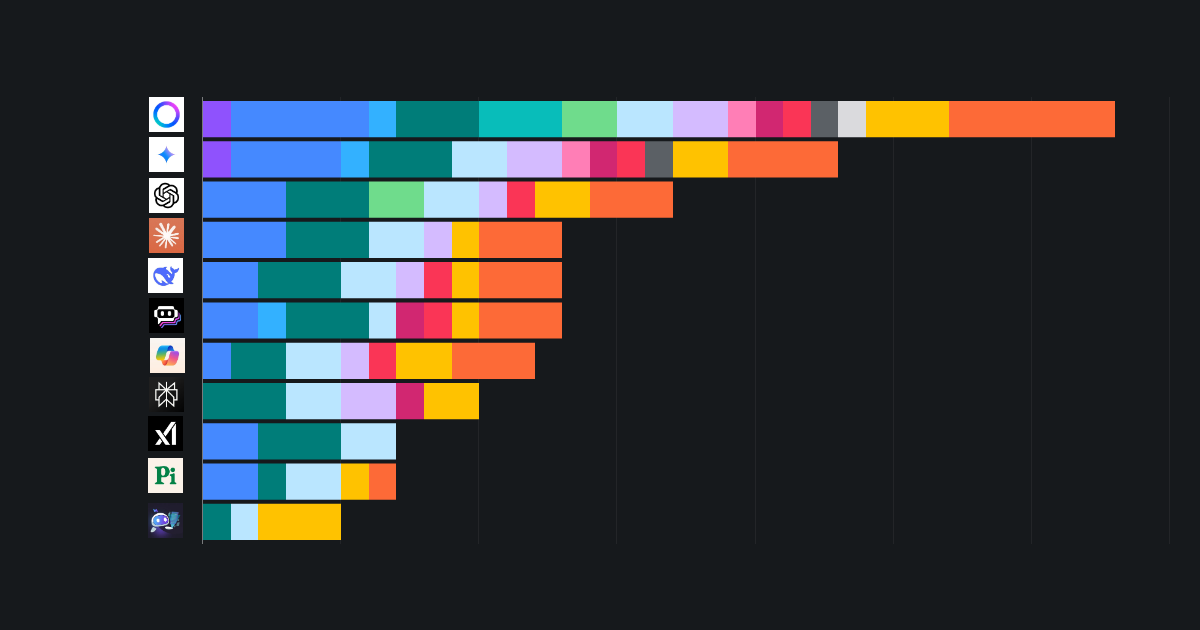
AI chatbots ranked by data they collect - Surfshark
Surfshark analyzed the data collection practices of popular AI chatbots, including Meta AI, Google Gemini, DeepSeek, ChatGPT, and others. The study shows that 70% of AI chatbots collect user location.
Latest ChatGPT model uses Elon Musk’s Grokipedia as source, tests reveal
Guardian found OpenAI’s platform cited Grokipedia on topics including Iran and Holocaust deniers

Reupping a 🧵 from this summer: This product is supposedly about conversations, but it's missing a key feature which highlights the interactions we've had The most useful tab I could have when viewing your profile is a timeline focused on *our* conversations: quotes, replies, reposts, likes, etc.

Paul Rohr
For example, what if MY view of YOUR profile included an affordance which let me chronologically browse the intersection of: - everything you posted + I liked, or - vice versa Would those two be separate timelines, or just a single conversational flow of all our mutual interactions? Hmmm...