

The report from the European Commission identifies 10 key challenges and emerging trends impacting European democratic systems and suggests future policy options. These challenges are structured across three interconnected levels: citizens and societal dynamics, the information and knowledge environment, and institutions and the democratic system. This framework aims to provide a comprehensive and integrated view of democracy as a connected ecosystem, emphasising how challenges in one area can affect the entire system.
New Project to Tackle the Challenge of Scaling Democratic Innovations | CoP CC on Participatory and Deliberative Democracy
The “Missing Link” between Research and Society
Fractured reality
The report examines the evolving impact of digital technologies on European democracy. In an era of a global struggle to control the information space, this report offers critical insights into the fracturing of perceived realities, the rise of the ‘fantasy-industrial complex’, and the systemic risks posed by the attention economy. It exposes how platforms algorithmically prioritise engagement over accuracy, reinforcing ideological echo chambers and amplifying mis- and disinformation that erode democratic resilience. The report highlights how structural incentives and foreign control of the most important players in the information space undermine information integrity, collective knowledge and civic discourse. In response, the report presents a number of recommendations from fostering alternative public spaces and crowd-sourced knowledge systems to reforming business models, restoring user agency, and advancing EU digital sovereignty through decentralised infrastructure
Five dimensions of scaling democratic deliberation: With and beyond AI
DemocracyNext's new paper on Five dimensions of scaling democratic deliberation: With and beyond AI
The architecture of the internet creates risks for democracy
Will democracy survive the internet? Do we need to choose between Facebook’s surveillance capitalism or democracy? Layered lines of evidence can inform questions like these. When considered together, the evidence gives rise to a concerning picture, as summarized in a recent report for the European Commission that I co-led.

Democracy Policy Network
Together, we can build the foundation for a deeper democracy.
Democracy Tracker | The Global State of Democracy
Each report describes an event that affects the state of democracy in a given country, with assessments made relative to that country's context, not as comparisons or rankings between countries.
Why Online Democracies Fail - Eclectic Corvine Muses
A compendium to my upcoming proposal for community infrastructure within the AT Protocol
The Crisis of Democracy: Report on the Governability of Democracies to the Trilateral Commission
The Crisis of Democracy: On the Governability of Democracies was initially a 1975 report written by Michel Crozier, Samuel P. Huntington, and Joji Watanuki for the Trilateral Commission and later published as a book. The report observed the political state of the United States, Europe and Japan and says that in the United States the problems of governance "stem from an excess of democracy" and thus advocates "to restore the prestige and authority of central government institutions."
A Roadmap to Democratic AI — The Collective Intelligence Project
Our roadmap outlines concrete steps that can be taken in 2024 to build a more democratic AI ecosystem that is adaptive, accountable, processes decentralized information, provides public goods, and safeguards human wellbeing. We describe what the ecosystem could build, research, advocate for, and fun
Citizen Participation (@oliverescobar.bsky.social)
Professor of Public Policy and Democratic Innovation | University of Edinburgh | Working on #democracy #participation #deliberation #commons #governance #power #research | RT≠ endorse | Own views | Profile: https://www.sps.ed.ac.uk/staff/oliver-escobar

Citizen Participation (@oliverescobar.bsky.social)
Professor of Public Policy and Democratic Innovation | University of Edinburgh | Working on #democracy #participation #deliberation #commons #governance #power #research | RT≠ endorse | Own views | Profile: https://www.sps.ed.ac.uk/staff/oliver-escobar
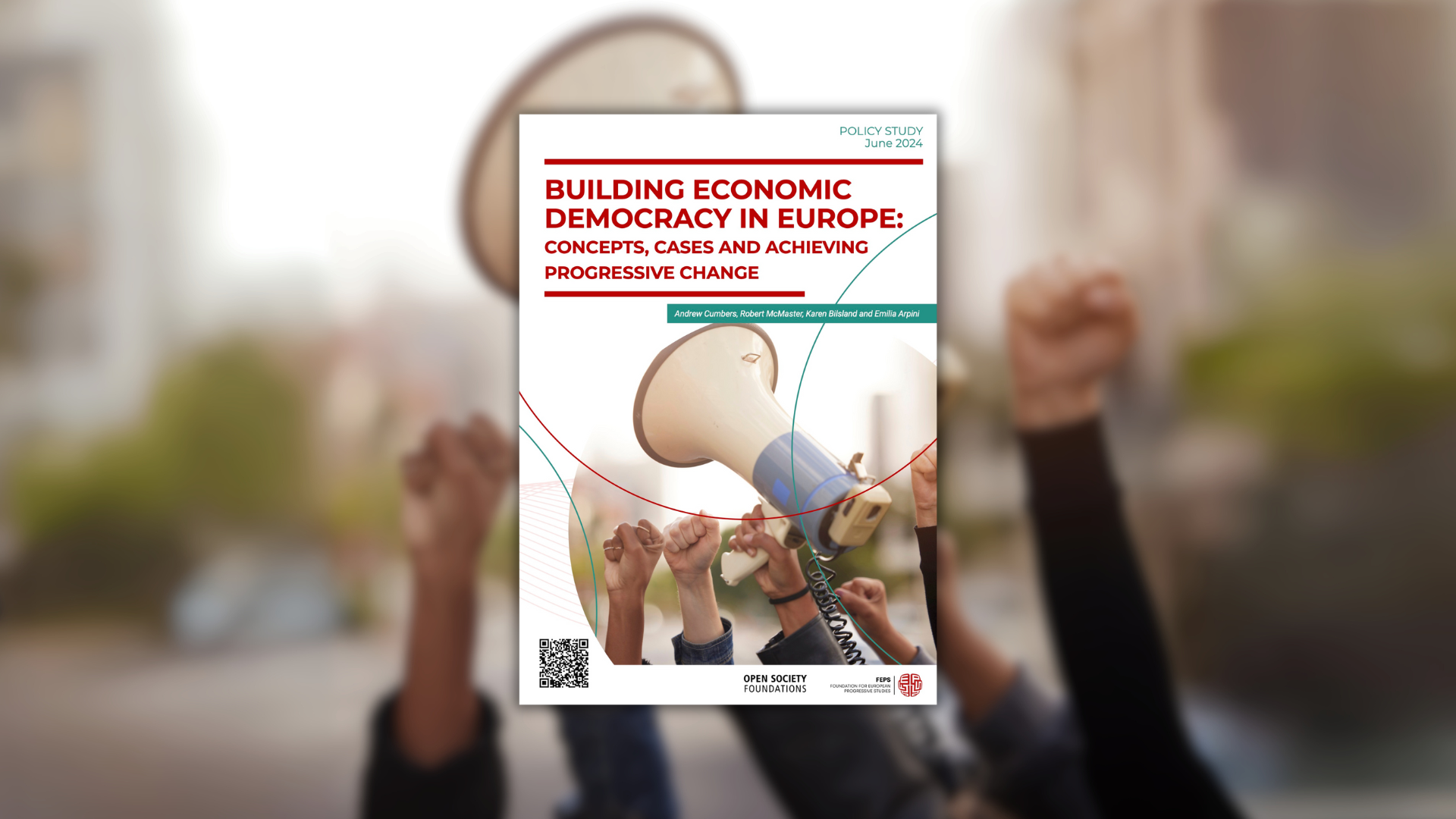
Building Economic Democracy in Europe - Foundation for European Progressive Studies
Concepts, Cases and Achieving Progressive Change
Democratic Governance of AI Is the Real Solution
The potential for catastrophic effects from the AI boom demands robust deliberation and real democratic governance. Localized initiatives like data center moratoria won't get us there.

We Need To Rethink Democracy
Democracy is an epistemic discipline, it only works if truth can constrain power. Without a faster, more transparent architecture for shared reality, the arc of democracy bends away from substance, through simulation, and toward authoritarianism. Without major action, it's the inevitable end state.
