Many Rust beginners with a background in systems programming tend to use bool (or even u8 – an 8-bit unsigned integer type) to represent “state”. For example, how about a bool to indicate whether a user is active or not? struct User { // ... …
A Kubernetes Operator in Rust
You can check the operator yourself here, or use it as boilerplate code to start your own rust operator. A little bit of background I’ve been writing Kubernetes operators for quite some time …

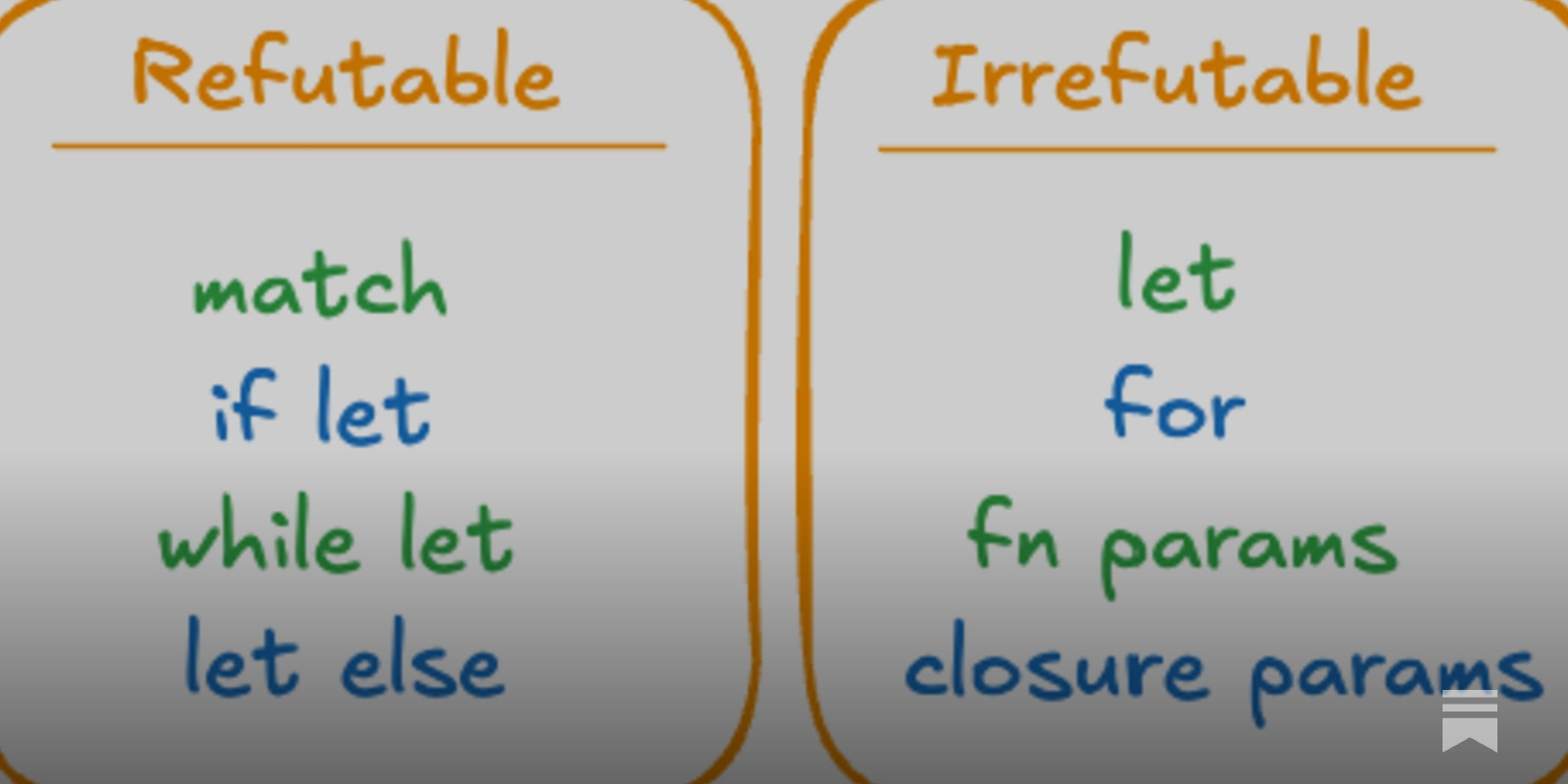
Level Up your Rust pattern matching
Rust’s pattern matching feels simple enough: match on enums, destructure tuples, handle Option and Result.
Place Capability Graphs: A General-Purpose Model of Rust’s Ownership and Borrowing Guarantees
Rust’s novel type system has proved an attractive target for verification and program analysis tools, due to the rich guarantees it provides for controlling aliasing and mutability. However, fully understanding, extracting and exploiting these guarantees is subtle and challenging: existing models for Rust’s type checking either support a smaller idealised language disconnected from real-world Rust code, or come with severe limitations in terms of precise modelling of Rust borrows, composite types storing them, function signatures and loops.
Rust Error Handling: thiserror, anyhow, and When to Use Each
In this blog post, we’ll explore strategies for streamlining error handling in Rust using two popular libraries: thiserror and anyhow. We’ll discuss their features, use cases, and provide insights on when to choose each library. TL;DR thiserror simplifies the implementation of custom error type, removing boilerplates anyhow consolidates errors that implement std::error::Error While thiserror provides detailed error information for specific reactions, anyhow hides internal details Return Different Error Types from Function Let’s start by creating a function decode() for illustration. The function has 3 steps:
Pretty State Machine Patterns in Rust
A computer scientist working in open source towards a more hopeful future.

The Rust Programming Language - The Rust Programming Language
by Steve Klabnik, Carol Nichols, and Chris Krycho, with contributions from the Rust Community
into_inner in Rust - NotDefine.dev
Learn how the into_inner pattern works in Rust: how it uses ownership to unwrap a struct and return the inner data, with a real-world example from std::io::BufWriter
Why Use Structured Errors in Rust Applications?
Going against the common wisdom of “using anyhow for applications”.
Tutorial: Writing a tiny Entity Component System in Rust
The Entity Component System (or ECS) pattern is all the rage in the Rust game development community. In this short tutorial we're going to build our own.
Pscheidl/rust-kubernetes-operator-example
An example of a Kubernetes operator implemented in Rust
fjall - Rust
Fjall is a log-structured embeddable key-value storage engine written in Rust. It features:
Be alert: targeted attacks on prominent Rustaceans | Rust Blog
Empowering everyone to build reliable and efficient software.
Rust in 2021
This is my response for this year's call for blog posts. I am writing this as a language implementor, not as a language user. I also don't try to prioritize the problems. The two things I'll mention are the things that worry me most without reflecting on the overall state of the project. They are not necessary the most important things.
Master Hexagonal Architecture in Rust
Everything you need to write flexible, future-proof Rust applications using hexagonal architecture.