

NoticeThis page is no longer being updated. It may contain outdated information and links may no longer function as originally intended.
Global: Risk Profiling Systems Used to Identify Potential Offenders Breach International Law and Must Be Banned – New Report
Widespread risk profiling by law enforcement, social security and migration is incompatible with international human rights law and must be banned.

The Matrix - The Center for Evidence-Based Crime Policy (CEBCP)
The Evidence-Based Policing Matrix What strategies can be effective in reducing crime and disorder in policing? The Evidence-Based Policing Matrix is a research-to-practice translation tool that collects, summarizes, and organizes moderate to very rigorous evaluations of police interventions, allowing agencies and researchers to view the field of research in this area. The Matrix includes studies…
Journalists and Researchers: How to Examine FBI Crime Data for Your Community
Here’s what to know about NIBRS, the FBI’s program for collecting police data from 15,000 agencies across the U.S.
Criminal Justice Fact Sheet
A compilation of facts and figures surrounding policing, the criminal justice system, incarceration, and more.

How Police Make Up The Law (ft. LegalEagle)
What About the Rapists and Murderers?
Trigger warning: rape, sexual assault, murder, torture, ablelism, trauma.
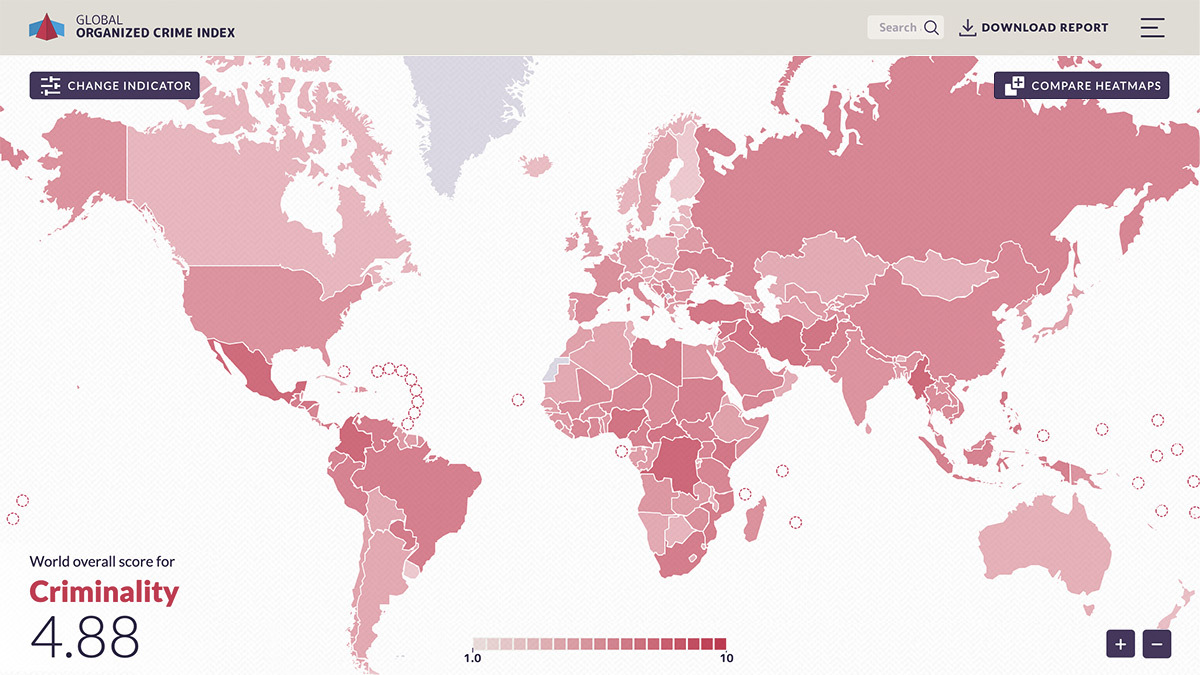
The Organized Crime Index
Based on the 2019 ENACT Organised Crime Index for Africa, the Global Organized Crime Index is a key flagship project of the Global Initiative Against Transnational Organized Crime.
Predictive Policing and the Politics of Patterns
Abstract Patterns are the epistemological core of predictive policing. With the move towards digital prediction tools, the authority of the pattern is rearticulated and reinforced in police work. Based on empirical research about predictive policing software and practices, this article puts the authority of patterns into perspective. Introducing four ideal-typical styles of pattern identification, we illustrate that patterns are not based on a singular logic, but on varying rationalities that give form to and formalize different understandings about crime. Yet, patterns render such different modes of reasoning about crime, and the way in which they feed back into policing cultures, opaque. Ultimately, this invites a stronger reflection about the political nature of patterns.

12 Commonsense Safeguards - staffny
Officers must list the law being violated, provide a case number, and explain the suspicion tied to a specific vehicle or plate. Limit use only to suspected fel...

Commission publishes guidelines on the protection of minors
On 14 July 2025, the Commission has published its guidelines on the protection of minors under the DSA to ensure a safe online experience for children and young people.
Artificial Intelligence, Predictive Policing, and Risk Assessment for Law Enforcement
There are widespread concerns about the use of artificial intelligence in law enforcement. Predictive policing and risk assessment are salient examples. Worries include the accuracy of forecasts that guide both activities, the prospect of bias, and an apparent lack of operational transparency. Nearly breathless media coverage of artificial intelligence helps shape the narrative. In this review, we address these issues by first unpacking depictions of artificial intelligence. Its use in predictive policing to forecast crimes in time and space is largely an exercise in spatial statistics that in principle can make policing more effective and more surgical. Its use in criminal justice risk assessment to forecast who will commit crimes is largely an exercise in adaptive, nonparametric regression. It can in principle allow law enforcement agencies to better provide for public safety with the least restrictive means necessary, which can mean far less use of incarceration. None of this is mysterious. Nevertheless, concerns about accuracy, fairness, and transparency are real, and there are tradeoffs between them for which there can be no technical fix. You can't have it all. Solutions will be found through political and legislative processes achieving an acceptable balance between competing priorities.
What It Looks Like When the New York City Police Commissioner Has “Unchecked Power” Over Officer Discipline
While a civilian board can prosecute misconduct cases involving NYPD officers, the police commissioner has the final word. Frequently, that power is used to reduce penalties.

Crime - One Nation Victoria
Toughest state on crime: a 24/7 Bail Court, ninety-day justice for violent charges, adult sentencing for serious child offenders, and police freed to patrol.
