

Another day, another exhortation to join an “ecosystem” that’s anything but. I could pick a hundred examples, but one that recently caught my eye was an ad placed in the Financial Times by the Singapore stock exchange, SGX Group, promising “multiple growth avenues, one trusted ecosystem”. SGX wants companies to list on its exchange rather than, say, the Hong Kong one which has more or less the same exclusive offer. SGX promises “access (to) Asia through our trusted ecosystem anchored in Singapore.” Ecosystems can be a lot of things. ‘Trusted’, by which they mean centrally policed to achieve defined, lower-risk outcomes, is not one of them. Calling built environments ‘ecosystems’ is common everywhere from financial services to supply chains to – quite a stretch, here – a retirement living complex. But it’s most often used in the tech world to describe the relations between software, services and hardware typically owned by a single company. For example, it’s how Google describes everything that hangs off the Android operating system. These kinds of proprietary and deterministic architectures are called ecosystems so often that we’ve stopped noticing. And that’s kind of the point. We need to start seeing this metaphor again, and what it’s hiding in plain sight. But first, a reminder of what an ecosystem actually is.
The ecosystem is moving
Considerations for distributed and decentralized technologies from the perspective of a product that many would like to see decentralize....
An ecological perspective to master the complexities of the digital economy
Economic and social interactions are shifting to digital platforms which grow into vast ecosystems where user engagement creates value for members while ecosystem orchestrators harvest massive revenue. The digital ecosystem business model succeeds by adeptly navigating fast-changing environments, including new technologies and volatile demands, through dynamic innovation in a decentralized decision-making setting. This renders digital platform ecosystems complex adaptive systems. Recognizing that natural ecosystems are a prime example of complex adaptive systems, we propose a systematic hierarchical framework for describing and understanding digital ecosystems, rooted in ecology and evolution. Our framework compares digital ecosystems hosted by societies to natural ecosystems embedded in biomes, products to species, and technologies and elements of business strategy to the genetic makeup of a species. As digital platforms face heightened scrutiny about their socio-economic power and societal value, our approach contributes to the development of deeper understanding and sustainable governance of the digital economy.
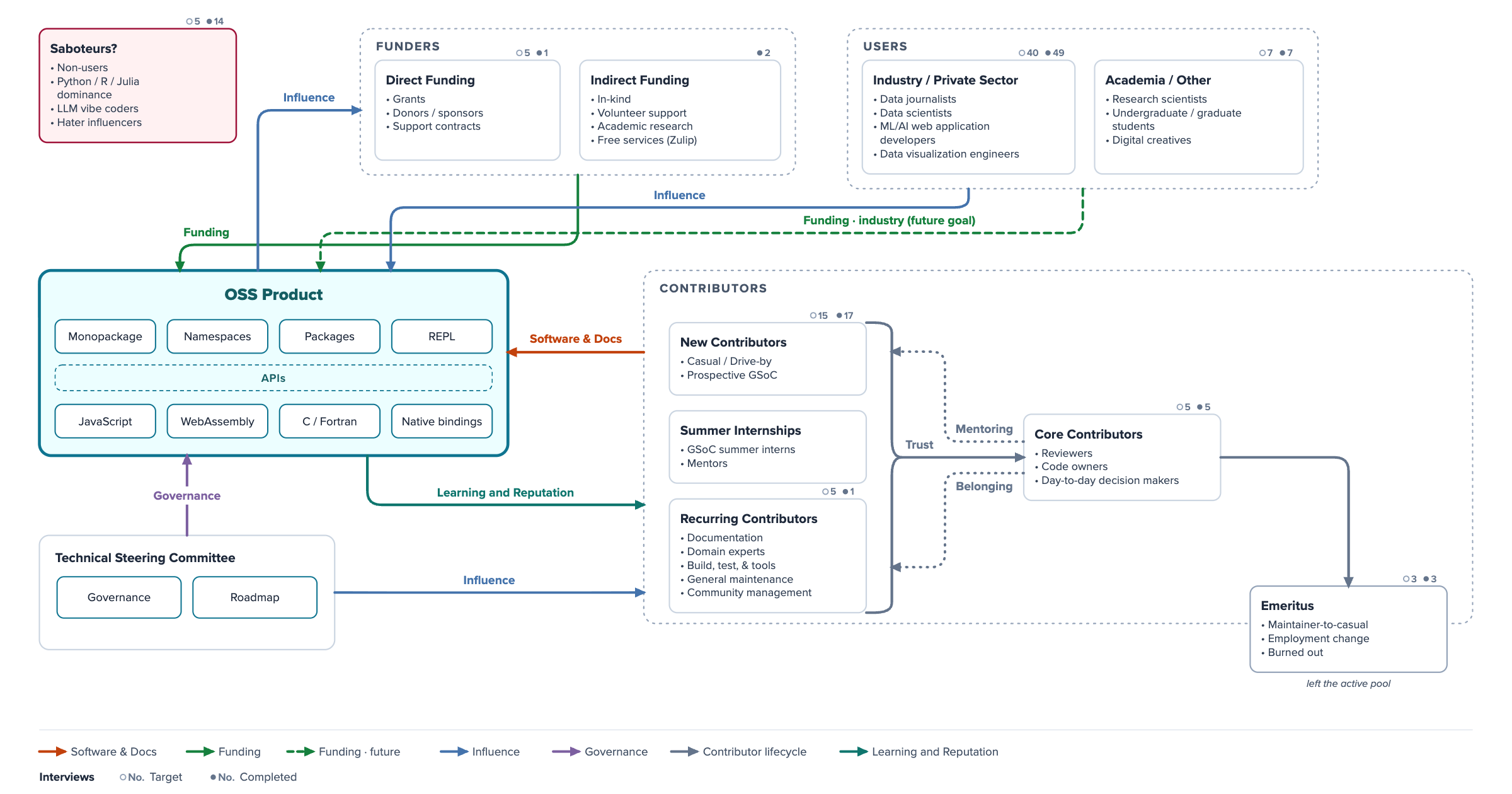
Ecosystem Mapping — Open Tech Strategies | Blog
All the power of open source comes from throwing in with your neighbors, even the neighbors you don't like very much. For most projects, the main reason to get involved in open source is to create productive relations with as many participants as possible, including rivals. Doing this well requires understanding who is in your ecosystem and how they relate to each other.
Defining “Participatory Ecosystem” — Grow the Pie, N...
A blog on social software, collaboration, trust, security, privacy, and internet tools by Christopher Allen. Defining “Participatory Ecosystem” — Grow t...
Closed platform
A closed platform, walled garden, or closed ecosystem[1][2] is a software system wherein the carrier or service provider has control over applications, content, and/or media, and restricts convenient access to non-approved applicants or content. This is in contrast to an open platform, wherein consumers generally have unrestricted access to applications and content.
Ecosystem Plugins - Wesley's notes
Bridging the interop gap and addressing the long-tail of user needs
Don't fork the ecosystem
Software can be rebuilt, because software is a machine. But a software ecosystem is not a machine. It is a living system.

Designing a multi-sided data platform: findings from the International Data Spaces case
The paper presents the findings from a 3-year single-case study conducted in connection with the International Data Spaces (IDS) initiative. The IDS represents a multi-sided platform (MSP) for secure and trusted data exchange, which is governed by an institutionalized alliance of different stakeholder organizations. The paper delivers insights gained during the early stages of the platform’s lifecycle (i.e. the platform design process). More specifically, it provides answers to three research questions, namely how alliance-driven MSPs come into existence and evolve, how different stakeholder groups use certain governance mechanisms during the platform design process, and how this process is influenced by regulatory instruments. By contrasting the case of an alliance-driven MSP with the more common approach of the keystone-driven MSP, the results of the case study suggest that different evolutionary paths can be pursued during the early stages of an MSP’s lifecycle. Furthermore, the IDS initiative considers trust and data sovereignty more relevant regulatory instruments compared to pricing, for example. Finally, the study advances the body of scientific knowledge with regard to data being a boundary resource on MSPs.

Mapping Your Ecosystem (and Its Saboteurs)
Naming everyone in your open-source ecosystem—both competitors and colleagues—and following where value flows.
Stuck in the middleware with you: the challenges of capitalizing a market-oriented approach to platform governance
T1 - Stuck in the middleware with you: the challenges of capitalizing a market-oriented approach to platform governance
Platformonomics - Dining Preferences of the Cloud and Open Source: Who Eats Who?
TL;DR: If the cloud didn’t eat Hadoop Inc., Pivotal and Red Hat, what explains their diminished prospects? Marc Andresseesssen’s “software is eating the world” has given rise to an entire technolog…

Ecosystem Review
A review of decentralized social media ecosystems published by Twitter's "bluesky" team on the 21st January 2021

Ecosystem services - nature’s benefits
Nature's benefits or ecosystem services depend on a healthy environment. Investing in nature will help to secure these benefits for future generations.
Composable Trust, Part 1: Communities Without Credible Exit - Eclectic Corvine Muses
We guarantee that users aren’t subject to platforms. Yet communities are still subject to their stewards. Can we fix this?
i think the core problem is that the ecosystem was lacking another client that had the institutional gravity to say 'were here longtime, were serious, and were gonna be competing with you on features' without that, the default incumbent trends towards safety (for good reasons)

dan
yea honestly it's a huge L on bsky side that this obvious growth hack is always killed by bikeshedding "how to do it properly". @alexbenzer.com @esb.lol pls just ship something here, change it later
Some thoughts on a taxonomy of ATmospheric apps. I see an ecosystem developing with three categories: - Symbionts, tightly coupled with Bsky; - Offshoots, growing large, parallel communities; and - Cuckoos, which scan as skeuomorphic clones on ATproto but go beyond. numergent.com/2026-04/A-taxonomy-of-ATmosph…
A taxonomy of ATmosphere applications
numergent.com
