


The CrowdNewsroom facilitates journalistic investigations on social grievances, allowing many individuals to participate.
AI Policy • States Newsroom
AI Policy States Newsroom is, above all, dedicated to journalism practiced by people. We believe in the power of having on-the-ground reporters covering our communities with the finesse and nuance that only human interaction can produce. We also recognize the power and potential of generative AI. We are open to the responsible and transparent use […]

Advocacy groups and Metric Media collaborate on local ‘community news’
<p>This is the second part of a two-part investigation. The first piece can be found here. Metric Media launched “Community Newsmaker” in 2020 using the language of citizen journalism. However, what appeared to be grassroots news is part of a sprawling network that promotes political agendas and corporate interests, without disclosing those ties to the […]</p>


A serious problem the news industry does not talk about
Ask anyone working in a newsroom what they think of their audience, and you’ll hear a variety of answers. Over the past couple of years…

Home | International Center for Journalists
We enable a global network of journalists to provide the trustworthy news essential to free and strong societies.

Language Models Trained on State Media Sources Launder Propaganda
Tech Policy Press is a nonprofit media and community venture intended to provoke new ideas, debate and discussion at the intersection of technology and democracy. We publish opinion and analysis.

Still Manufacturing Consent: An Interview with Noam Chomsky | Hacker News
The marking out of the symbiotic relationship between reliable information producers and journalists is also vital to understanding the media system. A reliable, centralised stream of new information content is the life blood of journalism organisations, with a strong emphasis on _reliable_ and _centralised_. This particular need that journalists have sees them often becoming dependent on state institutions and corporations at the expense of minority groups and labor. An example being the journalists 'on the beat' that used to hang out around the local courthouse because that's where the 'feeding trough' is. Or the reports so nicely formatted and condensed produced by the state departments such that journos merely have to copy-paste the information straight into their papers. Easy-peasy.
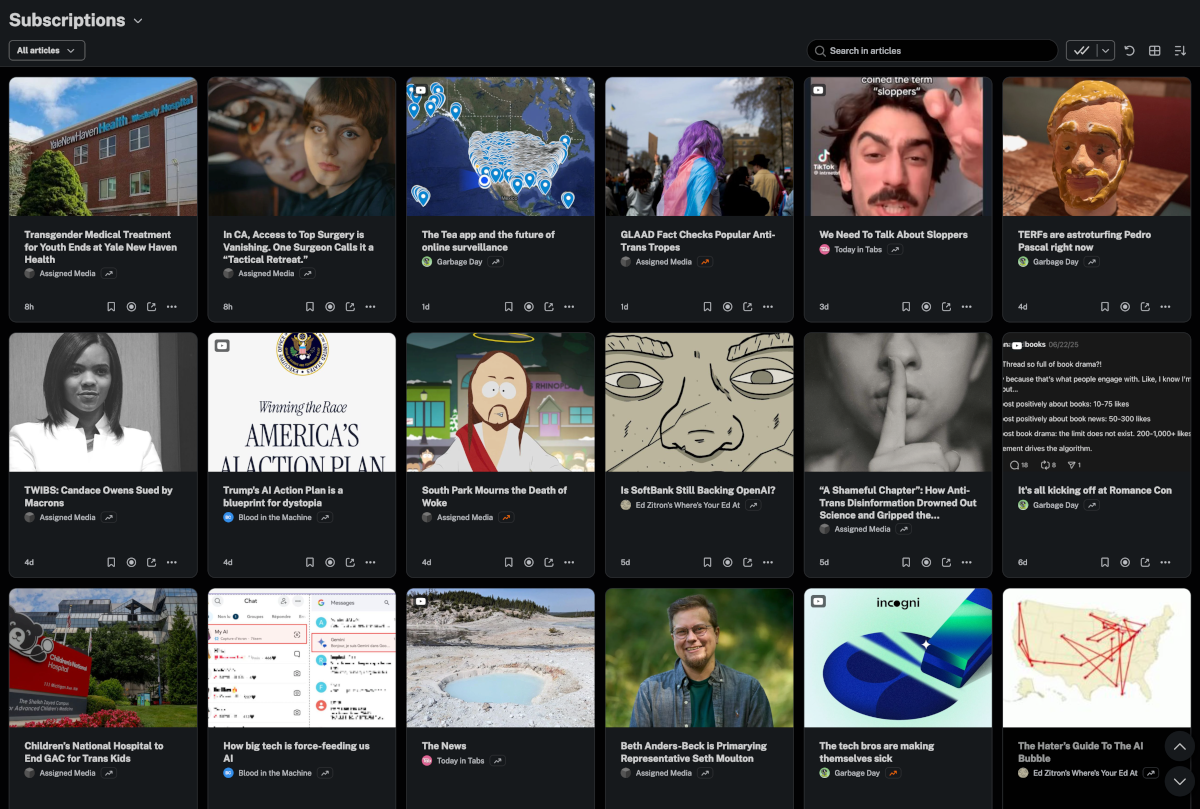
Curate your own newspaper with RSS
Escape newsletter inbox chaos and algorithmic surveillance by building your own enshittification-proof newspaper from the writers you already read
It’s Not 2006 Anymore; The Useful, Vernacular Institution; What Is Free Our Feeds, Anyway?
This issue explores emerging alternatives to centralized social media platforms and the institutional forms that might support them. The newsletter connects reflections from the ATMosphere Conference…

Local Journalism Directory | Media and Democracy Project
We created a directory to help you find local journalism and local news sources in your area worth reading and supporting.

Home - Black Press Media
Truth MattersClarity MattersCommunity MattersPowered by more than 200 Journalists Any Time. Any Place. Any Device. We are dedicated to serving more than 80 communities across Canada and North America with credible and hyperlocal journalism, brought to our readers by passionate journalists who live where they work. Black Press Media is a catalyst for informed engagement […]
The Local Connection Crisis: New Data on What Communities Need
Canadian Journalism Collective – Funding and Support for Canadian Journalism
Learn how the Canadian Journalism Collective distributes funds to Canadian news outlets under the Online News Act. Stay updated on programs and recipients.
What happens when content creators and journalists come together?
Find out how journalists and content creators can work together, and why this collaboration is needed to improve information integrity.

Improving social media for democratic discourse
Social media have expanded opportunities for communication and political participation, but today's dominant platforms are optimized primarily for engagement and advertising revenue, contributing...
