


Dependently typed programming for the BEAM through one kernel-checked compiler pipeline.
A Coming Revolution in Metaprogramming | Will Crichton
A single programming language is no longer enough. I predict that soon, the best programmers will fluently move between languages and the best languages will interoperate well with others. This interoperability will likely stem from strong metaprogramming facilities. I examine how we might build a programmable compiler and look at recent work toward that end.
The Coalton Programming Language
A statically typed, functional programming language that compiles to Common Lisp
Theorems for free! | Proceedings of the fourth international conference on Functional programming languages and computer architecture
The polymorphic blame calculus integrates static typing, including universal types, with dynamic typing. The primary challenge with this integration is preserving parametricity: even dynamically-typed code should satisfy it once it has been cast to a ...
Simply Typed Reverse-Mode Automatic Differentiation with Variants: Denotational Correctness via Idempotent Completion
Reverse-mode automatic differentiation can be derived denotationally as a structure-preserving interpretation of program syntax. In the usual simply typed model, each source type has one cotangent type. Variants break this representation because the valid cotangent space depends on the branch selected at run time; established correctness results therefore use primal-indexed families of cotangent spaces, whose direct internal language is dependent.
Integrating functional and imperative programming | Proceedings of the 1986 ACM conference on LISP and functional programming
We present a new model, based on monads, for performing input/output in a non-strict, purely functional language. It is composable, extensible, efficient, requires no extensions to the type system, and extends smoothly to incorporate mixed-language ...
Production Is a Compiler Input - The Phoenix Architecture
Boomerang | Proceedings of the 35th annual ACM SIGPLAN-SIGACT symposium on Principles of programming languages
Bidirectional programming languages are a practical approach to the view update problem. Programs in these languages, called lenses, define both a view and an update policy - i.e., every program can be read as a function mapping sources to views as well ...

Compiling Models to Megakernels
Fine-grained synchronization, deep pipelines, and zero kernel launch overheads, automatically.
Principal type-schemes for functional programs | Proceedings of the 9th ACM SIGPLAN-SIGACT symposium on Principles of programming languages
As part of the Digital Library's transition to Open Access, new features for researchers are available in the Premium Edition. Click here to learn more.
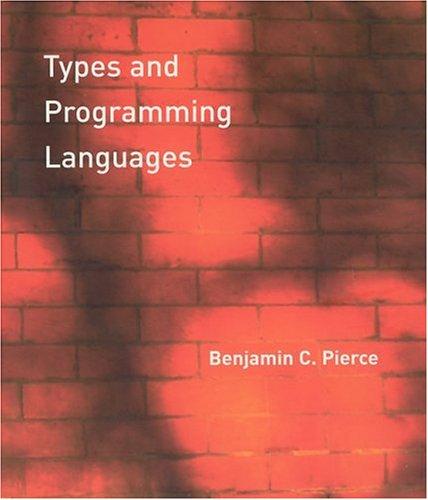
Types and Programming Languages
A type system is a syntactic method for automatically checking the absence of certain erroneous behaviors by classifying program phrases according to the kinds of values they compute. The study of type systems--and of programming languages from a type-theoretic perspective -- -has important applications in software engineering, language design, high-performance compilers, and security. This text provides a comprehensive introduction both to type systems in computer science and to the basic theory of programming languages. The approach is pragmatic and operational; each new concept is motivated by programming examples and the more theoretical sections are driven by the needs of implementations. Each chapter is accompanied by numerous exercises and solutions, as well as a running implementation, available via the Web. Dependencies between chapters are explicitly identified, allowing readers to choose a variety of paths through the material. The core topics include the untyped lambda-calculus, simple type systems, type reconstruction, universal and existential polymorphism, subtyping, bounded quantification, recursive types, kinds, and type operators. Extended case studies develop a variety of approaches to modeling the features of object-oriented languages.
Generic deriving of generic traversals | Proceedings of the ACM on Programming Languages
Functional programmers have an established tradition of using traversals as a design pattern to work with recursive data structures. The technique is so prolific that a whole host of libraries have been designed to help in the task of automatically ...

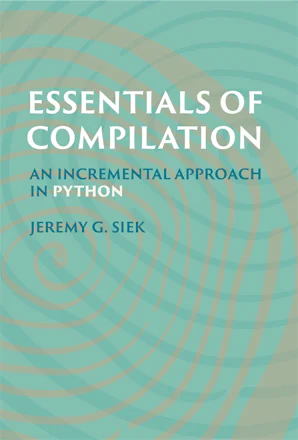
Essentials of Compilation
Compilers are notoriously difficult programs to teach and understand. Most books about compilers dedicate one chapter to each progressive stage, a structure ...
The mythical matched modules | Proceedings of the 24th ACM SIGPLAN conference companion on Object oriented programming systems languages and applications
Certified compilers are complex software systems. Like other large systems, they demand modular, extensible designs. While there has been progress in extensible metatheory mechanization, scaling extensibility and reuse to meet the demands of full ...

Prism: An Impure Functional Language With Typed Effects - Stephen Diehl
Personal blog of Stephen Diehl - Software engineer writing about technology, programming, and the future

Roc on Twitter / X
New syntax, new compiler, new Roc ✨Watch the full talk on where the language is today and where we’re going:https://t.co/FltMYr1YiR— Roc (@roc_lang) November 25, 2025