


An image saved by Parrhesiastes Apertus on Currents.
Save by Parrhesiastes Apertus · Currents
An image saved by Parrhesiastes Apertus on Currents.

Save by Parrhesiastes Apertus · Currents
An image saved by Parrhesiastes Apertus on Currents.

Parrhesiastes on Twitter / X
“No desperdicies el tiempo preguntándote qué hace otro; concéntrate en cumplir aquello que corresponde a tu propia naturaleza.” — Marco Aurelio— Parrhesiastes (@parrhesiastes00) October 3, 2026
Parrhesiastes Apertus on Twitter / X
İslam: duygu, düşünce, söz ve davranış bütünlüğü içinde yaşanması gereken bir dindir.— Parrhesiastes Apertus (@P_arrhesiastes) October 11, 2026
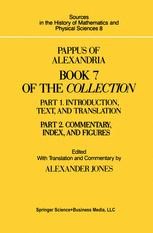
Pappus of Alexandria Book 7 of the Collection
The seventh book of Pappus's Collection, his commentary on the Domain (or Treasury) of Analysis, figures prominently in the history of both ancient and modern mathematics: as our chief source of information concerning several lost works of the Greek geometers Euclid and Apollonius, and as a book that inspired later mathematicians, among them Viete, Newton, and Chasles, to original discoveries in their pursuit of the lost science of antiquity. This presentation of it is concerned solely with recovering what can be learned from Pappus about Greek mathematics. The main part of it comprises a new edition of Book 7; a literal translation; and a commentary on textual, historical, and mathematical aspects of the book. It proved to be convenient to divide the commentary into two parts, the notes to the text and translation, and essays about the lost works that Pappus discusses. The first function of an edition of this kind is, not to expose new discoveries, but to present a reliable text and organize the accumulated knowledge about it for the reader's convenience. Nevertheless there are novelties here. The text is based on a fresh transcription of Vat. gr. 218, the archetype of all extant manuscripts, and in it I have adopted numerous readings, on manuscript authority or by emendation, that differ from those of the old edition of Hultsch. Moreover, many difficult parts of the work have received little or no commentary hitherto.

L’entrée dans la carrière des enseignants-chercheurs – 2026
Ce document présente les évolutions de différents indicateurs relatifs à l'entrée dans la carrière des enseignants-chercheurs.

Colin Madland
Aenean ornare velit lacus, ac varius enim ullamcorper eu. Proin aliquam facilisis ante interdum congue. Integer mollis, nisl amet convallis, porttitor magna ullamcorper, amet egestas mauris. Ut magna finibus nisi nec lacinia. Nam maximus erat id euismod egestas. By the way, check out my awesome work.

Hypogeum of the Aurelii
The Hypogeum of the Aurelii or the Hypogeum of Aurelius Felicissimus is a privately run catacomb in Rome.[1] It is sited at the junction of the modern viale Manzoni and via Luzzatti, behind the ancient via Labicana, in the Esquilino district.[2] It is on two levels, the upper one originally being a semi-underground hall (only the bottom part of which survives) and the lower one consisting of two completely underground spaces.[3]
Some Permacomputing links 🌱💽
A monitor displaying a digital acquarium framed by a plant and flower bouqet, along with knitting needles and yarn, microcassette recorder and an Ursula K Leguin booklet titled The Carrier Bag Theory of Fiction. This image is Creative Commons By attribution, Lee Tusman.

changelog.earth | Planetary release notes
New species. Balance changes. Unresolved bugs. An unofficial changelog for Earth.