

Curvenote Reader is now live across half a million bioRxiv preprints - bringing inline citations, zoomable figures, and connected context directly into the reading flow. Find out how we modernized one of science's biggest preprint repositories without disrupting a single workflow.
OpenRxiv & Curvenote’s new Reader launch took to the stage at FORCE11 2026
At FORCE11 2026, Curvenote showcased the newly launched Curvenote Reader deployed over all of openRxiv to enthusiastic feedback from scientific publishing leaders — with callouts on the innovation from the opening and closing keynotes as a meaningful step forward for open science.
Why we’re expanding the openRxiv Labs Curvenote Reader experiment
Read on for early results and what we’ll be looking at in the next phase.
Introducing Hypothesis commenting on bioRxiv and medRxiv: an updated way to engage with preprints - openRxiv
An important part of our mission at openRxiv is to collaborate with other organizations to improve science communication and promote interoperability. Preprints are just one part of the research workflow, and we want to ensure they are effectively integrated with the tools and communities that drive scientific progress. Today, we’re excited to share about another…
Curvenote Scientific Content Management System
A web-first experience that brings science and data to the surface. Enhance comprehension and maximize impact and reach of your research using rich metadata and interactive figures.
Curvenote® (@curvenote.com)
Curvenote's mission is to free science from static PDF documents to enable researchers to continuously share more interactive, reproducible, and richly-linked #openscience content. Curvenote develops authoring and publishing tools for researchers.

Scientific Content Management System | Curvenote
Create, manage, and publish interactive research with connected workflows, modular content, and built-in provenance. Book a demo
Launching openRxiv Labs - openRxiv
Over the last thirteen years, bioRxiv and medRxiv have grown into widely used infrastructure for rapid research sharing in biology and medicine. The reliability and researcher-first values that have defined these platforms since their founding remain central to how we operate, and building on the trust, partnerships, and community relationships researchers worldwide depend on is…
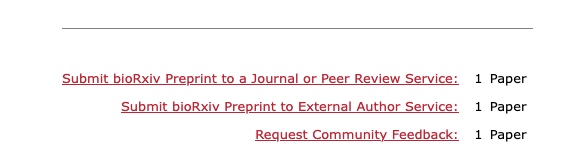
A new automated feedback option for authors - openRxiv
Authors who post preprints on openRxiv servers can get formal and informal feedback on their manuscripts in a number of ways. Our bioRxiv to journal (B2J) and medRxiv to journal (M2J) pipelines are linked to traditional peer review venues, enabling authors to save time by submitting directly from bioRxiv or medRxiv to any one of…
The Story behind the Science: Preprints of pandemic potential—how bioRxiv and medRxiv brought preprints to the life sciences
ABSTRACT The bioRxiv and medRxiv preprint servers brought preprinting to the life sciences and played a critical role in disseminating COVID research during the pandemic. Here, I reflect on the birth of bioRxiv and medRxiv and the crucial role so many members of the community played, our experience during the pandemic, and the launch of the new non-profit organization set up to oversee the servers. The pandemic was a stress test for bioRxiv and medRxiv that demonstrated their value and robustness. Under the umbrella of openRxiv, they are now poised to become long-term infrastructure underpinning a new publishing ecosystem.

Homepage - openRxiv
openRxiv is an independent non-profit, the new organizational home for bioRxiv and medRxiv, enabling researchers to instantly share groundbreaking findings with the global scientific community.
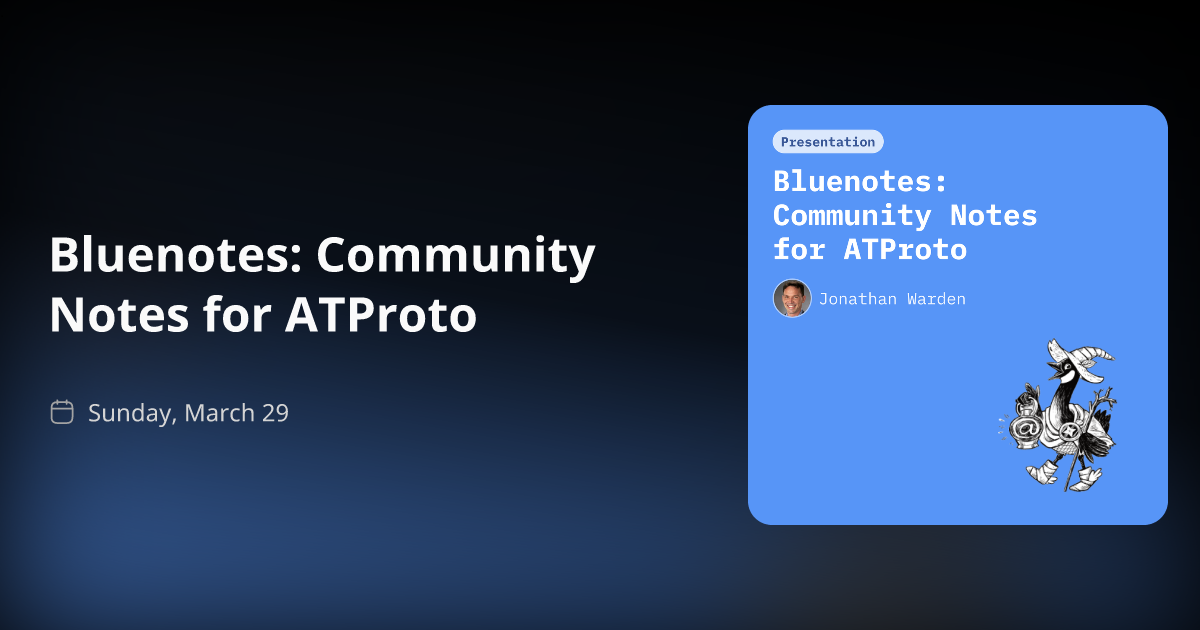
Bluenotes: Community Notes for ATProto
I'll briefly demonstrate Bluenotes, a fork of the Bluesky with Community Notes. Then I'll discuss a proposed "Open Community Notes" standard and lexicon for Community Notes on ATProto, and discuss challenges such as preserving contributor anonymity and defending against manipulation.
Linking the world's research to the code it runs on - OpenAlex blog
Research relies on software. Software written by scientists, for science, runs through the entire modern research stack: NumPy and SciPy, R and ggplot2, Jupyter, BLAST, ImageJ, AlphaFold. Yet in the scholarly record, that software is nearly invisible. Software is not usually cited formally in publications and is usually just mentioned in the text, which means […]

Readwise: Get the most out of what you read
Easily revisit and learn from your highlights and annotations.

The new way we’ll do science
Papers should become human-readable views over a graph of data, tools, results, and certificates.

Center for Open Science
At the Center for Open Science, our mission is to increase openness, integrity, and reproducibility of scholarly research. Promoting these practices within the research funding and publishing communities accelerates scientific progress

Note taking apps

Notes, Outliners, Markdown Editors, PKMs, Memexs, Second Brains, Commonplace books, and more

OmniCanvas - Free Infinite Canvas Notes App
Best Notes App - Write and Organize with UpNote

Antinote — a $5 scratchpad for macOS

NotePlan – Notes, Tasks and Calendar in One Daily Note

Let your thoughts sink in — Gravity
Knowledgebase Apps (by Boris) — Semble