


Two questions jumped out in the last week.
Questioning the Survey Responses of Large Language Models
The world's premier source for conference proceedings, offering Print-on-Demand, DOI, and Content Hosting services.

SimpleQA Verified: A Reliable Factuality Benchmark to Measure Parametric Knowledge
We introduce SimpleQA Verified, a 1,000-prompt benchmark for evaluating Large Language Model (LLM) short-form factuality based on OpenAI's SimpleQA. It addresses critical limitations in OpenAI's benchmark, including noisy and incorrect labels, topical biases, and question redundancy. SimpleQA Verified was created through a rigorous multi-stage filtering process involving de-duplication, topic balancing, and source reconciliation to produce a more reliable and challenging evaluation set, alongside improvements in the autorater prompt. On this new benchmark, Gemini 2.5 Pro achieves a state-of-the-art F1-score of 55.6, outperforming other frontier models, including GPT-5. This work provides the research community with a higher-fidelity tool to track genuine progress in parametric model factuality and to mitigate hallucinations. The benchmark dataset, evaluation code, and leaderboard are available at: https://www.kaggle.com/benchmarks/deepmind/simpleqa-verified.

SimpleQA Verified: A Reliable Factuality Benchmark to Measure Parametric Knowledge
We introduce SimpleQA Verified, a 1,000-prompt benchmark for evaluating Large Language Model (LLM) short-form factuality based on OpenAI's SimpleQA. It addresses critical limitations in OpenAI's benchmark, including noisy and incorrect labels, topical biases, and question redundancy. SimpleQA Verified was created through a rigorous multi-stage filtering process involving de-duplication, topic balancing, and source reconciliation to produce a more reliable and challenging evaluation set, alongside improvements in the autorater prompt. On this new benchmark, Gemini 2.5 Pro achieves a state-of-the-art F1-score of 55.6, outperforming other frontier models, including GPT-5. This work provides the research community with a higher-fidelity tool to track genuine progress in parametric model factuality and to mitigate hallucinations. The benchmark dataset, evaluation code, and leaderboard are available at: https://www.kaggle.com/benchmarks/deepmind/simpleqa-verified.
Qwen 3.8 27B is excellent, but it defaults to wildly overthinking things
Friday’s big release was Qwen 3.8 27B, an Apache 2 licensed 27B parameter vision-capable LLM from Alibaba’s Qwen research lab. I’ve been looking forward to this one: 27B is an …

The LLM Reasoning Debate Heats Up
Three recent papers examine the robustness of reasoning and problem-solving in large language models

Jailbreaking Large Language Models: If You Torture the Model Long Enough, It Will Confess!
A Cautionary Tale…

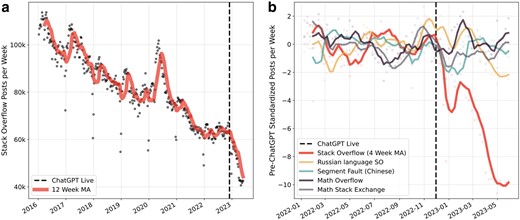
Large language models reduce public knowledge sharing on online Q&A platforms
Abstract. Large language models (LLMs) are a potential substitute for human-generated data and knowledge resources. This substitution, however, can present
Measuring short-form factuality in large language models
We present SimpleQA, a benchmark that evaluates the ability of language models to answer short, fact-seeking questions. We prioritized two properties in designing this eval. First, SimpleQA is challenging, as it is adversarially collected against GPT-4 responses. Second, responses are easy to grade, because questions are created such that there exists only a single, indisputable answer. Each answer in SimpleQA is graded as either correct, incorrect, or not attempted. A model with ideal behavior would get as many questions correct as possible while not attempting the questions for which it is not confident it knows the correct answer. SimpleQA is a simple, targeted evaluation for whether models "know what they know," and our hope is that this benchmark will remain relevant for the next few generations of frontier models. SimpleQA can be found at https://github.com/openai/simple-evals.
Measuring short-form factuality in large language models
We present SimpleQA, a benchmark that evaluates the ability of language models to answer short, fact-seeking questions. We prioritized two properties in designing this eval. First, SimpleQA is challenging, as it is adversarially collected against GPT-4 responses. Second, responses are easy to grade, because questions are created such that there exists only a single, indisputable answer. Each answer in SimpleQA is graded as either correct, incorrect, or not attempted. A model with ideal behavior would get as many questions correct as possible while not attempting the questions for which it is not confident it knows the correct answer. SimpleQA is a simple, targeted evaluation for whether models "know what they know," and our hope is that this benchmark will remain relevant for the next few generations of frontier models. SimpleQA can be found at https://github.com/openai/simple-evals.

Statistical Foundations of LLM-based A/B Testing: A Surrogacy...
Organizations and researchers show increasing interest in using large language models (LLMs) in place of human participants in A/B tests, in the hope of experimenting faster and at lower cost. We...
Stanford CS336 Language Modeling from Scratch I 2025
Why Are We Still Doing This?
Hi! If you like this piece and want to support my work, please subscribe to my premium newsletter. It’s $70 a year, or $7 a month, and in return you get a weekly newsletter that’s usually anywhere from 5000 to 185,000 words, including vast, extremely detailed analyses

Why Anthropic believes its latest model is too dangerous to release
“The language models we have now are probably the most significant thing to happen in security since we got the Internet.”

More than half of recent astronomy papers are written with language-model assistance
Language models leave a distinctive vocabulary in the prose they help write, and we measure how much of the astronomy literature now carries it. From the full text of 207,111 astro-ph papers spanning 2015 to mid-2026, we count those words in each paper and model the counts, in proportion to paper length, as a mixture of assisted and unassisted writing in a hierarchical Bayesian model. Papers from before 2020 calibrate the unassisted rate, and the 392 papers that disclose model use calibrate the assisted one. Our answer depends on how often these words would appear today if nobody used a model, a rate that must be modeled rather than observed, so we extend it past 2020 under three assumptions and report all three. For 2025 that gives $54^{+8}_{-8}\,(\mathrm{stat},\,95\%)\,^{+26}_{-0}\,(\mathrm{sys,\ background})$% of papers, the second error being the spread across the three. The estimate stays at or above 36% when we vary that choice, the calibration, and the requirement that adoption only rises. A word list built from the astro-ph corpus, keeping only words that rose across every subfield, leaves 2025 in the same range. Assisted writing is also getting harder to see, since authors adapt to the words that reveal it and the marker excess more than halves between 2023 and 2026. Our model allows for that fading, so it can separate a fainter trace from reduced use. More than half of recent astro-ph papers therefore carry a language-model trace, while only 0.81% of 2025 papers disclose it, one declaration for every $\sim$66 papers with a trace.