


Daily is the team behind Pipecat. Ultra low latency, open source SDKs, and enterprise reliability since 2016.
Pipecat Cloud: Enterprise Voice Agents Built On Open Source - Kwindla Hultman Kramer, Daily
pipecat-ai/smart-turn
Contribute to pipecat-ai/smart-turn development by creating an account on GitHub.
Pipedream Connect
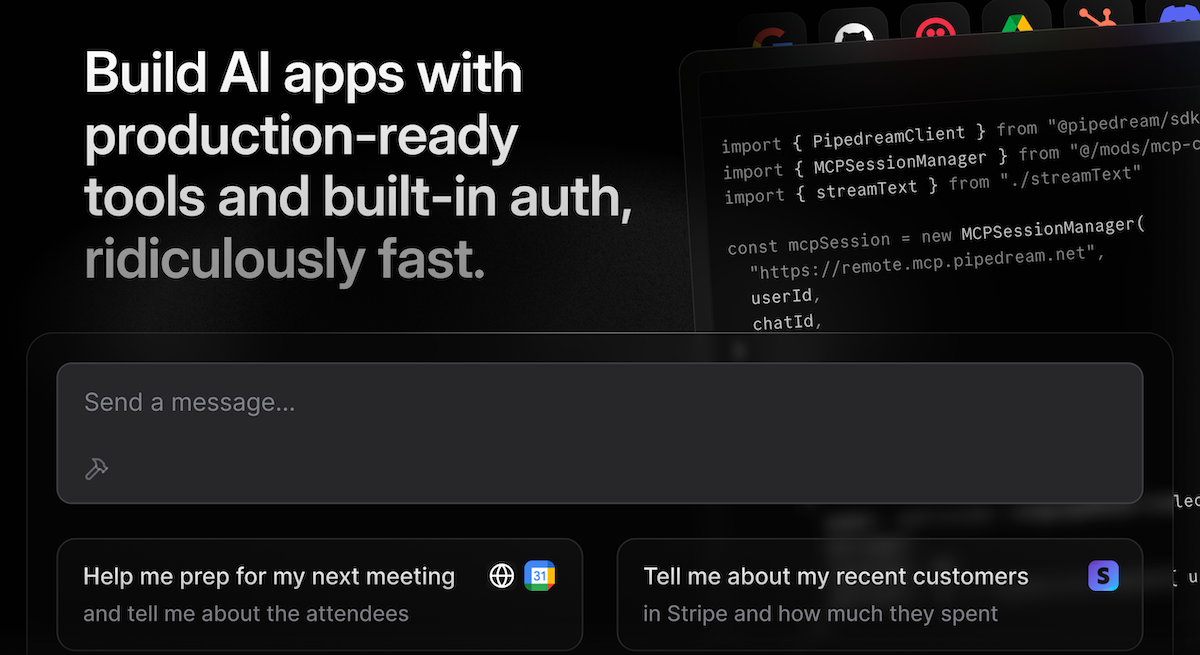
Pipedream Connect provides a developer toolkit that lets you add 2,700+ integrations to your app or AI agent. Build AI apps with production-ready tools and built-in auth, ridiculously fast.
Pipe Dreams: The life and times of Yahoo Pipes
In 2007, a small team at Yahoo! briefly changed how we program the internet. This is their story.

Serving Voice AI at $1/hr: Open-source, LoRAs, Latency, Load Balancing - Neil Dwyer, Gabber
Gabber - Build Realtime AI Apps that can see, hear, and speak
Low-latency inference for VLM, TTS, and STT with orchestration for making realtime apps.
Piped
Piped is a privacy friendly alternative YouTube frontend, which is efficient and scalable by design.

Fragile narrow laggy asynchronous mismatched pipes kill productivity - Tristan Hume
Something I’ve been thinking about recently is how when I’ve worked on any kind of distributed system, including systems as simple as a web app with frontend and backend code, probably upwards of 80% of my time is spent on things I wouldn’t need to do if it weren’t distributed. I came up with the following description of why I think this kind of programming requires so much effort: Everything is fragile narrow laggy asynchronous mismatched untrusted pipes. I think every programmer who’s worked on a networked system has encountered each of these issues, this is just my effort to coherently describe all of them in one place. I hope to prompt you to consider all the different hassles at once and think about how much harder/easier your job would be if you did/didn’t have to deal with these things. I think this is part of why web companies like Twitter seem to have so much lower impressiveness per engineer productivity than other places like game companies or SpaceX, although there’s other pieces to that puzzle. While part of the difficulty of distributed systems is inherent in physics, I think there’s lots of ideas for making each part of the problem easier, many already in common use, and I’ll try to mention lots of them. I hope that we as programmers continually develop more of these techniques and especially general implementations that simplify a problem. Like serialization libraries reducing the need for hand-written parsers/writers, I think there’s a lot of developer time out there to save by implementing generalized solutions where we currently painstakingly reimplement common patterns. I also think all these costs mean you should try really hard to avoid making your system distributed if you don’t have to.
Pipewire: Let's read the code!
Why MLX — Prince Canuma, Neywa Labs
goose | Your open source AI agent
Your native open source AI agent. Desktop app, CLI, and API — for code, workflows, and everything in between.
goose | Your open source AI agent
Your native open source AI agent. Desktop app, CLI, and API — for code, workflows, and everything in between.
Docker Blog | Docker
The 2026 Stack Overflow Developer Survey shows only 7% of developers trust AI output for important decisions. Here’s what that means for running agents safely.
Docker Blog | Docker
The 2026 Stack Overflow Developer Survey shows only 7% of developers trust AI output for important decisions. Here’s what that means for running agents safely.
Diving Bell Dev
We're in the business of building robust, high-quality software systems. If you like the sound of that, drop us a line.
Waterfall
The video platform giving power back to creators and their fans. Built on the AT Protocol, Waterfall lets you own your content and control your algorithms.
