

DALL·E image → GPT4 Vision → repeat
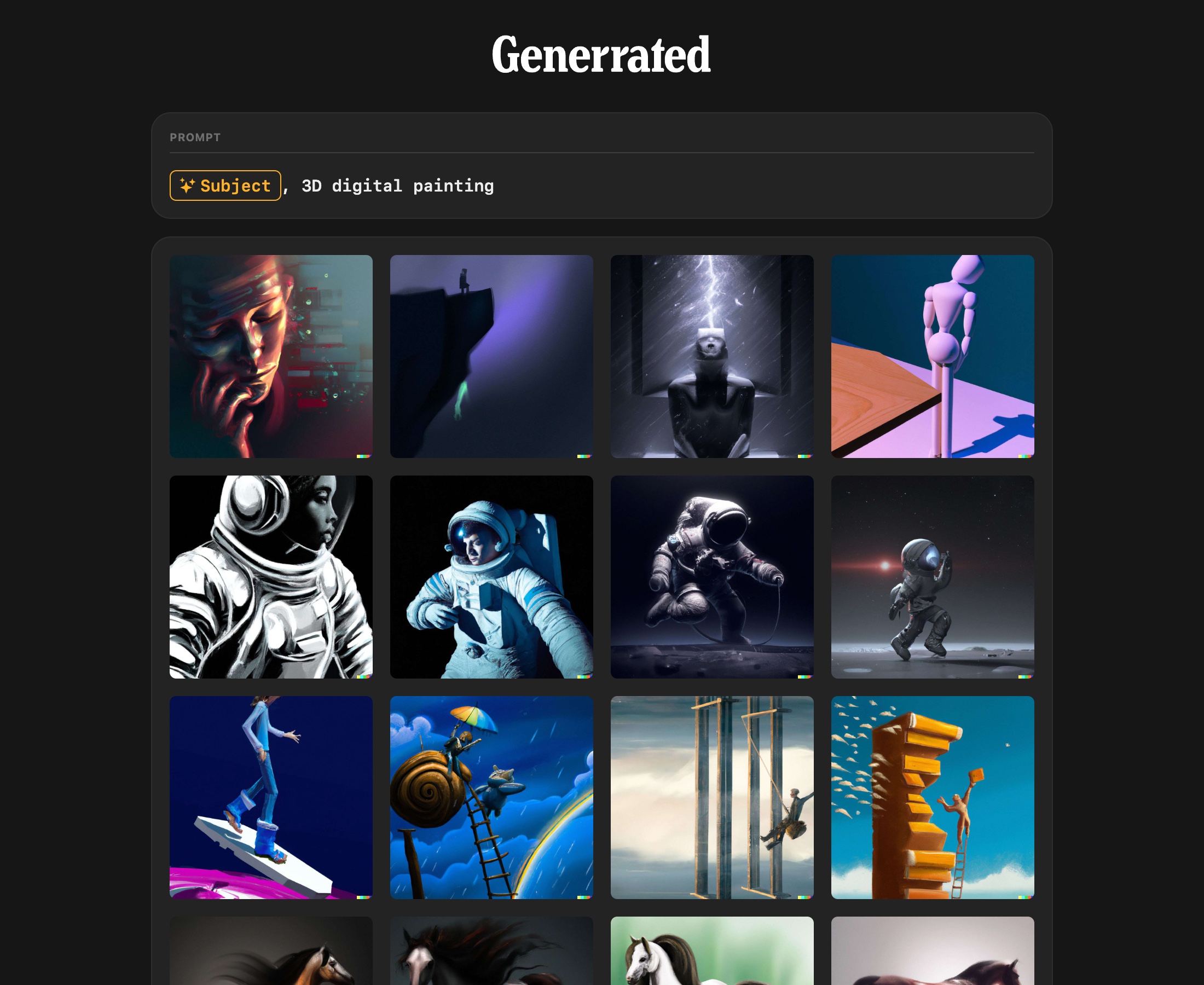
Generrated: 9,300 images generated with DALL·E 2 and DALL·E 3 prompts
An image/prompt reference and inspiration resource containing 9,300 images generated using DALL·E
DALL·E 3
This page introduced DALL·E 3, OpenAI’s 2023 image generation system with stronger prompt adherence and ChatGPT integration. Explore ChatGPT Images 2.5.

Quotient lenses | Proceedings of the 13th ACM SIGPLAN international conference on Functional programming
Bidirectional programming languages are a practical approach to the view update problem. Programs in these languages, called lenses, define both a view and an update policy - i.e., every program can be read as a function mapping sources to views as well ...

Releases · khromov/strata-gpuix-svelte
Strata: a second brain in a native GPUI window (notes, links, images, voice memos, hybrid search, RAG chat), built with gpuix-svelte - Releases · khromov/strata-gpuix-svelte
Hello GPT-4o
We’re announcing GPT-4 Omni, our new flagship model which can reason across audio, vision, and text in real time.
Boomerang | Proceedings of the 35th annual ACM SIGPLAN-SIGACT symposium on Principles of programming languages
Bidirectional programming languages are a practical approach to the view update problem. Programs in these languages, called lenses, define both a view and an update policy - i.e., every program can be read as a function mapping sources to views as well ...

Dependent Optics
A wide variety of bidirectional data accessors, ranging from mixed optics to functor lenses, can be formalized within a unique framework-dependent optics. Starting from two indexed categories, which encode what maps are allowed in the forward and backward directions, we define the category of dependent optics and establish under what assumptions it has coproducts. Different choices of indexed categories correspond to different families of optics: we discuss dependent lenses and prisms, as well as closed dependent optics. We introduce the notion of Tambara representation and use it to classify contravariant functors from the category of optics, thus generalizing the profunctor encoding of optics to the dependent case.

Symmetric lenses | Proceedings of the 38th annual ACM SIGPLAN-SIGACT symposium on Principles of programming languages
A lens is a bidirectional transformation between a pair of connected data structures, capable of translating an edit on one structure into an appropriate edit on the other. Many varieties of lenses have been studied, but none, to date, has offered a ...

The Curse of Recursion: Training on Generated Data Makes Models Forget
Stable Diffusion revolutionised image creation from descriptive text. GPT-2, GPT-3(.5) and GPT-4 demonstrated astonishing performance across a variety of language tasks. ChatGPT introduced such...
Sound & Vision
Explore the future of type with the Re:Vision 2025 typographic playground—an interactive showcase of emerging type trends. Dive in and shape the next wave of visual language.

Gallery | PolyCSS
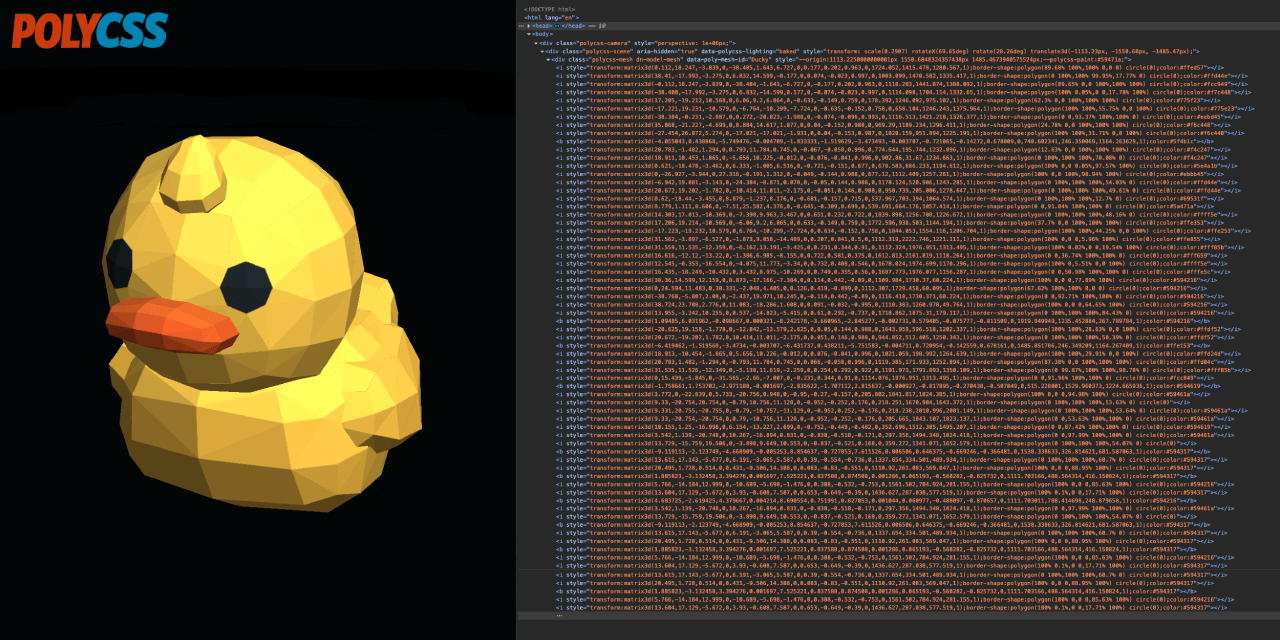
Explore PolyCSS-rendered OBJ, glTF, GLB, VOX, textured, animated, and generated mesh examples in the DOM.
Categories of Optics
Bidirectional data accessors such as lenses, prisms and traversals are all instances of the same general 'optic' construction. We give a careful account of this construction and show that it extends to a functor from the category of symmetric monoidal categories to itself. We also show that this construction enjoys a universal property: it freely adds counit morphisms to a symmetric monoidal category. Missing in the folklore is a general definition of 'lawfulness' that applies directly to any optic category. We provide such a definition and show that it is equivalent to the folklore profunctor optic laws.
What you needa know about Yoneda: profunctor optics and the Yoneda lemma (functional pearl) | Proceedings of the ACM on Programming Languages
Profunctor optics are a neat and composable representation of bidirectional data accessors, including lenses, and their dual, prisms. The profunctor representation exploits higher-order functions and higher-kinded type constructor classes, but the ...

On Software, or the Persistence of Visual Knowledge
Wendy Hui Kyong Chun; On Software, or the Persistence of Visual Knowledge. Grey Room 2005; (18): 26–51. doi: https://doi.org/10.1162/1526381043320741

Combinators for bidirectional tree transformations: A linguistic approach to the view-update problem: ACM Transactions on Programming Languages and Systems: Vol 29, No 3
We propose a novel approach to the view-update problem for tree-structured data: a domain-specific programming language in which all expressions denote bidirectional transformations on trees. In one direction, these transformations---dubbed lenses---map ...

Harness Lens - a Hugging Face Space by harness-hub
Compare coding-agent harnesses, every claim linked to source