



Sikuli: using GUI screenshots for search and automation
Usability is one of the factors that determines the success of a software system. Aiming to improve it’s usability, it is necessary to evaluate the interfaces using scientific evaluation methods, like questionnaires. Often the results of these ...

Usability/UX/Accessability Research? · Issue #819 · w3c-fedid/FedCM
I'm curious if this work has any usability, UX, or accessibility research that supports the designs here? Are there non-goals, or handling of failure case scenarios that have been envisioned an...
Rethinking the human-readability infrastructure
As part of the Digital Library's transition to Open Access, new features for researchers are available in the Premium Edition. Click here to learn more.
The Oxymoron of “Data-Driven Innovation”
Once upon a time, in the dawn of the internet era, web products came from college dudes. The dudes were almost always wealthy and well-connected, but they weren’t usually market-savvy. These …

Identifying Barriers to Adoption for Rust through Online Discourse (PLATEAU 2018) - SPLASH 2018
For PLATEAU 2019, see the workshop webpage at http://plateau-workshop.org/. Programming languages exist to enable programmers to develop software effectively. But programmer efficiency depends on the usability of the languages and tools with which they develop software. The aim of this workshop is to discuss methods, metrics and techniques for evaluating the usability of languages and language tools. The supposed benefits of such languages and tools cover a large space, including making programs easier to read, write, and maintain; allowing programmers to write more flexible and powerful ...

German UPA | Berufsverband für User Experience Professionals
Der Berufsverband für UX-Professionals in Deutschland: Veranstaltungen, Konferenzen & Austausch zu User Experience und Usability
The Distribution of Users’ Computer Skills: Worse Than You Think
Across 33 rich countries, only 5% of the population has high computer-related abilities, and only a third of people can complete medium-complexity tasks.
Toward People’s Community Control of Technology: Race, Access, and Education
This field review explores how the benefits of access to computing for racialized and minoritized communities has become an accepted fact in policy and research, despite decades of evidence that technical fixes do not solve the kinds of complex social problems that disproportionately affect these communities.

Design From the Margins
In an age of virtual connectivity and increased reliance on the internet for daily functions, including by marginalized groups, can companies and technologists reframe their features or standards to support the most marginalized users’ needs? Can the modes of resilience within digital spaces from some of the most marginalized groups be listened to, learned from, and centered when creating technology? Design from the Margins (DFM), a design process that centers the most impacted and marginalized users from ideation to production, pushes the notion that not only is this something that can and must be done, but also that it is highly beneficial for all users and companies. For this to happen, consumer interest conversations need to be framed outside the “biggest use case” scenarios and United States and European Union-centrisms and refocused on the cases often left in the margins: the decentered cases. This report outlines how the DFM method can be used to build our most well-known and relied-upon technologies for decentered cases (often deemed “edge cases” which is atypical or less common use case for a product) from the beginning of the design process, rather than retrofitting them post-deployment to cater to communities with what are perceived to be extra needs.

Design From the Margins
In an age of virtual connectivity and increased reliance on the internet for daily functions, including by marginalized groups, can companies and technologists reframe their features or standards to support the most marginalized users’ needs? Can the modes of resilience within digital spaces from some of the most marginalized groups be listened to, learned from, and centered when creating technology? Design from the Margins (DFM), a design process that centers the most impacted and marginalized users from ideation to production, pushes the notion that not only is this something that can and must be done, but also that it is highly beneficial for all users and companies. For this to happen, consumer interest conversations need to be framed outside the “biggest use case” scenarios and United States and European Union-centrisms and refocused on the cases often left in the margins: the decentered cases. This report outlines how the DFM method can be used to build our most well-known and relied-upon technologies for decentered cases (often deemed “edge cases” which is atypical or less common use case for a product) from the beginning of the design process, rather than retrofitting them post-deployment to cater to communities with what are perceived to be extra needs.
The Adoption and Usage of AI Agents: Early Evidence from Perplexity
This paper presents the first large-scale field study of the adoption, usage intensity, and use cases of general-purpose AI agents operating in open-world web environments. Our analysis centers on Comet, an AI-powered browser developed by Perplexity, and its integrated agent, Comet Assistant. Drawing on hundreds of millions of anonymized user interactions, we address three fundamental questions: Who is using AI agents? How intensively are they using them? And what are they using them for? Our findings reveal substantial heterogeneity in adoption and usage across user segments. Earlier adopters, users in countries with higher GDP per capita and educational attainment, and individuals working in digital or knowledge-intensive sectors -- such as digital technology, academia, finance, marketing, and entrepreneurship -- are more likely to adopt or actively use the agent. To systematically characterize the substance of agent usage, we introduce a hierarchical agentic taxonomy that organizes use cases across three levels: topic, subtopic, and task. The two largest topics, Productivity & Workflow and Learning & Research, account for 57% of all agentic queries, while the two largest subtopics, Courses and Shopping for Goods, make up 22%. The top 10 out of 90 tasks represent 55% of queries. Personal use constitutes 55% of queries, while professional and educational contexts comprise 30% and 16%, respectively. In the short term, use cases exhibit strong stickiness, but over time users tend to shift toward more cognitively oriented topics. The diffusion of increasingly capable AI agents carries important implications for researchers, businesses, policymakers, and educators, inviting new lines of inquiry into this rapidly emerging class of AI capabilities.

Reckoning: Frontend's Lost Decade | Alex Russell | performance.now() 2024
live data vis stuff, participatory performance/interaction

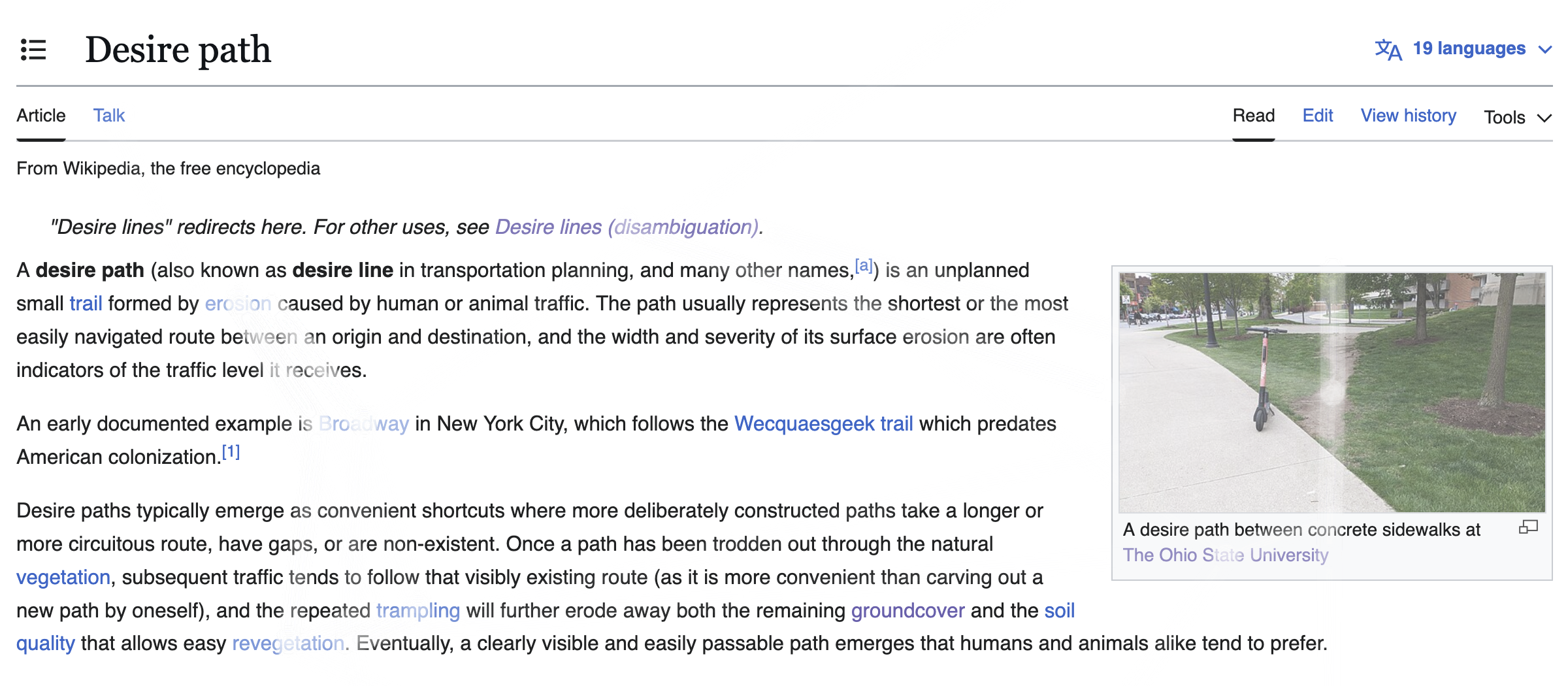
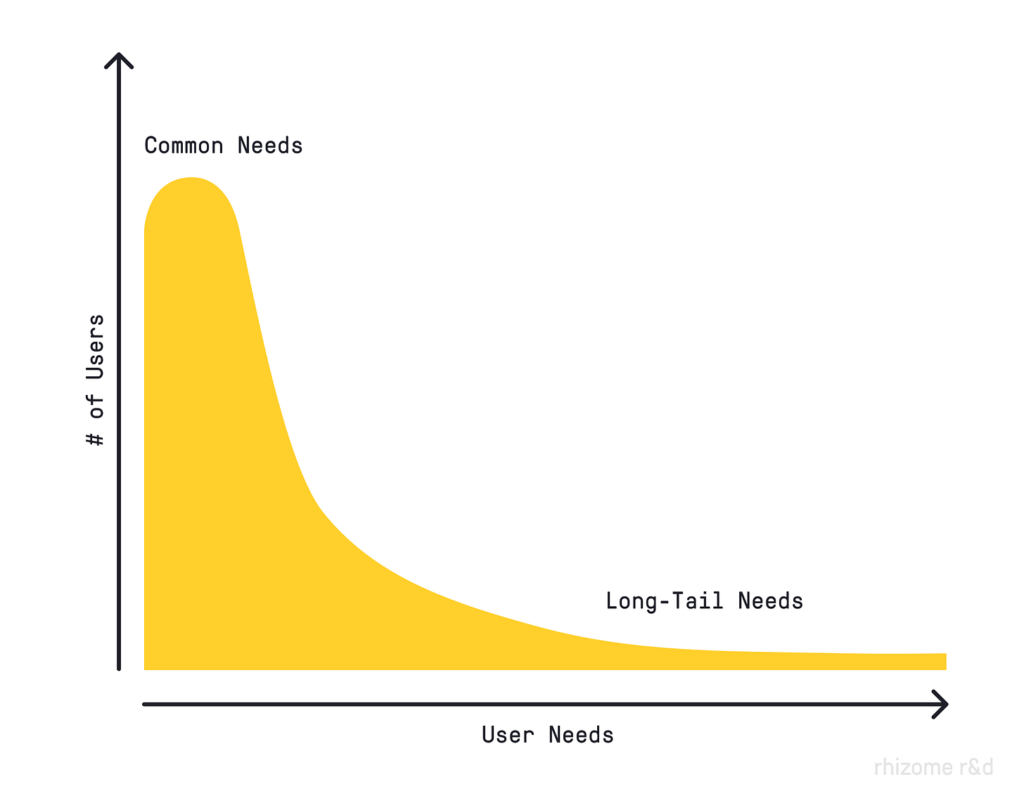
Long-tail of user needs

An analogy to understand how the rigidity of software interfaces fails to meet what we need from it.

pauline on Twitter / X
Amelia Wattenberger 🪷 on Twitter / X

Everything I Love | Chia Amisola
Everest Pipkin
we were online
User Agency in Other People's Websites - Orion Reed at JOTB25
When to Design for Emergence