

Data & Society believes that technology policy must be grounded in research, account for tech’s real-world impacts, and serve the public.
Governing by dismantling: tech oligarchy and the stifling of public data infrastructure
Published in Science as Culture (Ahead of Print, 2026)

Data Feminism
Today, data science is a form of power. It has been used to expose injustice, improve health outcomes, and topple governments. But it has also been used to d...

Living in Data: A Citizen's Guide to a Better Information Future (Paperback)
Jer Thorp’s analysis of the word “data” in 10,325 New York Times stories written between 1984 and 2018 shows a distinct trend: among the words most closely associated with “data,” we find not only its classic companions “information” and “digital,” but also a variety of new neighbors—from “scandal” and “misinformation” to “ethics,” “friends,” and “play.”To live in data in the twenty-first century

The Limits of Data
Policymakers want to make decisions based on clear data, but important factors are lost when we rely solely on data. A philosopher writes:

Data Leverage: A Framework for Empowering the Public in its Relationship with Technology Companies
Many powerful computing technologies rely on implicit and explicit data contributions from the public. In this paper, we synthesize emerging research that seeks to better understand and help people action this data leverage. Drawing on prior work in areas including machine learning, human-computer interaction, and fairness and accountability in computing, we present a framework for understanding data leverage that highlights new opportunities to change technology company behavior related to privacy, economic inequality, content moderation and other areas of societal concern.
Rethinking how technology uses our personal data
This essay explores visually how keeping data and AI on‑device could empower not only users, but also companies.
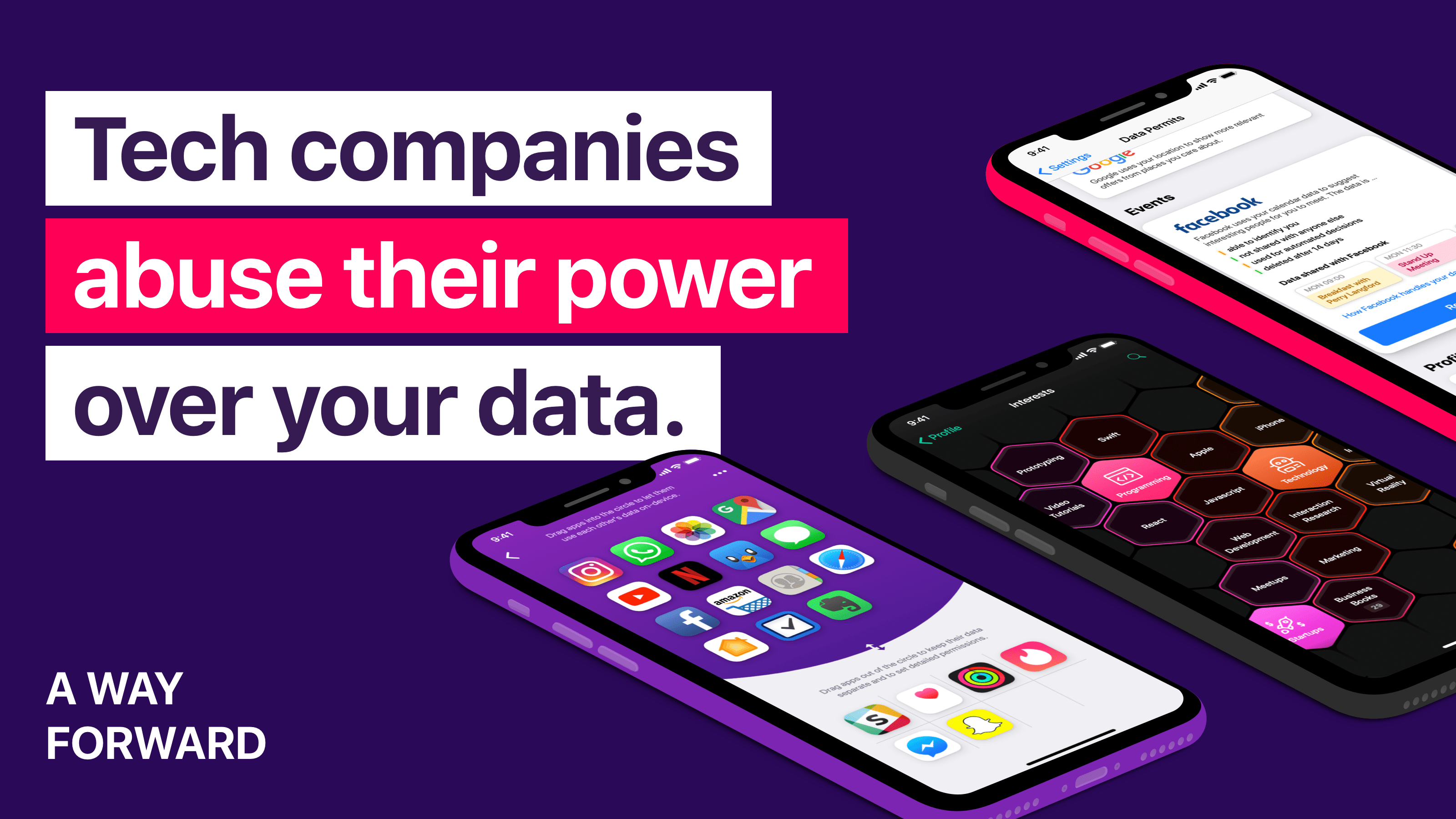
Data Feminism
A new way of thinking about data science and data ethics that is informed by the ideas of intersectional feminism.

Better Deal for Data - Practical Data Governance for the Social Sector
Better Deal for Data - practical data governance for the social sector.
The Risks of Industry Influence in Tech Research
Emerging information technologies like social media, search engines, and AI can have a broad impact on public health, political institutions, social dynamics, and the natural world. It is critical to develop a scientific understanding of these impacts to inform evidence-based technology policy that minimizes harm and maximizes benefits. Unlike most other global-scale scientific challenges, however, the data necessary for scientific progress are generated and controlled by the same industry that might be subject to evidence-based regulation. Moreover, technology companies historically have been, and continue to be, a major source of funding for this field. These asymmetries in information and funding raise significant concerns about the potential for undue industry influence on the scientific record. In this Perspective, we explore how technology companies can influence our scientific understanding of their products. We argue that science faces unique challenges in the context of technology research that will require strengthening existing safeguards and constructing wholly new ones.

Can “Conscious Data Contribution” Help Users to Exert “Data Leverage” Against Technology Companies?
Tech users currently have limited ability to act on concerns regarding the negative societal impacts of large tech companies. However, recent work suggests that users can exert leverage using their role in the generation of valuable data, for instance by withholding their data contributions to intelligent technologies. We propose and evaluate a new means to exert this type of leverage against tech companies: "conscious data contribution" (CDC).
Who Will Keep Research Data Infrastructure Open and Running?
The scientific community must consider the longevity of open research infrastructure—why it might fail and how to prevent it.

Who Will Keep Research Data Infrastructure Open and Running?
The scientific community must consider the longevity of open research infrastructure—why it might fail and how to prevent it.
A Polycentric Governance Lens on Data Infrastructures
Funding policies for data infrastructure promote open data sharing to drive positive social impact. However, concerns regarding the long-term management of data within and across distributed infrastructures can hinder data sharing. We draw upon the concept of polycentric governance to demonstrate how collaborative practices of data curation, in preparing and maintaining data for (future) sharing, provide a solid foundation for understanding data governance within data infrastructures. Based on a qualitative case study of a distributed ecological network, we investigate the conditions under which data are managed as a shared resource by local actors to ensure the long-term (re)usability of data. We contribute to CSCW by conceptualising data curation as a complex form of governance practice with multiple centres of decision-making, each of which operates with some degree of autonomy in data infrastructures. A polycentric governance lens on data infrastructures advances the CSCW conception of data curation as a collective governance practice that can cultivate a data democracy culture within and across organisations, empower individuals to be accountable for their data, and foster a mindset shift toward decentralised data governance.

MyData
The human-centric approach to data is aimed at a fair, sustainable, and prosperous digital society. In such a society, people get value from their data and set the agenda on how it is used. And for organisations, the ethical use of data is always the most attractive option.

A Data Utopia for Science-of-Science
Here I want to briefly sketch out a vision for how to solve a key set of problems facing science-of-science researchers, using the relatively new idea of a ‘data trust.’ In my ideal wor…

Data Leverage: A Framework for Empowering the Public in its...
Many powerful computing technologies rely on implicit and explicit data contributions from the public. This dependency suggests a potential source of leverage for the public in its relationship...