

Sender-Side Track Switching (SSTS) lets a publisher forward one track at a time out of a switching set, and leaves the choice of which track to a pluggable algorithm. The default algorithm divides a bandwidth estimate between switching sets. This document defines an alternative algorithm that uses no bandwidth estimate at all. It monitors the number of open forwarding streams carrying the currently active tier, steps rapidly through the switching set's ladder during fast start, regulates steady-state upshifts dynamically according to relative bitrate jumps and the subscriber's probing risk tolerance, and reacts to mid-group congestion using intra-group monitoring and retroactive stream supersede. The signal is directly observable at the publisher, requires no cooperation from the congestion controller, and degrades toward the lowest quality under load rather than toward none.
Media over QUIC Transport
This document defines Media over QUIC Transport (MOQT), a publish/ subscribe protocol that runs over QUIC and WebTransport. MOQT leverages the features of these transports, such as streams, datagrams, priorities, and partial reliability. MOQT operates both point-to-point and through intermediate relays, enabling scalable low-latency delivery. Despite its name, MOQT is media agnostic and can be used for a wide range of use cases.

ATOM: AT Protocol Over MoQ Transport
This document specifies how the Authenticated Transfer (AT) Protocol can leverage Media over QUIC Transport (MOQT) for efficient data synchronization across decentralized social networks. The AT Protocol's firehose event stream and repository synchronization mechanisms map naturally to MOQT's publish/subscribe model, enabling scalable relay infrastructure, priority-based delivery, and improved resilience for large-scale social data distribution. This specification addresses the challenges of the current WebSocket- based transport and demonstrates how MOQT's relay architecture, group-based caching, and multiplexed streams provide significant benefits for AT Protocol deployments at scale.
Streaming Data - AT Protocol Docs - AT Protocol
Synchronizing and streaming data from the AT Protocol.

Rek Bell — leaner web
Parkinson's Law of the Internet states that whatever the bandwidth, applications will always evolve to consume more than is currently available.

Introducing MSW 3.0
ESM, GraphQL subscriptions, and the best interception algorithm in the world.

Introducing Tap: Repository Synchronization Made Simple | Bluesky
Just about every app built on AT needs data from a repository at some point. For many use cases – feed generators, labelers, bots – streaming live data through a Relay or Jetstream works well. But some applications need to go beyond what Jetstream was designed for, like tracking specific subsets of a repo, automatically backfilling a database when adding new repos to monitor, or even mirroring the entire Atmosphere.

On Distributed Communications: I. Introduction to Distributed Communications Networks
The first in a series of 11 memoranda detailing the Distributed Adaptive Message Block Network, this volume introduces the system concept and outlines the requirements for and design considerations of the distributed digital data communications network. It considers especially the use of redundancy as a means of withstanding heavy enemy attacks.

Backstitch - Godot Asset Store
Real-time version control for Godot! Backstitch enables fast collaboration for dev teams, game jams, and classrooms.

The Stream Deck Just Got RIDICULOUSLY Huge!
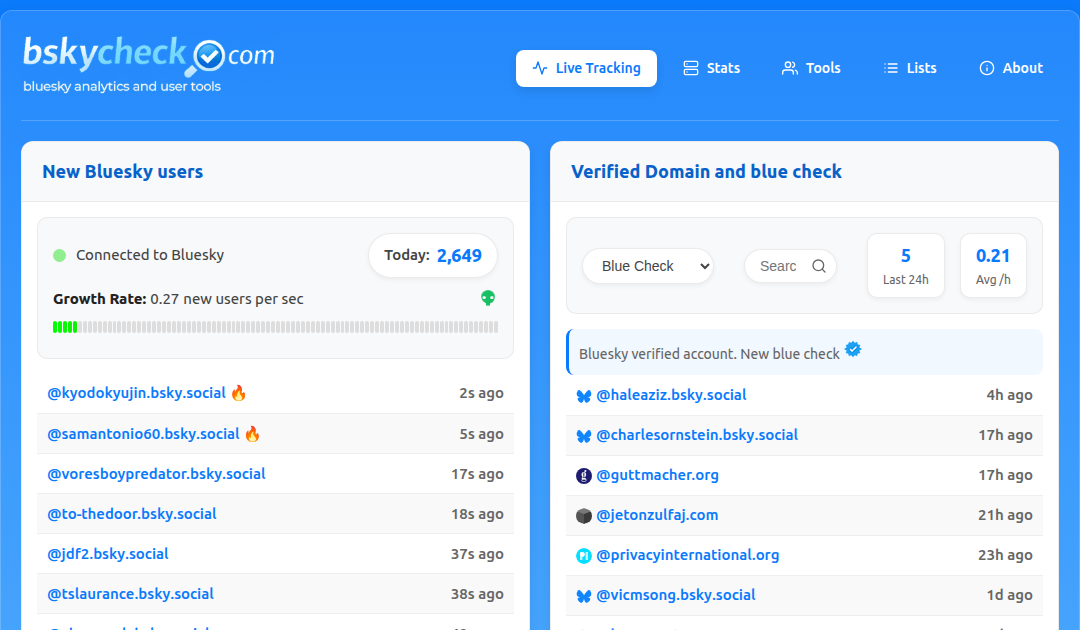
Top AT Protocol Apps (Atmosphere) | bskycheck
The apps built on the AT Protocol, beyond Bluesky itself, that write the most records every day: music, blogs, events, photos and more.
We're making Tailscale faster
Tailscale performance updates reduce memory use, increase throughput, and speed startup with multi-queue, writev, and netmap caching.

#atdev does anyone know if the relay throttles _consumers_? yesterday incoming bandwidth on my ingester went down to almost zero (and didn't go back up until restart), which corresponded suspiciously well with the bad bunny halftime show
