

This document discusses aspects of centralization that relate to Internet standards efforts. It argues that, while standards bodies have a limited ability to prevent many forms of centralization, they can still make contributions that assist in the decentralization of the Internet.
Centralization, Decentralization, and Internet Standards
Despite being designed and operated as a decentralized network-of- networks, the Internet is continuously subjected to forces that encourage centralization. This document offers a definition of centralization, explains why it is undesirable, identifies different types of it, catalogues limitations of common approaches to decentralization, and explores what Internet standards efforts can do to address it.
Practical Decentralization
The point of decentralization is to guarantee the rights of individuals and communities on the Internet. Pulling that off is a balancing act between practicality and ideology.
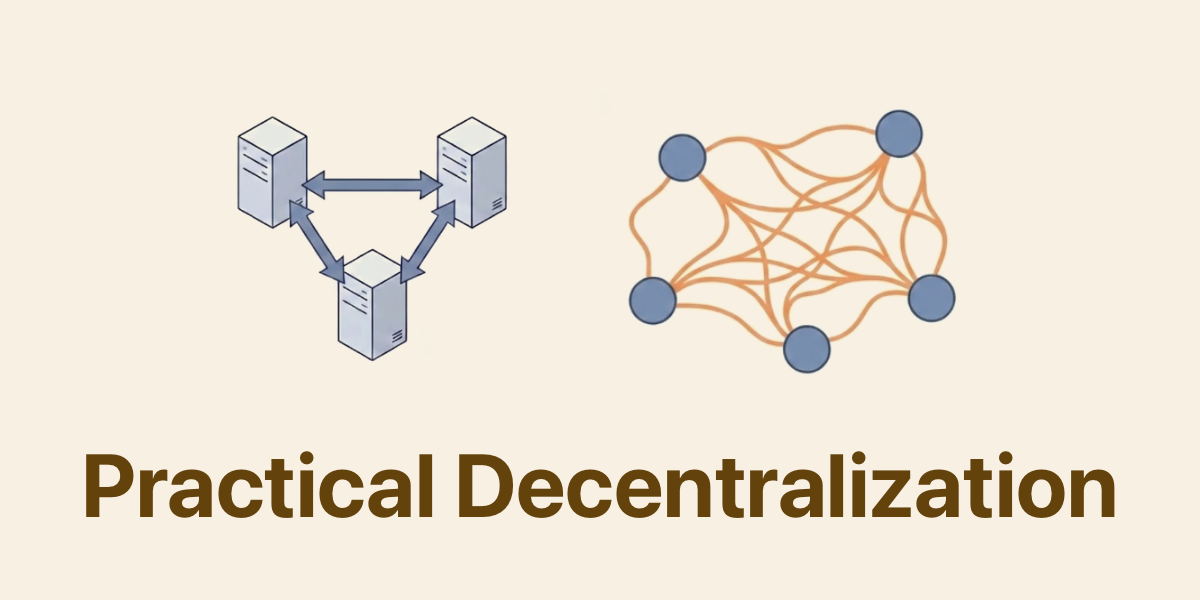
Practical Decentralization
The point of decentralization is to guarantee the rights of individuals and communities on the Internet. Pulling that off is a balancing act between practicality and ideology.
Decentralized Syndication — The Missing Internet Protocol
The Internet is decentralized by design. It came into being not at once, but in parts. New protocols were added on top of previous ones…
Protocol: How Control Exists after Decentralization
How Control Exists after DecentralizationIs the Internet a vast arena of unrestricted communication and freely exchanged information or a regulated, highly

The Decentralized Web: Defending Internet Freedom through Decentralization: Back to the Future? — MIT Digital Currency Initiative
In this report, we explore two important ways structurally decentralized systems could help address the risks of mega-platform consolidation: First, these systems can help users directly publish and discover content directly, without intermediaries, and thus without censorship. All of the systems we

Paradigm shifts for the decentralized Web
The answer to these questions varies with different degrees of decentralization:
EFFecting Change: How to Build a Decentralized Web That Truly Works for All
Centralization vs Decentralization - AVC
Decentralization is one of, if not the most, discussed features of the crypto tech stack. In a decentralized system, no single body controls the system. We have most certainly not reached the era fully decentralized systems, but that is what most of the world-class technologists working in the crypto sector are focused on getting us […]
Chad Kohalyk (@chadkoh@indieweb.social)
Web publishing is facing its next challenge: a new iteration of centralizing platforms. BUT there is also a new wave of open protocols and standards that can help us gain our independence. Next month in NYC we are gathering a group of frontier technologists and popular web publishers to discuss how we can sail into this next platform shift as captains. #ProtocolsForPublishers https://pfp.unternet.co
There Are No Standards Police
No one requires tech companies or open source projects to use most Internet standards, and no one requires people to use them either. This post explains why the voluntary nature of its standards are critical to the Internet's health.

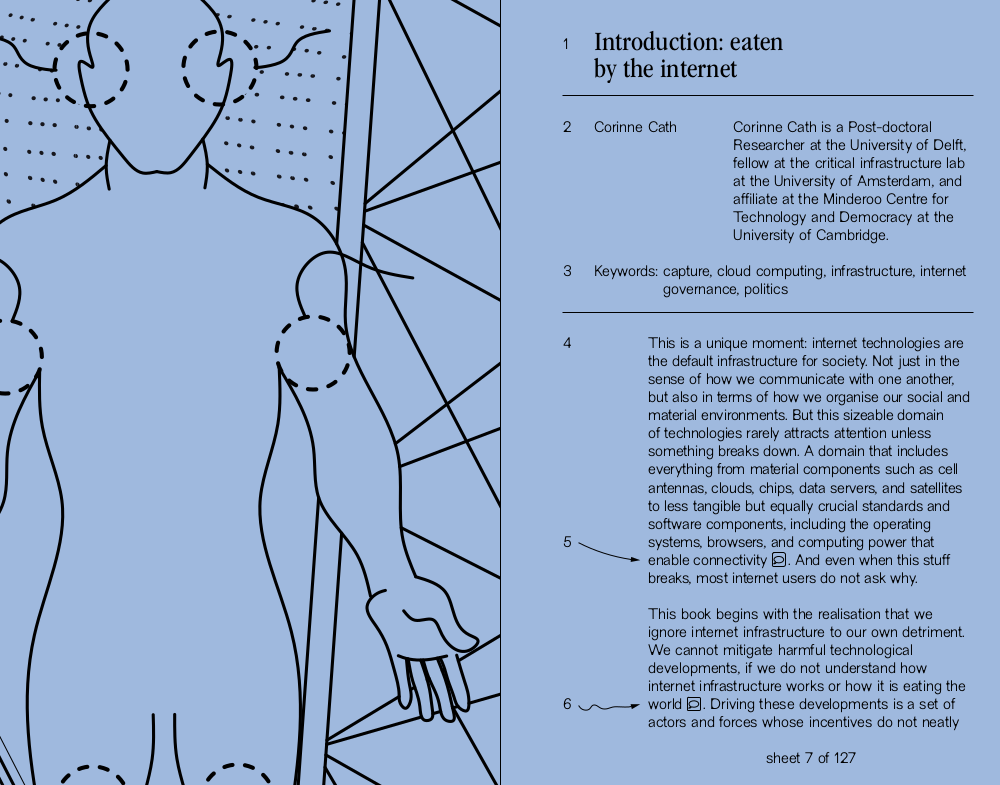
Eaten by the Internet
This book makes internet infrastructure visible as a force of political power, which is transforming the social world, from the bottom up—through fifteen chapters contributed by a global set of researchers, activists, and techies. We are living a unique moment: internet technologies are the default infrastructure for society, not just how we communicate but also how we organise our social life, politics, and economy, all the way down to our material environments, like cities. Our world is eaten by the internet. This means that those who control the internet control the bounds of public speech, economic production, social cohesion, and politics, making its infrastructure a core political terrain in the networked age. The book’s chapters cover a wide set of topics, spanning from the global politics of content moderation by internet infrastructure to the colonialism inherent in the race to plug the moon, from the harms wrought by blockchain companies in rural America to the particularities of online censorship across Asia. The chapters take on thorny topics, discussing power consolidation in the advertisement and cloud industry, the role of internet infrastructure in the war in Ukraine, and tech’s environmental impact—amongst others. In doing so, this book roots contemporary technology debates in the politics of internet infrastructure and urges us to ask how can we ensure our infrastructures sustain us, rather than consume us?
Minimum viable decentralization – John Backus – Medium
If you want people to use your product, decentralize the bare minimum. Lessons from Freenet, I2P, Darknet markets, and Reddit.

Are We Decentralized Yet?
Statistics on how concentrated user accounts and data are across the Fediverse, the Atmosphere, web hosting, email, and other Internet infrastructure.
Seeing the Politics of Decentralized Social Media Protocols
Calls to decentralize feed-based social media have been driven by concerns about the concentrated power of centralized platforms and their societal impact. In response, numerous decentralized social media protocols have emerged, each interpreting “decentralization” in a different way. We analyze four such protocols (ActivityPub, AT Protocol, Nostr, and Farcaster) drawing on protocol documentation, media coverage, direct usage, and semi-structured interviews with protocol developers and experts to situate each protocol within its socio-technical goals. To support this analysis, we develop a grounded lexicon that facilitates the description and comparison of analogous components across each protocol. With it, we show how each protocol distributes control over key components differently, shaping who holds power over critical aspects such as user identity, curation, and infrastructural ownership. By examining protocols as socio-technical artifacts, we show how they prioritize different values and make distinct trade-offs, providing CSCW researchers with a lens to more effectively evaluate and design future decentralized social media systems.

Web publishing is facing its next challenge: a new iteration of centralizing platforms. BUT there is also a new wave of open protocols+standards to gain independence. Next month in NYC let's discuss how we can sail into this next platform shift as captains. #ProtocolsForPublishers pfp.unternet.co
Protocols for Publishers
pfp.unternet.co