

(BI) Software is dead, apparently
HTML Clay: Software you can keep
Real software in a single HTML file on your computer. Every edit saves straight back into the file, and you can reshape how it works anytime.
Filling the potholes of the web.
People with the power to fix our inaccessible web have failed to do it for long enough. Isn’t it time to imagine ways we can repair the web without waiting for them?
HTML papers on arXiv -- why it is important, and how we made it happen
In October 2023, arXiv made HTML formatted papers available to readers. This was the exciting outcome of over a year of accessibility research and development with the scientific community. Currently, only 2.4% of research outputs meet accessibility guidelines. Informed by scientists who rely on assistive technology, our analysis demonstrates that offering HTML is the most impactful step arXiv can take. Scientists need HTML now, and emphasize to not let perfect be the enemy of good enough. In this paper we share with you how arXiv is achieving HTML conversions from LaTeX now, and our plans for future improvements.

A tale from 30 years of HTML
In a few days the Hypertext Markup Language known to most simply as “HTML” will turn 30 years old. After the release of its first version…
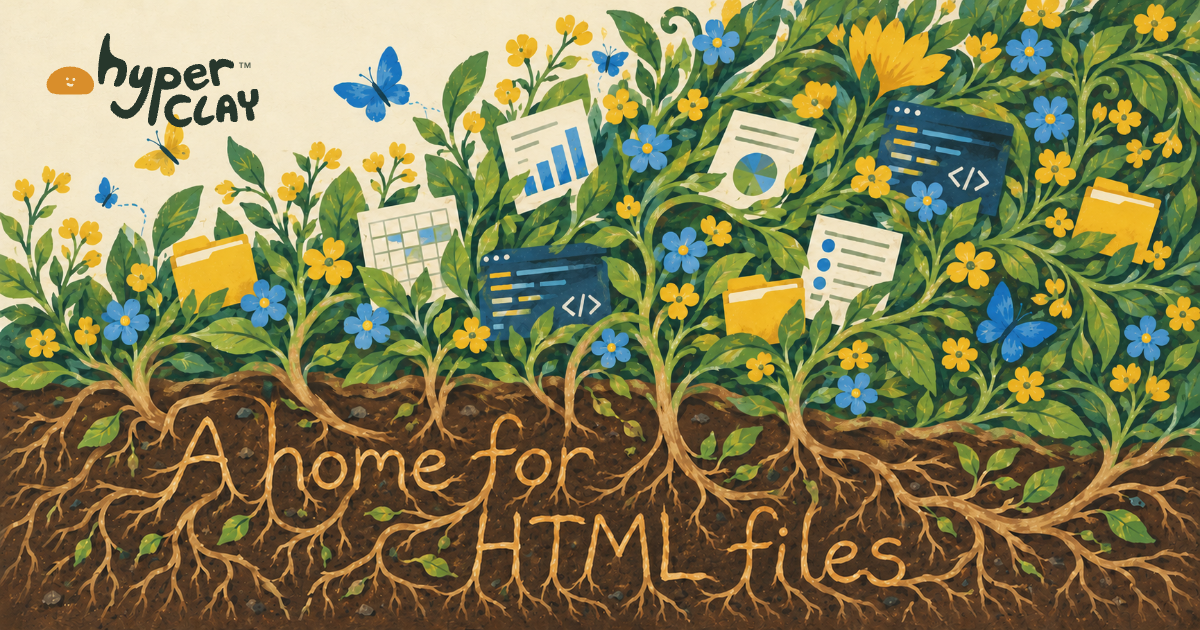
Hyperclay | Where your team's HTML files belong
A shared workspace and local desktop app for the dashboards, reports, and tools your team and AI agents build as HTML files. Start free locally or collaborate live online.
On folders, broken links, and Bill Gates' biggest mistake
Files and folders are holding us back. There has to be a better way.
HTML/SR Support lookup
TetraLogical Services Ltd. Company number 12951928. Content released under a GNU General Public License v3.0
Home Page - Software Heritage
preserves software source code for present and future generations
Practical Rateless Set Reconciliation
HTML conversions sometimes display errors due to content that did not convert correctly from the source. This paper uses the following packages that are not yet supported by the HTML conversion tool. Feedback on these issues are not necessary; they are known and are being worked on.
How to implement a web-based rich text editor in 2023?
Since 2011 I’ve been spending a great junk of my time taming web browsers to behave correctly and predictably when editing rich text. If you’ve ever tried to include a custom rich text editor in your web application, you know it’s a rather difficult problem to solve. I’d even predict that you’ll mos…

Why You Should Pay Attention to WebAssembly
There may come a day when the humble web browser – having already yielded enterprise grade server side technologies like Firecracker, Isolates and Node.js – has nothing of interest left for the industry to extract. But that day has certainly not arrived yet, as the increasing chatter around WebAssembly (WASM) proves. The fact that people

Solutions for Link Rot on the Modern Web
Web links are fundamental to the web, enabling navigation between pages and citations in research articles. However, web links suffer from "link rot", a phenomenon in which links are likely to become inaccessible over time. This can occur if a link’s site disappears, making it impossible to resolve the hostname or establish a server connection, or the linked page has been deleted, resulting in an HTTP 404 "Not Found" error. Today, a common solution to tackle link rot is to rely on web archives, which capture snapshots of web pages for future reference. However, the modern web has evolved significantly since web archives were first introduced, leading to several limitations in their effectiveness. First, the scale of the web has grown tremendously, making it infeasible to crawl every page whenever it changes. As a result, many broken links either have no archived copies, or the archived copies have stale content. Second, modern web pages rely heavily on increasingly complex and diverse JavaScript. This shift has made it more challenging for preserving fidelity in archived copies, significantly increasing both the computational cost of operating browser-based crawlers and engineering effort required to maintain accurate replay systems. This thesis presents a set of solutions to cope with link rot on the modern web. My work aims to mitigate the various limitations of web archives. First, for broken links without any archived copy, or if the archived copy includes stale content or unavailable functionalities, I built Fable. Fable revives the dead link with the new URL to the same page whenever available. Compared to prior approaches, Fable revives 4.6K broken links—a 50% increase—with much higher accuracy. Second, for pages that require dynamic crawling, I show how web archives can achieve a better tradeoff between efficiency and fidelity. By carefully choosing 8.9% of pages to crawl dynamically and strategically reusing resources from those crawls, an archive can serve 99% of the remaining statically crawled pages without any fidelity loss. Third, for fidelity violations in archived copies that are caused by incorrect edits to crawled scripts, I built FidEx. FidEx reliably detects when an archived page differs from its original version and pinpoints the root cause. After fixing the most common errors pinpointed by FidEx, I reduced the fraction of pages for which FidEx reports a violation of fidelity from 15% to 9%.
Community Software is Dead
I just got back into the “community software” category after an eight year hiatus. The customers, analysts and consultants are still…

Angelina Fabbro | Return of Inspector Web: Web Components a Year Later | Fronteers 2013
A little over a year ago at JSConf EU, Angelina tried to inspire developers to take an interest in Web Components, which includes Shadow Dom, HTML Templates, HTML Imports, and Custom Elements. In this talk we'll take a look at how far we've come in a year: what has been implemented, what hasn't, the current state of the relevant specifications, and discuss various frameworks and libraries that have emerged either with patterns similar to web components or embracing the technology completely. We will take a look at these changes, and also dive into some code for a comprehensive overview of 'the state of things' - spoiler: it's still always changing.

