

A conjectural theory of cognitive inequality
The Attention Economy and the Collapse of Cognitive Autonomy
Check out the first in a series on social media from Denny Center Student Fellow Rai Hasen Masoud (F'27) to learn more about the attention economy and it's impacts on our democracy.
Rethinking the cognitive foundations of the attention economy
The attention economy is the economic system in which human attention is the scarce resource. This literature takes a particular passage in Herbert Simon’s seminal Chapter Designing Organization fo...

Cognitive Bias Lab | Learn to Make Better Decisions
Explore cognitive biases with interactive tests, simulations, and real-world examples. Free platform to sharpen decision-making and critical thinking — no sign-up needed.
To Make Sense of the Present, Brains May Predict the Future | Quanta Magazine
A controversial theory suggests that perception, motor control, memory and other brain functions all depend on comparisons between ongoing actual experiences and the brain’s modeled expectations.

We don’t have a hundred biases, we have the wrong model
Behavioral economics has identified dozens of cognitive biases that stop us from acting 'rationally'. But instead of building up a messier and messier picture of human behavior, we need a new model.
Power Laws, Weblogs, and Inequality - Clay Shirky
Diversity plus freedom of choice creates inequality.

Thinking Fast, Slow, Artificially: AI and Your Brain
AI can boost your decisions — or quietly undermine them. Wharton researchers introduce a new theory of cognition that every leader needs to understand.

The Irrational Decision
How the computer revolution shaped our conception of rationality—and why human problems require solutions rooted in human intuition, morality, and judgment

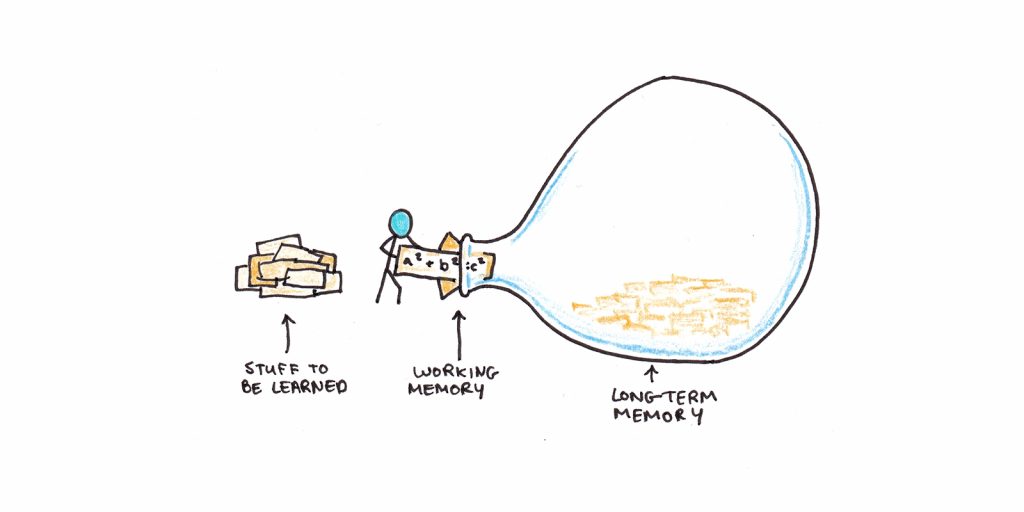
Cognitive Load Theory and its Applications for Learning - Scott H Young
What makes learning hard? How can we make it easier? Cognitive load theory explains how we learn and how to do it better.
How Focus Became More Valuable Than Intelligence
This may be the most important problem of our lifetime.

Dec 2020 -- Jelle Bruineberg -- Embodied cognition and the attention crisis
Microsoft Study Finds AI Makes Human Cognition “Atrophied and Unprepared”
Researchers find that the more people use AI at their job, the less critical thinking they use.

Microsoft Study Finds AI Makes Human Cognition “Atrophied and Unprepared”
Researchers find that the more people use AI at their job, the less critical thinking they use.
Norm theory: Comparing reality to its alternatives.
Discover this 1986 paper in Psychological Review by Kahneman, Daniel; and, Miller, Dale T. focusing on: Attribution; Emotional Responses; Social Norms; Judgment; Models Abstract: Presents a theory of norms and normality and applies the theory to phenomena of emotional responses, social judgment, and conversations about causes. Norms are assumed to be constructed ad hoc by recruiting specific representations. Category norms are derived by recruiting exemplars. Specific objects or events generate their own norms by retrieval of similar experiences stored in memory or by construction of counterfactual alternatives. The normality of a stimulus is evaluated by comparing it with the norms that it evokes after the fact, rather than to precomputed expectations. Norm theory is applied in analyses of the enhanced emotional response to events that have abnormal causes, of the generation of predictions and inferences from observations of behavior, and of the role of norms in causal questions and answers. (3 p ref) (PsycInfo Database Record (c) 2025 APA, all rights reserved)
Capturing our Attention by @neillevy.bsky.social "we possess sophisticated capacities of epistemic vigilance, which work reasonably well to distinguish reliable from unreliable information, but ... we do not have parallel defences against attentional capture" > tandfonline.com/doi/full/10.1080/00048402.202…
