


The creator of Graphite, the Google Docs killer, has a new blockchain tool to help startups reach audiences. Has he figured out Web3's sluggish user growth?
Understanding Web 3 — A User Controlled Internet
Coinbase breaks down the motivation and technology behind the development of Web 3
Why We Need Web 3.0
Ethereum co-founder Gavin Wood on why today’s internet is broken — and how we can do better next time around

Chris Granger - "Is Web3... anything?"
The term “web3” seems pretty fluid and is being used as a label for a bunch of disparate ideas. Given that it’s a decentralized group describing a decentralized movement, that lack of focus isn’t exactly surprising. Almost by definition it’s going to end up being different things to different people.
The Web’s Creator Looks to Reinvent It (Published 2016)
Tim Berners-Lee and other computer scientists are pondering newer technologies to create a web with more privacy and less government control.

Web of the People — Open Indie
Whether you think of web3 as the advent of peer-to-peer protocols, coin-operated blockchains or autocomplete-AI synthesizers, change is c...
De-google-ify Internet - Main Page
The web giants centralize our digital lives in exchange for their services The Free Software community offers alternative ethical services The Framasoft network intends to prove itby hosting them
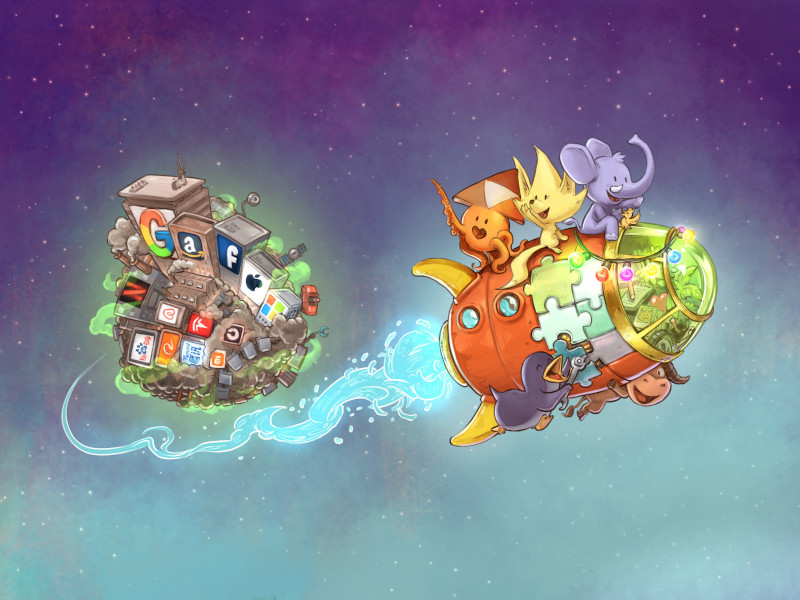
The Web 3.0: The Web Transition Is Coming | HackerNoon
Transitioning from web 2.0 to the 3.0 version is going to likely go unnoticed by most people. The applications are going to look almost exactly like what you are currently using, but the change will be on the back-end. If you are a betting man you will want to consider Siacoin for Cloud, Steemit as a platform for social media, and even Augur as the way to check out future betting events.

Privacy vs. Profit: The Impact of Google's Manifest Version 3 (MV3) Update on Ad Blocker Effectiveness
Google's recent update to the manifest file for Chrome browser extensions, transitioning from manifest version 2 (MV2) to manifest version 3 (MV3), has raised concerns among users and ad blocker providers, who worry that the new restrictions, notably the shift from the powerful WebRequest API to the more restrictive DeclarativeNetRequest API, might reduce ad blocker effectiveness. Because ad blockers play a vital role for millions of users seeking a more private and ad-free browsing experience, this study empirically investigates how the MV3 update affects their ability to block ads and trackers. Through a browser-based experiment conducted across multiple samples of ad-supported websites, we compare the MV3 to MV2 instances of four widely used ad blockers. Our results reveal no statistically significant reduction in ad-blocking or anti-tracking effectiveness for MV3 ad blockers compared to their MV2 counterparts, and in some cases, MV3 instances even exhibit slight improvements in blocking trackers. These findings are reassuring for users, indicating that the MV3 instances of popular ad blockers continue to provide effective protection against intrusive ads and privacy-infringing trackers. While some uncertainties remain, ad blocker providers appear to have successfully navigated the MV3 update, finding solutions that maintain the core functionality of their extensions.

NextGraph - Decentralized, encrypted and local-first platform and framework, towards the better internet we all deserve!
Features a social network, shared documents, productivity tools, an app store, and more! You can use NextGraph for free : resilient, secure, private and encrypted. You own your data and software! Developers can build new web3.0 local-first apps with our open source framework, based on open standards, with CRDTs, E2EE, Linked Data, JSON, Markdown...
Web Crypto’s SubtleCrypto: A Masterclass in Developer Hostility and How It Strangles the Modern Web
Not Subtle, Just Sabotage — An API Against the Web
Don't Lie To Me About Web 2.0
If you’re like me and you’re trying to keep an open mind that there may someday be a non-scam application of blockchains, you’ve probably read some articles about “Web3”, which promises to re-decentralize the web by something something Blockchain.
Google’s nightmare “Web Integrity API” wants a DRM gatekeeper for the web
It's just a "proposal," but it's also being prototyped inside Chrome right now.

Web3 is Self-Certifying
There’s been a lot of discussion lately about what Web3 is and isn’t. Here’s my definition: Web3 is user-generated authority, enabled by…

Hackers Expose Age-Verification Software Powering Surveillance Web
Three hacktivists tried to find a workaround to Discord’s age-verification software. Instead, they found its frontend exposed to the open internet.
Web3 is not decentralization
It's just not. Here's a deep dive into why, exactly, I think that.
ĐApps: What Web 3.0 Looks Like
As we move into the future, we find increasing need for a zero-trust interaction system. Even pre-Snowden, we had realised that entrusting our information to arbitrary entities on the internet was fraught with danger. However, post-Snowden the argument plainly falls in the hand of those who believe that large organisations and governments routinely attempt to stretch and overstep their authority. Thus we realise that entrusting our information to organisations in general is a fundamentally broken model. The chance of an organisation not meddling with our data is merely the effort required minus their expected gains. Given they tend to have an income model that requires they know as much about people as possible the realist will realise that the potential for convert misuse is difficult to overestimate.