


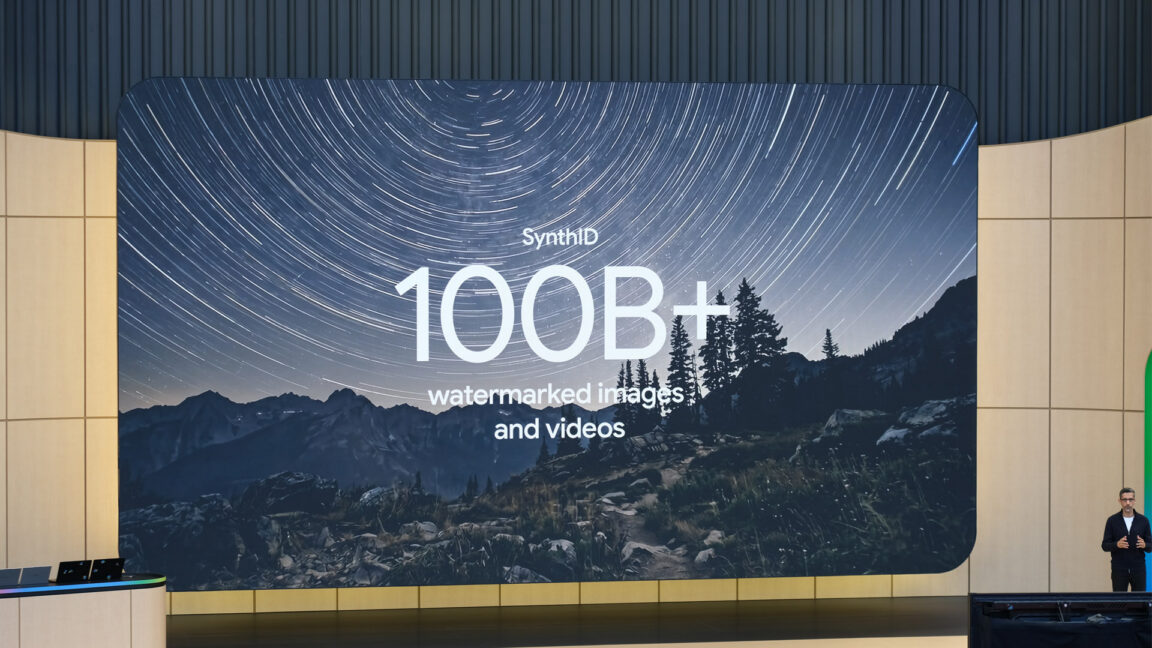
Today, in partnership with Google Cloud, we’re beta launching SynthID, a new tool for watermarking and identifying AI-generated images. It’s being released to a limited number of Vertex AI customers using Imagen, one of our latest text-to-image models that uses input text to create photorealistic images. This technology embeds a digital watermark directly into the pixels of an image, making it imperceptible to the human eye, but detectable for identification. While generative AI can unlock huge creative potential, it also presents new risks, like creators spreading false information — both intentionally or unintentionally. Being able to identify AI-generated content is critical to empowering people with knowledge of when they’re interacting with generated media, and for helping prevent the spread of misinformation.
Google made a watermark for AI images that you can’t edit out
For now, SynthID works only in Google’s ecosystem — but it could someday be all over the internet

Google’s invisible AI watermark will help identify generative text and video
New AI tools to generate videos and detect them as well.

Google's SynthID AI watermarking tech is being adopted by OpenAI, Nvidia, and more
AI content is getting good, but SynthID might be able to help tell truth from fiction.
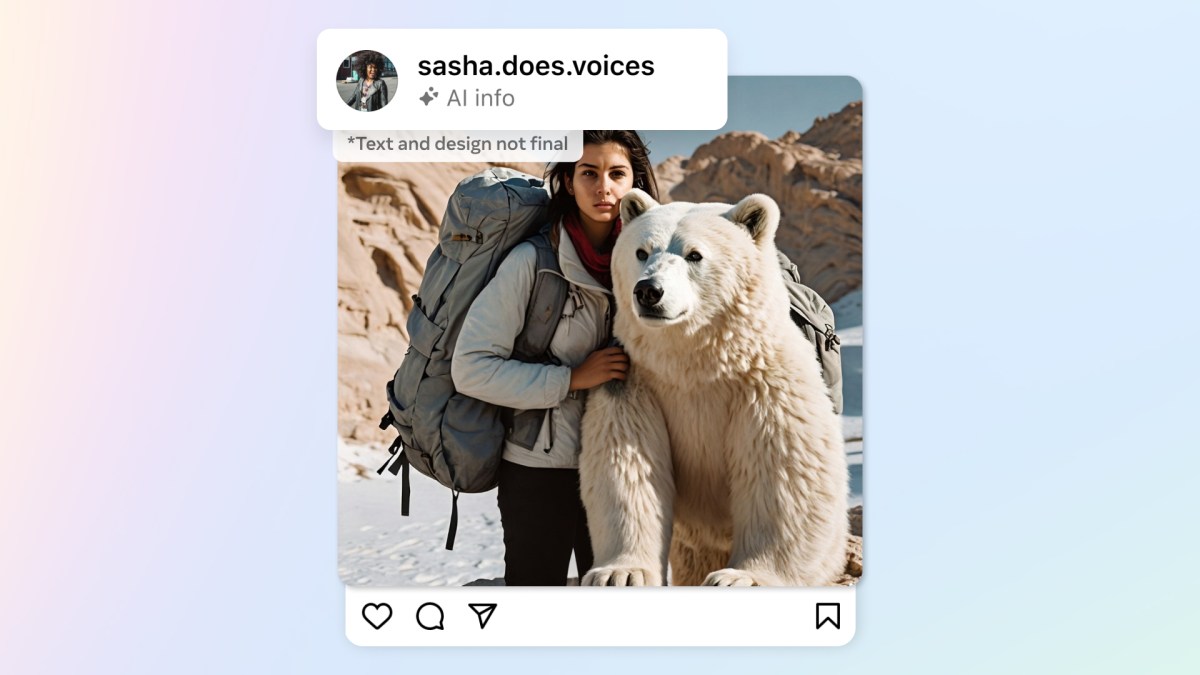
Labeling AI-Generated Images on Facebook, Instagram and Threads
Nick Clegg offers a new approach to identifying and labeling AI-generated content.
An AI-Generated Content Empire Is Spreading Fake Celebrity Images on Google
A ring of websites using AI and run by an aspiring movie star are behind fake celebrity images featured in Google results, Motherboard found.

Google joins AI watermarking coalition as deepfakes hit mainstream tech platforms
Google said it will look to use a project from Adobe called Content Credentials, which adds metadata that indicates AI editing and allows viewers to verify images, videos, audio and documents.
AI-synthesized faces are indistinguishable from real faces and more trustworthy
Artificial intelligence (AI)–synthesized text, audio, image, and video are being weaponized for the purposes of nonconsensual intimate imagery, financial fraud, and disinformation campaigns. Our evaluation of the photorealism of AI-synthesized faces indicates that synthesis engines have passed through the uncanny valley and are capable of creating faces that are indistinguishable—and more trustworthy—than real faces.

AI-synthesized faces are indistinguishable from real faces and more trustworthy
Artificial intelligence (AI)–synthesized text, audio, image, and video are being weaponized for the purposes of nonconsensual intimate imagery, financial fraud, and disinformation campaigns. Our evaluation of the photorealism of AI-synthesized faces indicates that synthesis engines have passed through the uncanny valley and are capable of creating faces that are indistinguishable—and more trustworthy—than real faces.
How to tell if an image is AI-generated
Scammers are using AI-generated images to make fake stories more convincing. Here's how to separate real from fake.

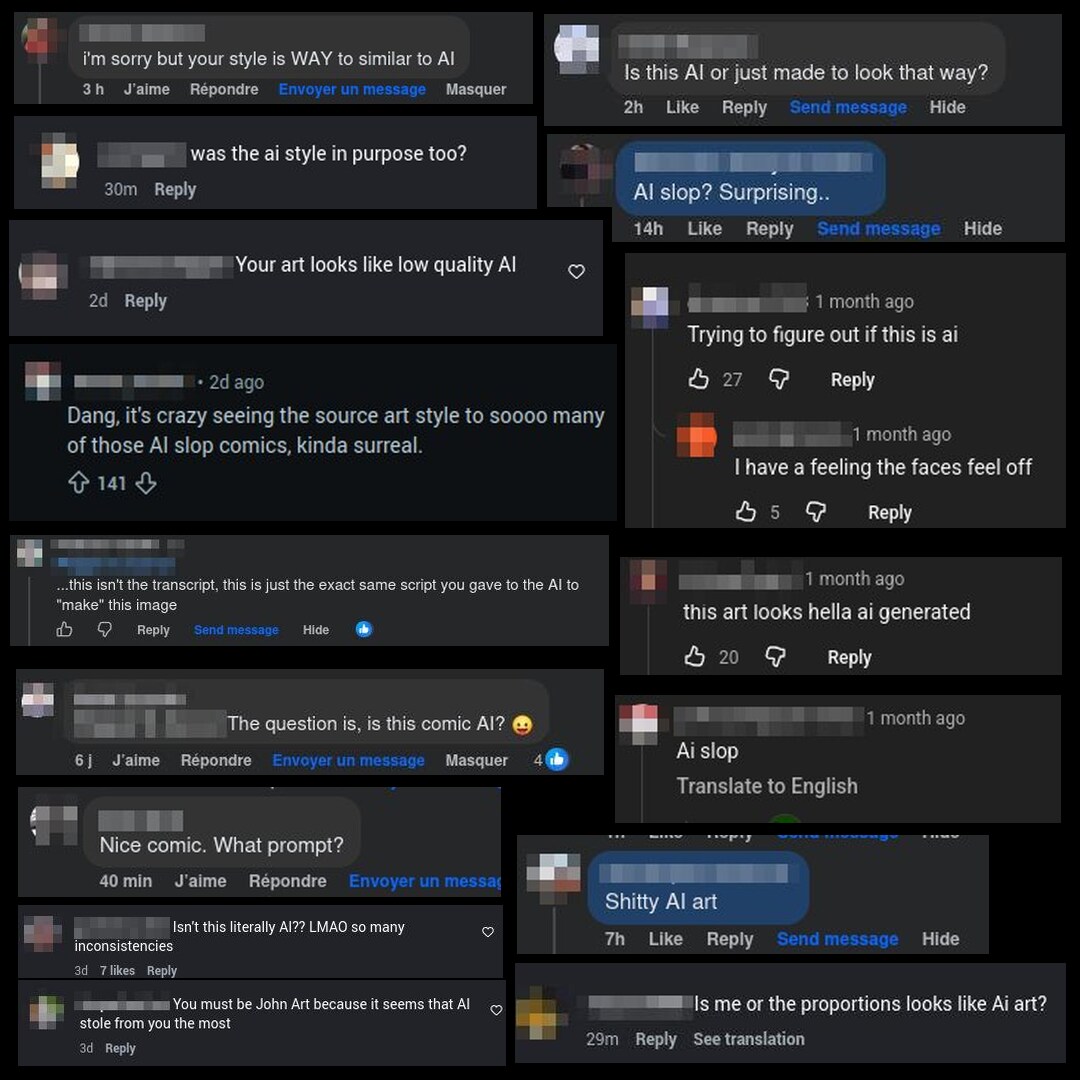
When online commenters 'detect' my art as AI
Here is a collection of screenshots (obfuscated) of dozens and dozens of online comments from many platforms (Reddit, YouTube, Instagram, Facebook) containing accusations or confusion that my artworks and comics are AI-generated. Despite creating every piece by hand, despite sharing timelapses, the comments keep coming, and they're getting stronger.
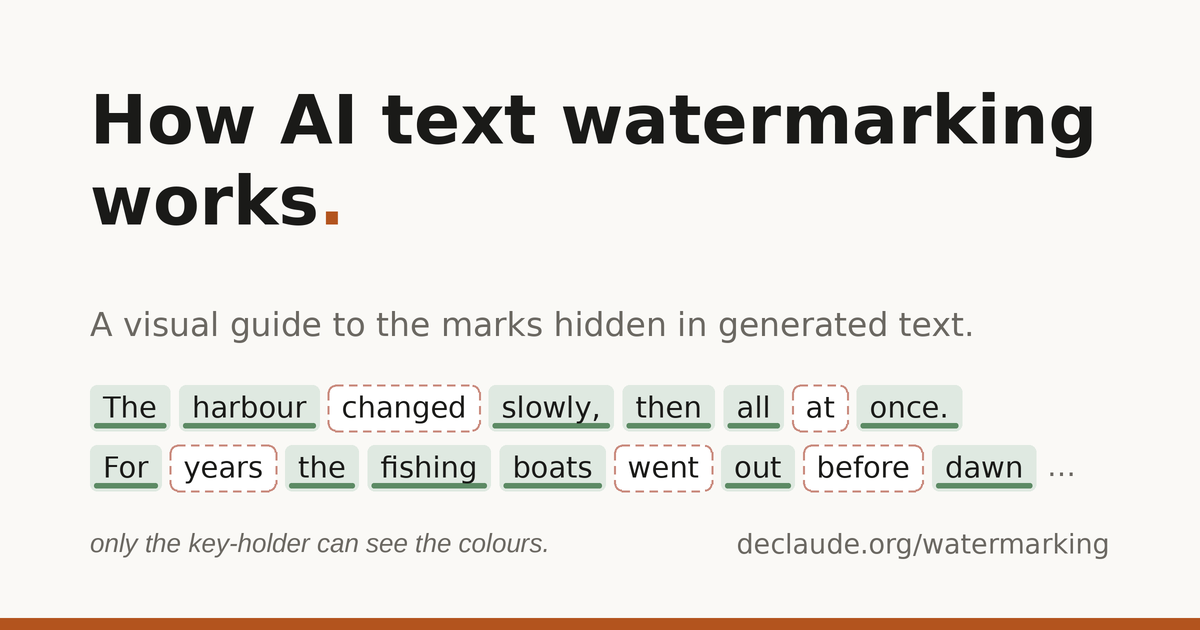
How AI text watermarking works
A gentle visual guide to how a statistical mark hides inside generated text, and what erases it.
AMMeBa: A Large-Scale Survey and Dataset of Media-Based Misinformation In-The-Wild
The prevalence and harms of online misinformation is a perennial concern for internet platforms, institutions and society at large. Over time, information shared online has become more media-heavy and misinformation has readily adapted to these new modalities. The rise of generative AI-based tools, which provide widely-accessible methods for synthesizing realistic audio, images, video and human-like text, have amplified these concerns. Despite intense public interest and significant press coverage, quantitative information on the prevalence and modality of media-based misinformation remains scarce. Here, we present the results of a two-year study using human raters to annotate online media-based misinformation, mostly focusing on images, based on claims assessed in a large sample of publicly-accessible fact checks with the ClaimReview markup. We present an image typology, designed to capture aspects of the image and manipulation relevant to the image's role in the misinformation claim. We visualize the distribution of these types over time. We show the rise of generative AI-based content in misinformation claims, and that its commonality is a relatively recent phenomenon, occurring significantly after heavy press coverage. We also show "simple" methods dominated historically, particularly context manipulations, and continued to hold a majority as of the end of data collection in November 2023. The dataset, Annotated Misinformation, Media-Based (AMMeBa), is publicly-available, and we hope that these data will serve as both a means of evaluating mitigation methods in a realistic setting and as a first-of-its-kind census of the types and modalities of online misinformation.

AMMeBa: A Large-Scale Survey and Dataset of Media-Based Misinformation In-The-Wild
The prevalence and harms of online misinformation is a perennial concern for internet platforms, institutions and society at large. Over time, information shared online has become more media-heavy and misinformation has readily adapted to these new modalities. The rise of generative AI-based tools, which provide widely-accessible methods for synthesizing realistic audio, images, video and human-like text, have amplified these concerns. Despite intense public interest and significant press coverage, quantitative information on the prevalence and modality of media-based misinformation remains scarce. Here, we present the results of a two-year study using human raters to annotate online media-based misinformation, mostly focusing on images, based on claims assessed in a large sample of publicly-accessible fact checks with the ClaimReview markup. We present an image typology, designed to capture aspects of the image and manipulation relevant to the image's role in the misinformation claim. We visualize the distribution of these types over time. We show the rise of generative AI-based content in misinformation claims, and that its commonality is a relatively recent phenomenon, occurring significantly after heavy press coverage. We also show "simple" methods dominated historically, particularly context manipulations, and continued to hold a majority as of the end of data collection in November 2023. The dataset, Annotated Misinformation, Media-Based (AMMeBa), is publicly-available, and we hope that these data will serve as both a means of evaluating mitigation methods in a realistic setting and as a first-of-its-kind census of the types and modalities of online misinformation.
Google research shows the fast rise of AI-generated misinformation | CBC News
From fake images of war to celebrity hoaxes, AI technology has spawned new forms of reality-warping misinformation online. New analysis co-authored by Google researchers shows just how quickly the problem has grown.

Glaze: Protecting Artists from Style Mimicry by Text-to-Image Models
Recent text-to-image diffusion models such as MidJourney and Stable Diffusion threaten to displace many in the professional artist community. In particular, models can learn to mimic the artistic style of specific artists after "fine-tuning" on samples of their art. In this paper, we describe the design, implementation and evaluation of Glaze, a tool that enables artists to apply "style cloaks" to their art before sharing online. These cloaks apply barely perceptible perturbations to images, and when used as training data, mislead generative models that try to mimic a specific artist. In coordination with the professional artist community, we deploy user studies to more than 1000 artists, assessing their views of AI art, as well as the efficacy of our tool, its usability and tolerability of perturbations, and robustness across different scenarios and against adaptive countermeasures. Both surveyed artists and empirical CLIP-based scores show that even at low perturbation levels (p=0.05), Glaze is highly successful at disrupting mimicry under normal conditions (>92%) and against adaptive countermeasures (>85%).
How Text-to-Image AI Works, What AI Image Generators Can Create
Overview Text prompts can be transformed into photographs, artwork, concepts, characters and creative visuals.Many modern generators progressively remove noise
