

Social media isn't toxic, most people just haven't figured out the game (yet)
The Noisy Room
Only 3% of social media users post toxic content — but Americans estimate 43%. An interactive essay.
Bias, Skew, and Search Engines Are Sufficient to Explain Online Toxicity
RIP social media. What comes next is messy.
As social media splinters, how can we keep the new online spaces from devolving into toxic pits of despair?

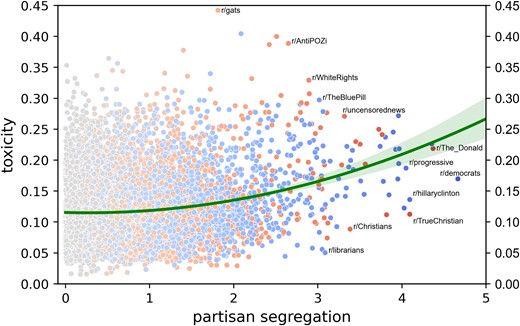
The social media discourse of engaged partisans is toxic even when politics are irrelevant
Abstract Prevailing theories of partisan incivility on social media suggest that it derives from disagreement about political issues or from status competition between groups. This study—which analyzes the commenting behavior of Reddit users across diverse cultural contexts (subreddits)—tests the alternative hypothesis that such incivility derives in large part from a selection effect: Toxic people are especially likely to opt into discourse in partisan contexts. First, we examined commenting behavior across over 9,000 unique cultural contexts (subreddits) and confirmed that discourse is indeed more toxic in partisan (e.g. r/progressive, r/conservatives) than in nonpartisan contexts (e.g. r/movies, r/programming). Next, we analyzed hundreds of millions of comments from over 6.3 million users and found robust evidence that: (i) the discourse of people whose behavior is especially toxic in partisan contexts is also especially toxic in nonpartisan contexts (i.e. people are not politics-only toxicity specialists); and (ii) when considering only nonpartisan contexts, the discourse of people who also comment in partisan contexts is more toxic than the discourse of people who do not. These effects were not driven by socialization processes whereby people overgeneralized toxic behavioral norms they had learned in partisan contexts. In contrast to speculation about the need for partisans to engage beyond their echo chambers, toxicity in nonpartisan contexts was higher among people who also comment in both left-wing and right-wing contexts (bilaterally engaged users) than among people who also comment in only left-wing or right-wing contexts (unilaterally engaged users). The discussion considers implications for democratic functioning and theories of polarization.
Trust: Foundation of Human Knowledge yet online Platforms won't allow | David Karger | TEDxMIT Salon
Social Media Is Now Parasocial Media
When practitioners used the term “social media” to describe the internet tools that emerged in the mid-aughts, they were giving a name to the kinds of platforms and protocols that allowed people to socialize with friends and communities of interest by using digital technologies. Twenty years later, users of social media are far more likely to scroll than post – and the content that they consume is often strategically produced and algorithmically curated. In this essay, I argue that the very essence of social media has changed. To more effectively interrogate what we are witnessing, we need to stop presuming that these tools are “social media” and begin recognizing that they are now “parasocial media.” Doing so raises new questions about digitally mediated sociality, not to mention the politics and governance of these platforms.

Play nice! How the internet is trying to design out toxic behaviour
Online abuse can be cruel – but for some tech companies it is an existential threat. Can giants such as Facebook use behavioural psychology and persuasive design to tame the trolls?
The social media discourse of engaged partisans is toxic even when politics are irrelevant
Abstract. Prevailing theories of partisan incivility on social media suggest that it derives from disagreement about political issues or from status compet
The social media discourse of engaged partisans is toxic even when politics are irrelevant
Abstract. Prevailing theories of partisan incivility on social media suggest that it derives from disagreement about political issues or from status compet
Digital Social Norm Enforcement: Online Firestorms in Social Media
Actors of public interest today have to fear the adverse impact that stems from social media platforms. Any controversial behavior may promptly trigger temporal, but potentially devastating storms of emotional and aggressive outrage, so called online firestorms. Popular targets of online firestorms are companies, politicians, celebrities, media, academics and many more. This article introduces social norm theory to understand online aggression in a social-political online setting, challenging the popular assumption that online anonymity is one of the principle factors that promotes aggression. We underpin this social norm view by analyzing a major social media platform concerned with public affairs over a period of three years entailing 532,197 comments on 1,612 online petitions. Results show that in the context of online firestorms, non-anonymous individuals are more aggressive compared to anonymous individuals. This effect is reinforced if selective incentives are present and if aggressors are intrinsically motivated.
Digital Social Norm Enforcement: Online Firestorms in Social Media
Actors of public interest today have to fear the adverse impact that stems from social media platforms. Any controversial behavior may promptly trigger temporal, but potentially devastating storms of emotional and aggressive outrage, so called online firestorms. Popular targets of online firestorms are companies, politicians, celebrities, media, academics and many more. This article introduces social norm theory to understand online aggression in a social-political online setting, challenging the popular assumption that online anonymity is one of the principle factors that promotes aggression. We underpin this social norm view by analyzing a major social media platform concerned with public affairs over a period of three years entailing 532,197 comments on 1,612 online petitions. Results show that in the context of online firestorms, non-anonymous individuals are more aggressive compared to anonymous individuals. This effect is reinforced if selective incentives are present and if aggressors are intrinsically motivated.
Rational Silence and False Polarization: How Viewpoint Organizations and Recommender Systems Distort the Expression of Public Opinion
Social media platforms are one of the most important domains in which artificial intelligence (AI) has already transformed the nature of economic and social interaction. AI enables the massive scale and highly personalized nature of online information sharing that we now take for granted. Extensive attention has been devoted to the polarization that social media platforms appear to facilitate. However, a key implication of the transformation we are experiencing due to these AI-powered platforms has received much less attention: how platforms impact what observers of online discourse come to believe about community views. These observers include policymakers and legislators, who look to social media to gauge the prospects for policy and legislative change, as well as developers of AI models trained on large-scale internet data, whose outputs may similarly reflect a distorted view of public opinion. In this paper, we present a nested game-theoretic model to show how observed online opinion is produced by the interaction of the decisions made by users about whether and with what rhetorical intensity to share their opinions on a platform, the efforts of viewpoint organizations (such as traditional media and advocacy organizations) that seek to encourage or discourage opinion-sharing online, and the operation of AI-powered recommender systems controlled by social media platforms. We show that signals from ideological viewpoint organizations encourage an increase in rhetorical intensity, leading to the rational silence of moderate users. This, in turn, creates a polarized impression of where average opinions lie. We also show that this observed polarization can also be amplified by recommender systems that, pursuant to a platform’s incentive to maximize engagement, encourage the formation of viewpoint communities online that end up seeing a skewed sample of opinion. Unlike existing models, these well-known online phenomena are not here attributed to distortion in the formation of opinions nor to the seeking out of like-minded others, but rather to the interaction of the incentives of users, viewpoint organizations, and platforms implementing recommender systems. In addition to showing how these interactions can play out in simulations, we also identify practical strategies platforms can implement, such as reducing exposure to signals from ideological viewpoint organizations and a tailored approach to content moderation.
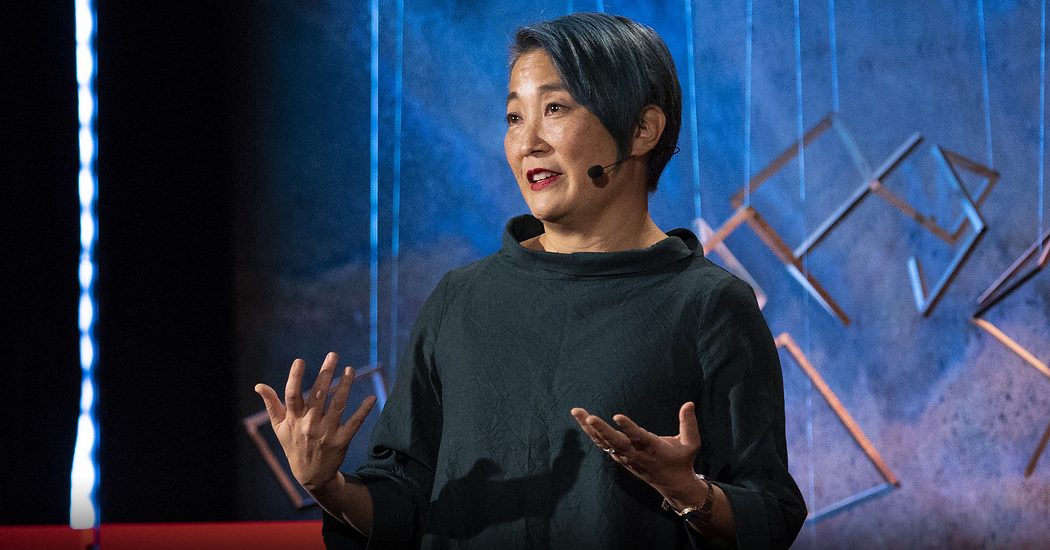
Lisa Nakamura: The internet is a trash fire. Here's how to fix it.
Life on the internet is real life, and we need to stop pretending that what happens online doesn't matter, says digital media researcher Lisa Nakamura. In this timely talk, she explains the steps we can take to correct the toxic behaviors that have become common online -- and help make the internet a place where we all feel safe.
Everyone Cheering The Social Media Addiction Verdicts Against Meta Should Understand What They’re Actually Cheering For
First things first: Meta is a terrible company that has spent years making terrible decisions and being terrible at explaining the challenges of social media trust & safety, all while prioritiz…

Can a video game company tame toxic behaviour?
Scientists are helping to stop antisocial behaviour in the world's most popular online game. The next stop could be a kinder Internet.

Social media discourse is driven by false #polarization We find that: 1) ideologues post opinions more than moderates 2) extreme attitudes are posted more than moderate one 3) This replicates in 40 countries 4) Opinions that users post are more hostile than the beliefs they keep to themselves
