

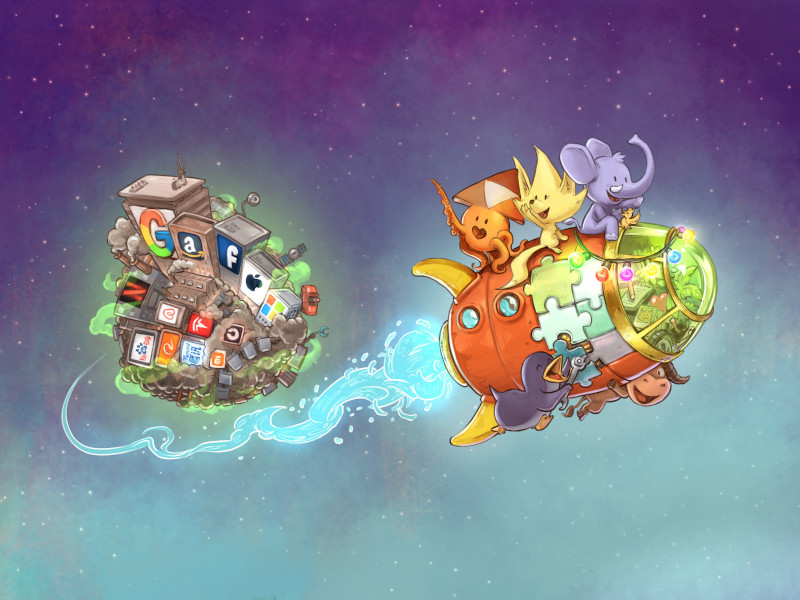
The web giants centralize our digital lives in exchange for their services The Free Software community offers alternative ethical services The Framasoft network intends to prove itby hosting them
Framasoft
Framasoft is a not-for-profit popular educational organization, a group of friends convinced that an emancipatory digital world is possible, convinced that it will arise through actual actions on real world and online with and for you!

The Decentralized Web: Defending Internet Freedom through Decentralization: Back to the Future? — MIT Digital Currency Initiative
In this report, we explore two important ways structurally decentralized systems could help address the risks of mega-platform consolidation: First, these systems can help users directly publish and discover content directly, without intermediaries, and thus without censorship. All of the systems we

Self-Hosting on the Dark Web | David Álvarez Rosa
This site is now reachable over Tor as a hidden service, at a .onion address that resolves only inside the Tor network. Tor relays and encrypts your traffic as …


15 Open-Source Tools for Digital Sovereignty (2026) | Comparisons & Alternatives | Vucense
Own your digital stack. The 15 best open-source tools for privacy, security, and full control over your data — reviewed and ranked for 2026.

I’m Building an Algorithm That Doesn’t Rot Your Brain
The State of the Web at Google I/O 2018
The web is a global treasure, and has many strengths we all enjoy. It is a distribution platform like no other, providing people around the ...

Leave big tech behind! How to replace Amazon, Google, X, Meta, Apple – and more
A handful of companies monopolise the web, with unprecedented access to our data. But there are many more ethical – and often distinctively European – alternatives

Cloudflare's Matthew Prince has a plan to get Google and the AI oliigarchs to pay for your content even though many are used to getting it for free. He might have enough leverage to make them.
AI chatbots are blowing up the 30-year economic relationship publishers have had with search engines. Many think this will kill the web if not addressed. Google needs to change first. It's resisting. Cloudflare's Matthew Prince is going to try and make them.

Long Live the Web: A Call for Continued Open Standards and Neutrality
The Web is critical not merely to the digital revolution but to our continued prosperity—and even our liberty. Like democracy itself, it needs defending

Reclaim the internet: Mozilla’s rebrand for the next era of tech | The Mozilla Blog
Mozilla isn’t just another tech company — we’re a global crew of activists, technologists and builders, all working to keep the internet free, op

Welcome to the CHATONS website | CHATONS
CHATONS – kittens in french – is the Collective of Hosters Alternative, Transparent, Open, Neutral and Solidarity. This collective aims to bring together structures offering free, ethical and decentralised online services in order to allow users to quickly find alternatives that respect their data and privacy to the services offered by GAFAM (Google, Apple, Facebook, Amazon, Microsoft). CHATONS is a collective initiated by the association Framasoft in 2016 following the success of its campaign De-google-ify Internet.
The crusade against open-source abuse | TechCrunch
There’s a dark cloud on the horizon. The behavior of cloud infrastructure providers threatens the viability of open source. Thankfully, several leaders have mobilized to propose multiple solutions.

Internet for the People: The Fight for Our Digital Future
"For all the informational convenience the internet offers, it is deeply flawed. How can it be improved? Writer Ben Tarnoff proposes one possibility in this intriguing book, which urges the development of 'a public lane on the information superhighway.' It's worth checking out for yourself." – Seth MacFarlane Why is the internet so broken, and what could ever possibly fix it? In Internet for the People, leading tech writer Ben Tarnoff offers an answer. The internet is broken, he argues, because it is owned by private firms and run for profit. Google annihilates your privacy and Facebook amplifies right-wing propaganda because it is profitable to do so. But the internet wasn't always like this—it had to be remade for the purposes of profit maximization, through a years-long process of privatization that turned a small research network into a powerhouse of global capitalism. Tarnoff tells the story of the privatization that made the modern internet, and which set in motion the crises that consume it today. The solution to those crises is straightforward: deprivatize the internet. Deprivatization aims at creating an internet where people, and not profit, rule. It calls for shrinking the space of the market and diminishing the power of the profit motive. It calls for abolishing the walled gardens of Google, Facebook, and the other giants that dominate our digital lives and developing publicly and cooperatively owned alternatives that encode real democratic control. To build a better internet, we need to change how it is owned and organized. Not with an eye towards making markets work better, but towards making them less dominant. Not in order to create a more competitive or more rule-bound version of privatization, but to overturn it. Otherwise, a small number of executives and investors will continue to make choices on everyone’s behalf, and these choices will remain tightly bound by the demands of the market. It's time to demand an internet by, and for, the people now.