

We automatically generate complex kernels, like Flash Attention, with zero hand engineering
Luminal - Search-Based Deep Learning Compilers - Joe Fioti
Benchmarking Subquadratic’s latest model & SSA Kernel | Appen
56× faster than FlashAttention-2 at 1M tokens. Independent efficiency, retrieval, and SWE-Bench benchmark of sparse self-attention. Download the full report.
Compiling Models to Megakernels
Fine-grained synchronization, deep pipelines, and zero kernel launch overheads, automatically.
jafioti/luminal | DeepWiki
This document provides a high-level introduction to the luminal deep learning framework, covering its core architecture, design principles, and key components. This overview explains how luminal's gra
Modern GPU Programming For MLSys — Modern GPU Programming For MLSys
Machine learning systems sit at the heart of modern AI workloads. In these systems, performance often comes down to the quality of a small number of GPU kernels. Attention kernels, LLM prefill and decode kernels, low-precision block-scaled GEMMs, fused MoE layers, and other large fused kernels all directly shape end-to-end speed in both training and serving.
Modern GPU Programming For MLSys — Modern GPU Programming For MLSys
Machine learning systems sit at the heart of modern AI workloads. In these systems, performance often comes down to the quality of a small number of GPU kernels. Attention kernels, LLM prefill and decode kernels, low-precision block-scaled GEMMs, fused MoE layers, and other large fused kernels all directly shape end-to-end speed in both training and serving.
Can LLMs Be Computers? | Percepta
We build a computer inside a transformer — executing arbitrary C programs for millions of steps with exponentially faster inference via 2D attention heads.
Can LLMs Be Computers? | Percepta
We build a computer inside a transformer — executing arbitrary C programs for millions of steps with exponentially faster inference via 2D attention heads.
Escher Circuits: Using Vision to Perform Computation
esolangs, esoplatforms, esosystems, and all that break from the norms of computing

Andrej Karpathy on Twitter / X
The race for LLM "cognitive core" - a few billion param model that maximally sacrifices encyclopedic knowledge for capability. It lives always-on and by default on every computer as the kernel of LLM personal computing.Its features are slowly crystalizing:- Natively multimodal… https://t.co/2jsVevkTSJ— Andrej Karpathy (@karpathy) June 27, 2025
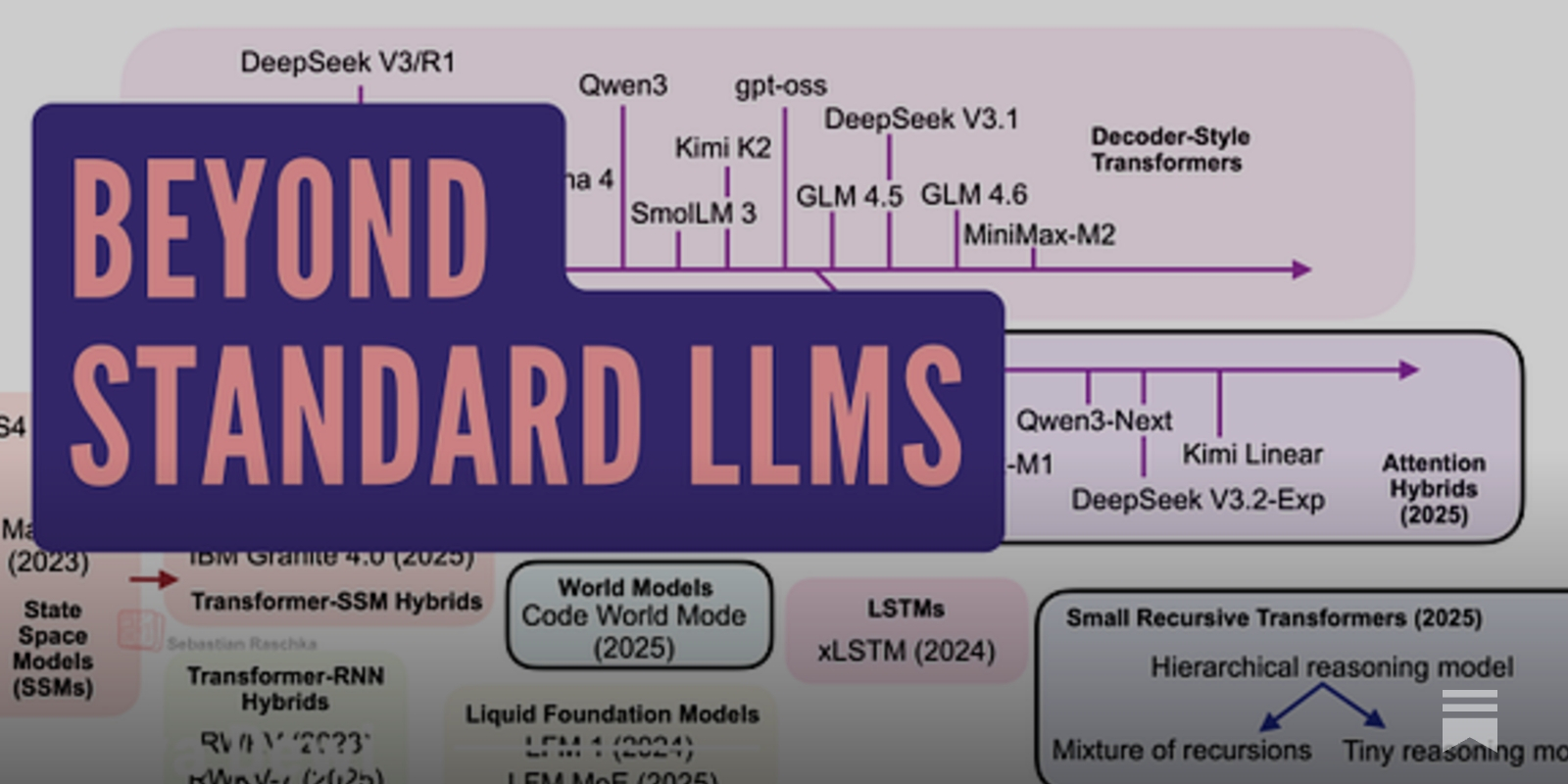
Beyond Standard LLMs
Linear Attention Hybrids, Text Diffusion, Code World Models, and Small Recursive Transformers
Attention Is All You Need
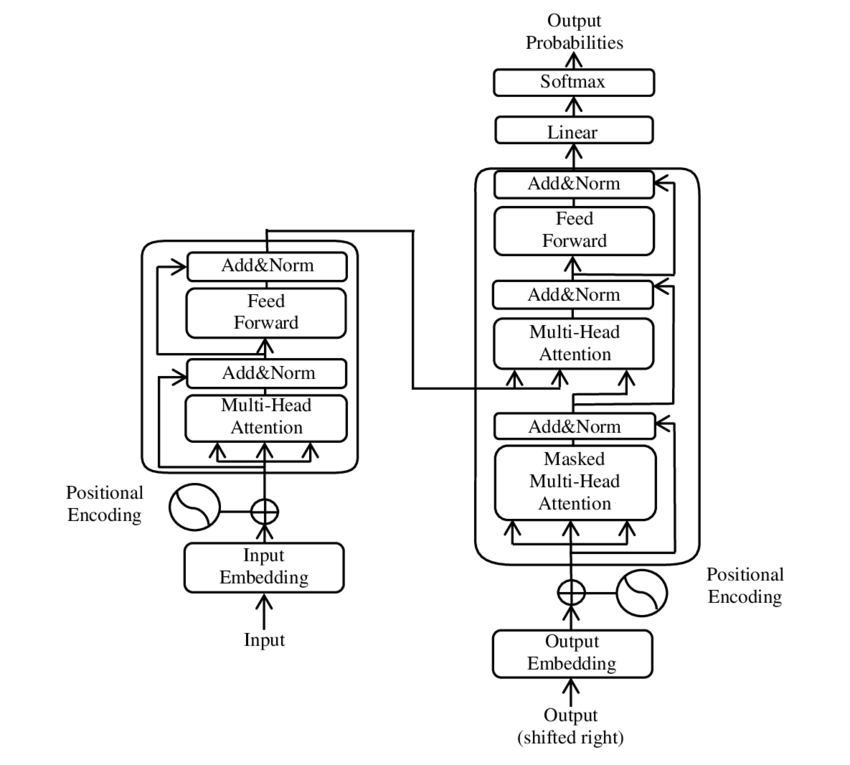
"Attention Is All You Need" is a 2017 research paper in machine learning authored by eight scientists and engineers working at Google. The paper introduced a new deep learning architecture known as the transformer, based on the attention mechanism proposed in 2014 by Bahdanau et al. The transformer approach it describes has become the main architecture of a wide variety of artificial intelligence systems, including large language models. At the time, the focus of the research was on improving Seq2seq techniques for machine translation, but the authors go further in the paper, foreseeing the technique's potential for other tasks like question answering and what is now known as multimodal generative AI.
Introducing Lumo 1.1 for faster, advanced reasoning | Proton
Lumo 1.1 is a faster, smarter AI assistant that matches Big Tech’s capabilities while protecting your privacy with zero-access encryption.

A world of active objects for work and play: the first ten years of lively
The Lively Kernel is a complete platform for Web programming written in JavaScriptTM using graphics available in leading browsers. A widget set built from these elements provides a user interface kit, and the widget set is also extensible. A window-...

Create | Diffuse
You can generate interfaces or features easily using AI. Diffuse provides a skill to use with LLMs. Claude usage example:
The Lively Kernel