

Papra, the document archiving and sharing platform.
IIPC WAC 2024 Presentation: A Conceptual Model of Decentralized Storage for Community-Based Archives
Rethinking Digital Storage for Community-Based Archives
Over the last few decades, the standard procedure for storing and backing up data has been ‘put it in the cloud.’ Many of us use cloud…

ArchiveBox - Open-source self-hosted web archiving
Preserve websites, media, bookmarks, feeds, source code, evidence, and research material in durable files you control.
skeetgen - Bluesky archiving tool
This will not be shared to any servers, any processing is done on your device.
Webrecorder: Web Archiving for All
Webrecorder provides open source solutions for everyone to archive the complex, interactive Web.
Introducing Aris: The publishing platform for the Post-PDF Era - Aris
We're building the future of academic publishing: tools that make it easy to create, share, and preserve knowledge in formats designed for the web, not the printing press.
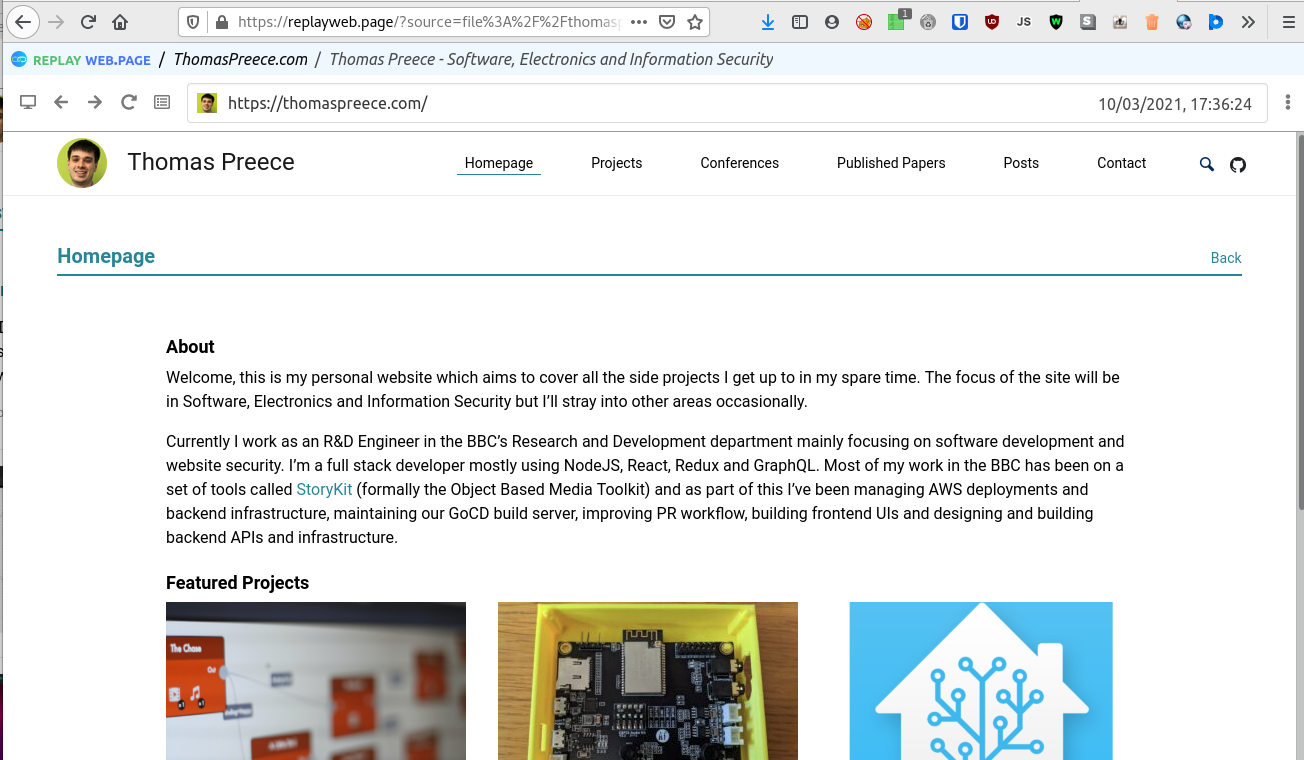
Web Archiving: Playback Tools - Thomas Preece
Web Archiving: Playback Tools - Below I've listed some of the tools I found to playback web archives. The two most popular tools that I found were OpenWayback and PyWb. Of the tests I
Preservation Initiatives - Canadian Association of Research Libraries
DPC RAM Benchmarking Project CARL’s Digital Preservation Working Group (DPWG) is facilitating a national benchmarking exercise using the Digital Preservation Coalition’s Rapid Assessment Model (DPC RAM). This project fulfills one of the main recommendations from […]

What's new? - Sri's leaflets
Launching at.new - a new way to create atproto records and share drafts
Karpathy's LLM Knowledge Base Wiki for Enterprise | Vijoy Pandey posted on the topic | LinkedIn
There's a new kind of computer media in the enterprise: Write once, Read never. The docs are perpetually stale, constantly diverging from reality, and scattered across Confluence, SharePoint, GitHub, Webex (or Slack) threads, Notion, Obsidian - and in my personal life, add Apple Notes, Goodnotes, web clippings, and multiple Google Drives worth of docs and slides that nobody is ever going back to. Karpathy tweeted his LLM knowledge base wiki architecture which went viral last weekend and I decided to give it a run yesterday. Verdict: You *have* to try this out. Prediction: You won’t be able to live without it soon. There were a few mods and decisions I made to the base Karpathy provided. First, the vault / folder structure in Obsidian. I already use Obsidian as a human. Instead of creating separate vaults and dealing with the sync nightmare, I just have folders for Human and Agent, and a Raw folder. (1) The Human/ folder is where I write long form articles and notes independent of the knowledge base wiki. No LLM or agent touches this folder. (2) I do have Arnold Layne, my OpenClaw agent, doing background tasks for me. Raw/ is where both Arnold and I, dump raw snippets. Inclusive of diverse kinds of media. (3) The Agent/ folder is where the LLM (Claude in my case) synthesizes the wiki. No human touches this folder. Second, some customizations to CLAUDE.md for enterprise-like usage - (4) Domain extensions - the agent needs to know that quantum computing and agentic AI have different entity types and different provenance thresholds. (5) Primary source protection, when I drop in my own original work, secondary sources can extend it or raise questions against it, but they cannot overwrite it. It sounds like a small thing but its’s not, especially at enterprise scale where provenance actually matters. Karpathy is upfront that what he’s built is working memory for a single agent, and it’s truly remarkable at that. The jump to Shared Context across teams, reconciling conflicting beliefs at org scale, ontologies that don’t collapse under the weight of a hundred contributors - those are much harder problems and what we are exploring with the Internet of Cognition. PS: The screenshot shows my Obsidian vault after just two runs: one with Karpathy’s original tweet and gist file itself (so meta!) and one with our Internet of Cognition paper. Claude (Sonnet) read it, compiled it into structured summaries, entity pages, concept pages, backlinks, merged all the information cohesively, and keeps it all maintained from there. You just read the Wiki. It’s simply magical.

Archivist - Storage That Can't Be Stopped
Archivist is a decentralized durable storage network. Data is encrypted, erasure-coded, and dispersed across independent operators. Verified by zero-knowledge proofs. Sovereign storage that survives censorship, provider failure, and time.
n0-computer/iroh-docs
Multi-dimensional key-value documents with an efficient synchronization protocol.
Standard Reader - Chrome Web Store
Save articles and follow publications on the standard.site network.

Back into blogging and just published something I've been thinking about for a while now – making archival content more resilient and discoverable on atproto. Oral history, interactive transcripts, content addressing, and keeping important stories from being quietly erased. maboa.it/resilient-archives-on-the-at-…

Keeping Archives Alive: Resilience and Discovery on ATProto
maboa.it