A listing of impossible state symptoms and how to circumvent them.
Impossible Programs
At Scottish Ruby Conference 2013 and GoGaRuCo 2013 I gave a talk called Impossible Programs, adapted from chapter 8 of Understanding Computation. It’s a talk about programs that are impossible to write in Ruby — it covers computational universality, undecidability, the halting problem and Rice’s theorem, explained in plain English and illustrated with Ruby code. The slides are available, and here’s the video:
Quantum mysteries dissolve if possibilities are realities
Quantum mysteries can be avoided if reality encompasses possibilities as well as actualities, a new paper proposes.

Finally, a Problem That Only Quantum Computers Will Ever Be Able to Solve | Quanta Magazine
Computer scientists have been searching for years for a type of problem that a quantum computer can solve but that any possible future classical computer cannot. Now they’ve found one.

On the Hardness of Detecting Macroscopic Superpositions
When is decoherence "effectively irreversible"? Here we examine this central question of quantum foundations using the tools of quantum computational complexity. We prove that, if one had a quantum circuit to determine if a system was in an equal superposition of two orthogonal states (for example, the $|$Alive$\rangle$ and $|$Dead$\rangle$ states of Schrödinger's cat), then with only a slightly larger circuit, one could also $\mathit{swap}$ the two states (e.g., bring a dead cat back to life). In other words, observing interference between the $|$Alive$\rangle$and $|$Dead$\rangle$ states is a "necromancy-hard" problem, technologically infeasible in any world where death is permanent. As for the converse statement (i.e., ability to swap implies ability to detect interference), we show that it holds modulo a single exception, involving unitaries that (for example) map $|$Alive$\rangle$ to $|$Dead$\rangle$ but $|$Dead$\rangle$ to -$|$Alive$\rangle$. We also show that these statements are robust---i.e., even a $\mathit{partial}$ ability to observe interference implies partial swapping ability, and vice versa. Finally, without relying on any unproved complexity conjectures, we show that all of these results are quantitatively tight. Our results have possible implications for the state dependence of observables in quantum gravity, the subject that originally motivated this study.

Unstoppability depends on mutual aid
If you want a system to be censorship resistant, it means that it needs to be able to route around attempts to silence you.
State of exception
A state of exception (German: Ausnahmezustand) is a concept introduced in the 1920s by the German philosopher, jurist and later Nazi Party member Carl Schmitt, similar to a state of emergency (martial law) but based in the sovereign's ability to transcend the rule of law in the name of the public order and the survival of a state. Its difference to a state of emergency lies in the two concepts' diverging relationship to the law; while a state of emergency is considered to be mostly declaratory, a state of exception is considered to be more politically significant, as it nullifies the legal validity of certain legal orders by the sovereign decision.
99% impossible: A valid, or falsifiable, internal meta-analysis.
Explorable - Think Outside The Box - Research, Experiments, Psychology, Self-Help
"It is impossible to live without failing at something, unless you live so cautiously that you might as well not have lived at all - in which case, you fail by default." - J.K. Rowling
How Complex Systems Fail
All of the interesting systems (e.g. transportation, healthcare, power generation) are inherently and unavoidably hazardous by the own nature. The frequency of hazard exposure can sometimes be changed but the processes involved in the system are themselves intrinsically and irreducibly hazardous. It is the presence of these hazards that drives the creation of defenses against hazard that characterize these systems.

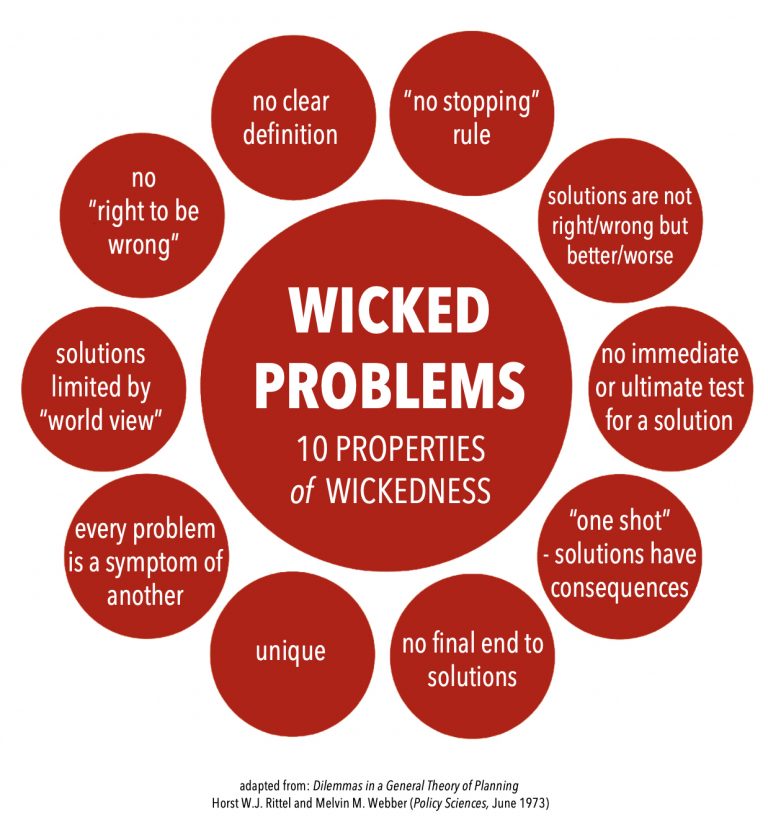
Wicked problem
In planning and policy, a wicked problem is a problem that is difficult or impossible to solve because of incomplete, contradictory, and changing requirements that are often difficult to recognize. It refers to an idea or problem that cannot be fixed, where there is no single solution to the problem; "wicked" does not indicate evil, but rather resistance to resolution. Another definition is "a problem whose social complexity means that it has no determinable stopping point". Because of complex interdependencies, the effort to solve one aspect of a wicked problem may reveal or create other problems. Due to their complexity, wicked problems are often characterized by organized irresponsibility.
Turing Complete User
With the disappearance of the computer, something else is silently becoming invisible as well — the User.
Unsimple Truths: Science, Complexity, and Policy
Amazon.com: Unsimple Truths: Science, Complexity, and Policy eBook : Mitchell, Sandra D.: Kindle Store

Governments Can’t Agree on What AI Actually Is
Without clear definitions, governance is impossible.

Solene'% : A Stateless Workstation
In this article, I explain the rational and experiment about my project of a stateless workstation