Automate web performance audits with Lighthouse
Web Engines Hackfest 2025
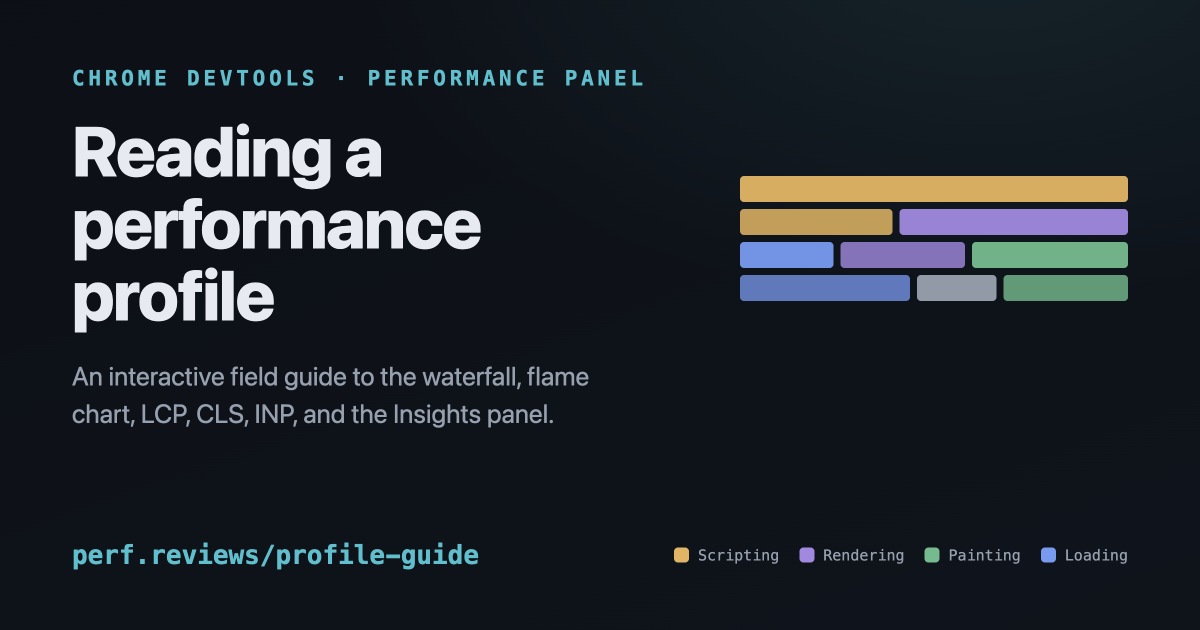
Reading a Performance Profile: Field Guide
An interactive field guide to the Chrome DevTools Performance panel: waterfall, flame chart, LCP, CLS, INP, and the Insights panel.
Put State in the Right Place - Delaney Gillilan | SSW 2026
Turbocharging Web Apps: Efficient AI Model Caching in Chrome
google/crosvm
The Chrome OS Virtual Machine Monitor - Mirror of https://chromium.googlesource.com/crosvm/crosvm/
Alert-driven monitoring | Documentation
Why we believe alerts, not dashboards, are the real core of infrastructure monitoring and how to build a system you actually trust.
Improving the trustworthiness of Javascript on the Web
Today, there's no way to audit a site’s client-side code as it changes, making it hard to trust sites that use cryptography. We preview a specification we coauthored that adds auditability to the web.


Built-in AI | AI on Chrome | Chrome for Developers
nanobrowser/nanobrowser
Open-Source Chrome extension for AI-powered web automation. Run multi-agent workflows using your own LLM API key. Alternative to OpenAI Operator.
firecrawl/firecrawl
The context API to search, scrape, and interact with the web at scale. 🔥
Big Help or Big Brother? Auditing Tracking, Profiling, and Personalization in Generative AI Assistants
Generative AI (GenAI) browser assistants integrate powerful capabilities of GenAI in web browsers to provide rich experiences such as question answering, content summarization, and agentic navigation. These assistants, available today as browser extensions, can not only track detailed browsing activity such as search and click data, but can also autonomously perform tasks such as filling forms, raising significant privacy concerns. It is crucial to understand the design and operation of GenAI browser extensions, including how they collect, store, process, and share user data. To this end, we study their ability to profile users and personalize their responses based on explicit or inferred demographic attributes and interests of users. We perform network traffic analysis and use a novel prompting framework to audit tracking, profiling, and personalization by the ten most popular GenAI browser assistant extensions. We find that instead of relying on local in-browser models, these assistants largely depend on server-side APIs, which can be auto-invoked without explicit user interaction. When invoked, they collect and share webpage content, often the full HTML DOM and sometimes even the user's form inputs, with their first-party servers. Some assistants also share identifiers and user prompts with third-party trackers such as Google Analytics. The collection and sharing continues even if a webpage contains sensitive information such as health or personal information such as name or SSN entered in a web form. We find that several GenAI browser assistants infer demographic attributes such as age, gender, income, and interests and use this profile--which carries across browsing contexts--to personalize responses. In summary, our work shows that GenAI browser assistants can and do collect personal and sensitive information for profiling and personalization with little to no safeguards.

Which browsers are best for privacy?
An open-source privacy audit of popular web browsers.